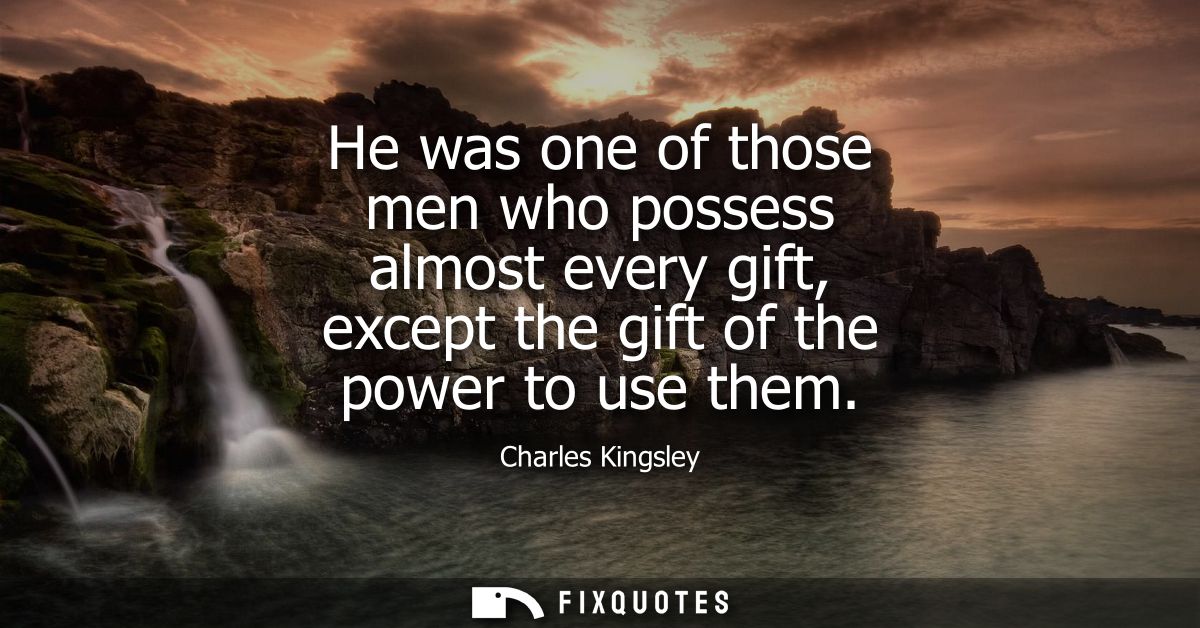
"He was one of those men who possess almost every gift, except the gift of the power to use them"
About this Quote
As a clergyman steeped in mid-19th-century arguments about duty, character, and earnestness, Kingsley isn’t just diagnosing laziness. He’s taking aim at a class of cultivated promise that never matures into service: the educated gentleman, the clever talker, the charismatic parishioner who mistakes potential for achievement. In a culture obsessed with moral improvement and social responsibility, unused ability reads as a spiritual failure, not a mere personal quirk.
The syntax does the moral work. "Almost every gift" piles up abundance; "except" snaps the sentence shut like a trap. Then the phrase "the gift of the power" doubles down, suggesting that agency itself is a kind of grace. The subtext is uncomfortable: you can be richly endowed and still be poor where it counts. Kingsley turns talent into a test, and the failure isn’t incapacity; it’s the refusal, or inability, to convert possibility into action.
Quote Details
| Topic | Wisdom |
|---|---|
| Source | Help us find the source |
| Cite |
Citation Formats
APA Style (7th ed.)
Kingsley, Charles. (2026, January 16). He was one of those men who possess almost every gift, except the gift of the power to use them. FixQuotes. https://fixquotes.com/quotes/he-was-one-of-those-men-who-possess-almost-every-127370/
Chicago Style
Kingsley, Charles. "He was one of those men who possess almost every gift, except the gift of the power to use them." FixQuotes. January 16, 2026. https://fixquotes.com/quotes/he-was-one-of-those-men-who-possess-almost-every-127370/.
MLA Style (9th ed.)
"He was one of those men who possess almost every gift, except the gift of the power to use them." FixQuotes, 16 Jan. 2026, https://fixquotes.com/quotes/he-was-one-of-those-men-who-possess-almost-every-127370/. Accessed 31 Mar. 2026.