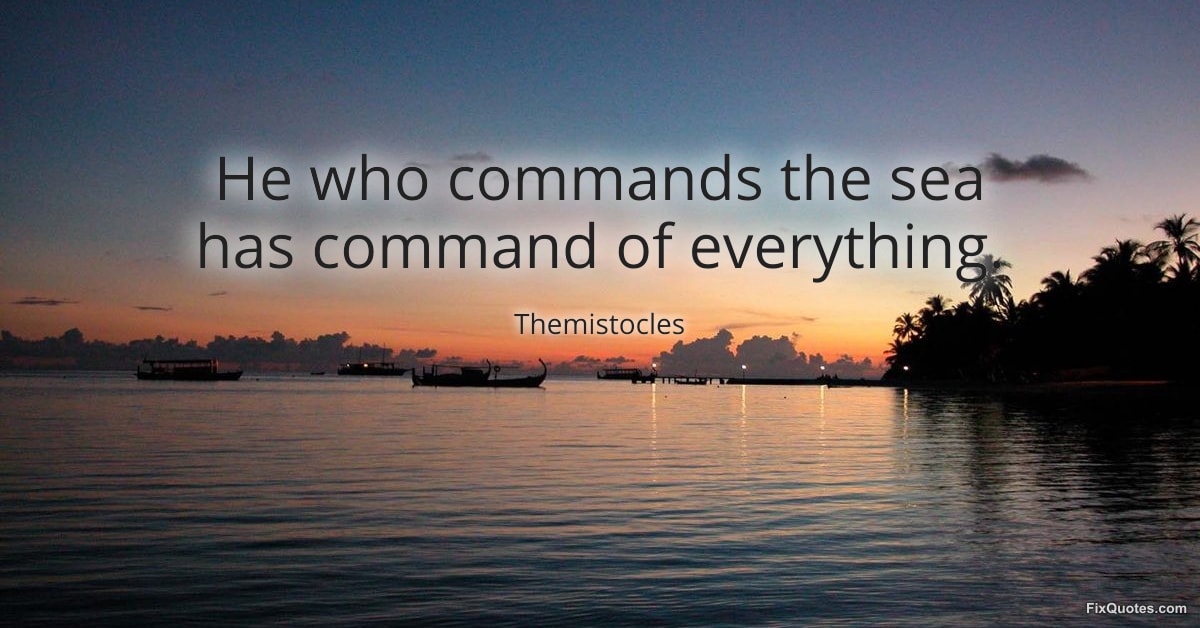
"He who commands the sea has command of everything"
About this Quote
Power, Themistocles argues, is not a throne or a treaty; its real address is the shoreline. In a single, blunt line, he reduces the messy politics of the Greek city-states to an infrastructural truth: whoever controls movement controls outcomes. Sea power isn’t just military advantage, it’s the ability to decide what arrives, what leaves, who eats, and who panics.
The intent is strategic persuasion. Themistocles wasn’t speaking as a dreamy philosopher but as an operator trying to drag Athens away from aristocratic, land-first assumptions and toward ships, sailors, and the long game. In the years around the Persian Wars, Athens faced an empire whose strength traveled on water. Building a fleet meant taxes, labor, and a shift in national identity. So the line works like a political wedge: it makes naval investment feel less like one option among many and more like the master key to survival.
The subtext is about leverage. “Command of everything” isn’t literal omnipotence; it’s a claim about choke points. In a maritime world, trade routes, grain shipments, and alliances move across the Aegean. A fleet lets you protect commerce, raid enemies, blockade cities, and project force without occupying territory. It also quietly elevates the lower-class rowers who power triremes, hinting at a more democratic Athens whose security depends on its people, not just its hoplites.
What makes the sentence stick is its absolutism. It’s a recruiting slogan for an empire-to-be, packaging geography as destiny and selling dominance as simple arithmetic: control the sea, and everything else negotiates with you.
The intent is strategic persuasion. Themistocles wasn’t speaking as a dreamy philosopher but as an operator trying to drag Athens away from aristocratic, land-first assumptions and toward ships, sailors, and the long game. In the years around the Persian Wars, Athens faced an empire whose strength traveled on water. Building a fleet meant taxes, labor, and a shift in national identity. So the line works like a political wedge: it makes naval investment feel less like one option among many and more like the master key to survival.
The subtext is about leverage. “Command of everything” isn’t literal omnipotence; it’s a claim about choke points. In a maritime world, trade routes, grain shipments, and alliances move across the Aegean. A fleet lets you protect commerce, raid enemies, blockade cities, and project force without occupying territory. It also quietly elevates the lower-class rowers who power triremes, hinting at a more democratic Athens whose security depends on its people, not just its hoplites.
What makes the sentence stick is its absolutism. It’s a recruiting slogan for an empire-to-be, packaging geography as destiny and selling dominance as simple arithmetic: control the sea, and everything else negotiates with you.
Quote Details
| Topic | Vision & Strategy |
|---|---|
| Source | Help us find the source |
More Quotes by Themistocles
Add to List