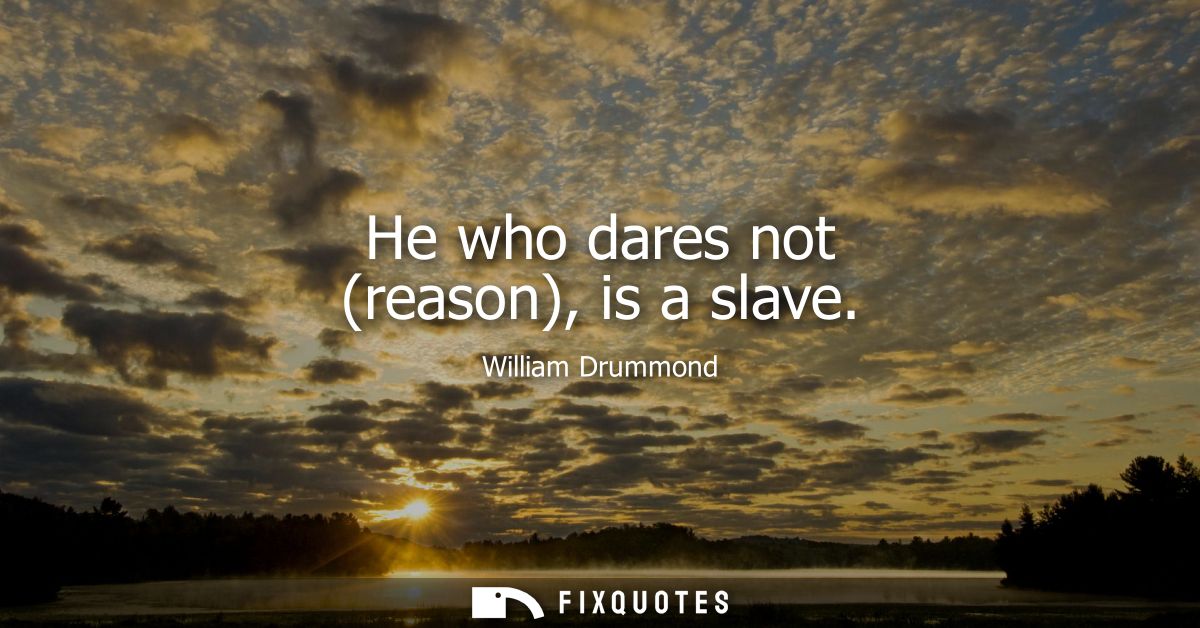
"He who dares not (reason) is a slave"
About this Quote
Drummond’s line is blunt enough to read like a motto, but its sting comes from how it defines “slavery” as an interior condition, not just a political one. The parenthetical “(reason)” functions like a whispered correction: daring isn’t about bravado or rebellion for its own sake, it’s about the courage to think. That small insert tightens the meaning into something sharper and more accusatory. If you refuse to reason, you’re not merely ignorant; you’ve accepted a master.
The subtext is a warning about the comfort of mental submission. Drummond implies that power doesn’t need chains when it can recruit your fear of complexity, your reluctance to question, your preference for ready-made answers. “Dares not” frames reasoning as risky because it is: to reason is to expose contradictions in authority, tradition, even in oneself. That’s why it’s brave. It threatens belonging, certainty, and the social peace that comes from nodding along.
Contextually, Drummond sits in a period when religious and political loyalties could cost you livelihood or life; rational inquiry wasn’t always a salon pastime, it could be a provocation. Read now, the quote feels eerily current: the “slave” is the person who won’t click past the headline, won’t interrogate the tribe’s talking points, won’t do the lonely work of doubt. Drummond isn’t romanticizing intellect; he’s insisting that freedom begins as a habit of mind, and that the first captor is often our own timidity.
The subtext is a warning about the comfort of mental submission. Drummond implies that power doesn’t need chains when it can recruit your fear of complexity, your reluctance to question, your preference for ready-made answers. “Dares not” frames reasoning as risky because it is: to reason is to expose contradictions in authority, tradition, even in oneself. That’s why it’s brave. It threatens belonging, certainty, and the social peace that comes from nodding along.
Contextually, Drummond sits in a period when religious and political loyalties could cost you livelihood or life; rational inquiry wasn’t always a salon pastime, it could be a provocation. Read now, the quote feels eerily current: the “slave” is the person who won’t click past the headline, won’t interrogate the tribe’s talking points, won’t do the lonely work of doubt. Drummond isn’t romanticizing intellect; he’s insisting that freedom begins as a habit of mind, and that the first captor is often our own timidity.
Quote Details
| Topic | Reason & Logic |
|---|---|
| Source | Help us find the source |
| Cite |
Citation Formats
APA Style (7th ed.)
Drummond, William. (2026, February 16). He who dares not (reason) is a slave. FixQuotes. https://fixquotes.com/quotes/he-who-dares-not-reason-is-a-slave-163623/
Chicago Style
Drummond, William. "He who dares not (reason) is a slave." FixQuotes. February 16, 2026. https://fixquotes.com/quotes/he-who-dares-not-reason-is-a-slave-163623/.
MLA Style (9th ed.)
"He who dares not (reason) is a slave." FixQuotes, 16 Feb. 2026, https://fixquotes.com/quotes/he-who-dares-not-reason-is-a-slave-163623/. Accessed 28 Mar. 2026.
More Quotes by William
Add to List