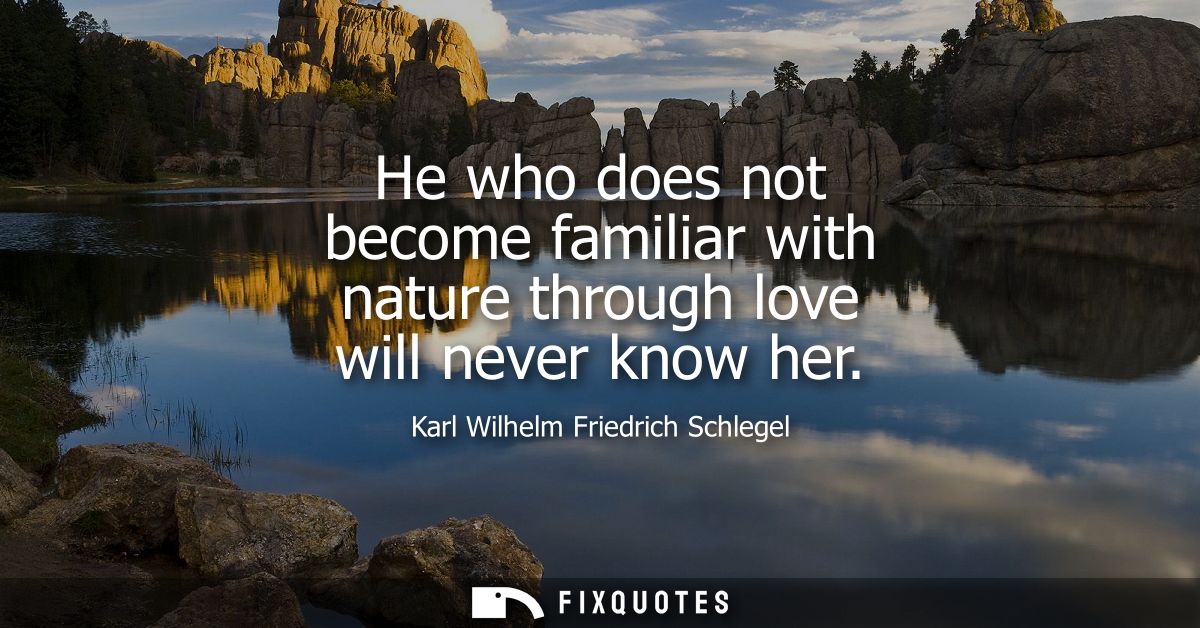
"He who does not become familiar with nature through love will never know her"
About this Quote
The subtext is a rebuke to the Enlightenment posture that treats the world as an object and the knower as a detached instrument. Schlegel, writing in the thick of early German Romanticism, is surrounded by a cultural argument about what counts as truth: measurement and method versus imagination, feeling, and the “inner sense.” His “never” is deliberately absolutist, less a scientific thesis than a boundary line around what he thinks nature is. If nature is “her,” a gendered figure with agency, then knowledge becomes relational. You don’t “have” her; you’re admitted.
There’s also a quiet ethics embedded in the phrasing. Love implies restraint: you linger, you listen, you accept opacity. In an era when industrial modernity is beginning to reorder landscapes and labor, Schlegel makes a counter-demand: before you use nature, you must learn to be with it. The quote works because it turns knowing into a test of character, not just competence.
Quote Details
| Topic | Nature |
|---|---|
| Source | Help us find the source |
| Cite |
Citation Formats
APA Style (7th ed.)
Schlegel, Karl Wilhelm Friedrich. (2026, January 18). He who does not become familiar with nature through love will never know her. FixQuotes. https://fixquotes.com/quotes/he-who-does-not-become-familiar-with-nature-12943/
Chicago Style
Schlegel, Karl Wilhelm Friedrich. "He who does not become familiar with nature through love will never know her." FixQuotes. January 18, 2026. https://fixquotes.com/quotes/he-who-does-not-become-familiar-with-nature-12943/.
MLA Style (9th ed.)
"He who does not become familiar with nature through love will never know her." FixQuotes, 18 Jan. 2026, https://fixquotes.com/quotes/he-who-does-not-become-familiar-with-nature-12943/. Accessed 7 Apr. 2026.