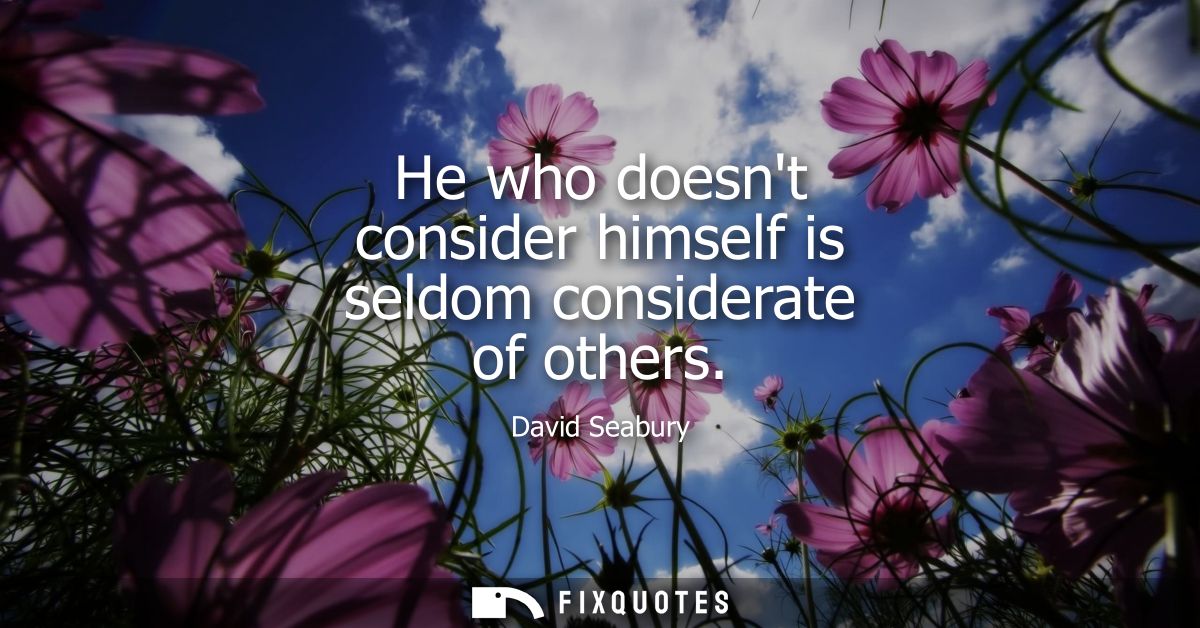
"He who doesn't consider himself is seldom considerate of others"
About this Quote
Self-absorption can look like narcissism, but Seabury is pointing at a sneakier culprit: self-neglect. "He who doesn't consider himself" isn’t the swaggering egotist; it’s the person who hasn’t bothered to examine his own motives, limits, injuries, and contradictions. The line quietly argues that what we call "consideration" for others is often a byproduct of self-knowledge. If you can’t read your own inner weather, you’ll misread everyone else’s.
The phrasing is deliberately old-fashioned and moral-sounding, like a proverb, but it’s doing psychological work. "Consider" means think about, weigh, reflect - not pamper. Seabury frames introspection as a civic skill. The subtext is blunt: empathy isn’t just a warm feeling; it’s a calibrated perception, and calibration requires a baseline. People who never confront their own needs tend to outsource them - to partners, coworkers, children - then act shocked when those people fail to deliver. That’s how entitlement can masquerade as selflessness: you "do so much" for others while quietly demanding they patch the parts of you you refuse to face.
Context matters: Seabury wrote in an era when popular psychology was becoming a household tool, translating Freud-era insights into advice for modern life. This sentence reads like a bridge between Victorian moral instruction and twentieth-century self-help: introspection not as indulgence, but as responsibility. The jab lands because it flips the usual ethic. Instead of praising self-sacrifice, it suggests that unexamined self-denial is one of the fastest routes to being inconsiderate.
The phrasing is deliberately old-fashioned and moral-sounding, like a proverb, but it’s doing psychological work. "Consider" means think about, weigh, reflect - not pamper. Seabury frames introspection as a civic skill. The subtext is blunt: empathy isn’t just a warm feeling; it’s a calibrated perception, and calibration requires a baseline. People who never confront their own needs tend to outsource them - to partners, coworkers, children - then act shocked when those people fail to deliver. That’s how entitlement can masquerade as selflessness: you "do so much" for others while quietly demanding they patch the parts of you you refuse to face.
Context matters: Seabury wrote in an era when popular psychology was becoming a household tool, translating Freud-era insights into advice for modern life. This sentence reads like a bridge between Victorian moral instruction and twentieth-century self-help: introspection not as indulgence, but as responsibility. The jab lands because it flips the usual ethic. Instead of praising self-sacrifice, it suggests that unexamined self-denial is one of the fastest routes to being inconsiderate.
Quote Details
| Topic | Kindness |
|---|---|
| Source | Help us find the source |
| Cite |
Citation Formats
APA Style (7th ed.)
Seabury, David. (2026, January 15). He who doesn't consider himself is seldom considerate of others. FixQuotes. https://fixquotes.com/quotes/he-who-doesnt-consider-himself-is-seldom-57879/
Chicago Style
Seabury, David. "He who doesn't consider himself is seldom considerate of others." FixQuotes. January 15, 2026. https://fixquotes.com/quotes/he-who-doesnt-consider-himself-is-seldom-57879/.
MLA Style (9th ed.)
"He who doesn't consider himself is seldom considerate of others." FixQuotes, 15 Jan. 2026, https://fixquotes.com/quotes/he-who-doesnt-consider-himself-is-seldom-57879/. Accessed 27 Mar. 2026.
More Quotes by David
Add to List