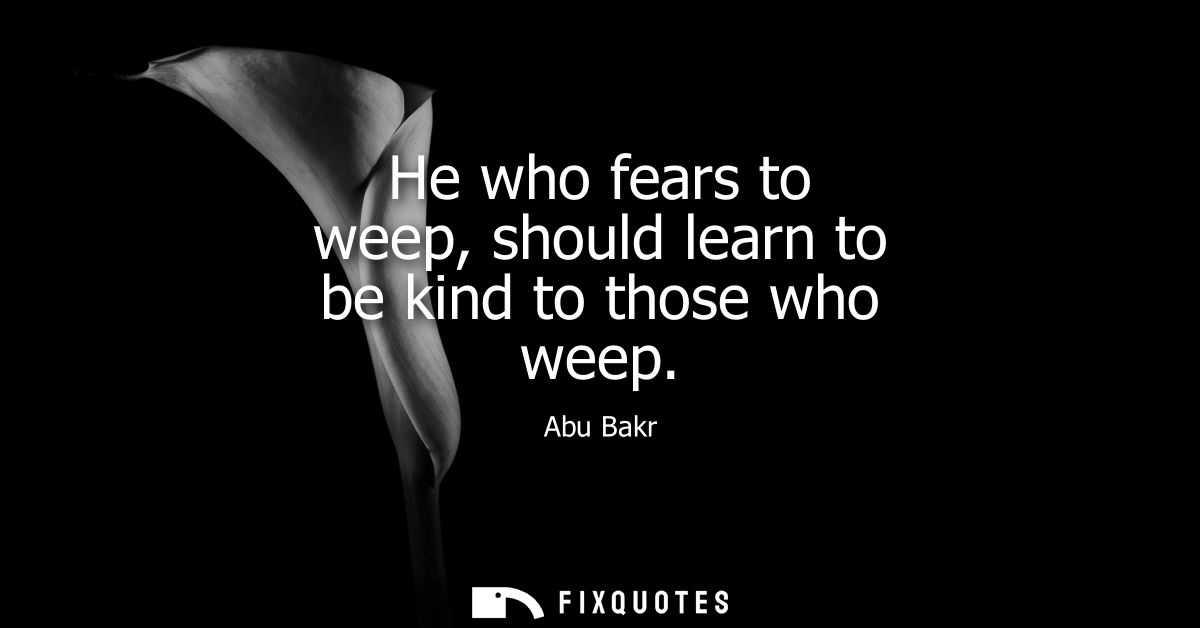
"He who fears to weep, should learn to be kind to those who weep"
About this Quote
A leader’s authority is always tempted to harden into performance: composure as proof of fitness. Abu Bakr’s line cuts against that instinct by treating tears not as a private weakness but as a civic fact. If you’re afraid to weep, he suggests, your fear will likely curdle into contempt for those who do. The remedy isn’t to force bravery through stoicism; it’s to practice kindness toward visible grief. In other words, compassion is training for emotional honesty.
The rhetoric is deceptively simple: a conditional warning dressed as advice. It doesn’t flatter the listener for being strong; it indicts the kind of “strength” that relies on suppressing empathy. The subtext is about governance as much as morality. Early Islamic leadership, especially in the fragile years after the Prophet Muhammad’s death, required managing real communal loss, conflict, and fear. In that atmosphere, tears are not just personal emotion; they’re a sign of a community under strain. A ruler who cannot tolerate grief will punish it, stigmatize it, or ignore the conditions that produce it.
There’s also a psychological insight that feels modern: people often police in others what they can’t permit in themselves. Abu Bakr proposes a counter-discipline. You don’t start by mastering your own vulnerability; you start by protecting it in others. Kindness becomes the public safeguard that keeps a society from confusing emotional silence with moral clarity.
The rhetoric is deceptively simple: a conditional warning dressed as advice. It doesn’t flatter the listener for being strong; it indicts the kind of “strength” that relies on suppressing empathy. The subtext is about governance as much as morality. Early Islamic leadership, especially in the fragile years after the Prophet Muhammad’s death, required managing real communal loss, conflict, and fear. In that atmosphere, tears are not just personal emotion; they’re a sign of a community under strain. A ruler who cannot tolerate grief will punish it, stigmatize it, or ignore the conditions that produce it.
There’s also a psychological insight that feels modern: people often police in others what they can’t permit in themselves. Abu Bakr proposes a counter-discipline. You don’t start by mastering your own vulnerability; you start by protecting it in others. Kindness becomes the public safeguard that keeps a society from confusing emotional silence with moral clarity.
Quote Details
| Topic | Kindness |
|---|---|
| Source | Help us find the source |
| Cite | Cite this Quote |
Citation Formats
APA Style (7th ed.)
Bakr, Abu. (2026, January 17). He who fears to weep, should learn to be kind to those who weep. FixQuotes. https://fixquotes.com/quotes/he-who-fears-to-weep-should-learn-to-be-kind-to-44806/
Chicago Style
Bakr, Abu. "He who fears to weep, should learn to be kind to those who weep." FixQuotes. January 17, 2026. https://fixquotes.com/quotes/he-who-fears-to-weep-should-learn-to-be-kind-to-44806/.
MLA Style (9th ed.)
"He who fears to weep, should learn to be kind to those who weep." FixQuotes, 17 Jan. 2026, https://fixquotes.com/quotes/he-who-fears-to-weep-should-learn-to-be-kind-to-44806/. Accessed 4 Feb. 2026.
More Quotes by Abu
Add to List