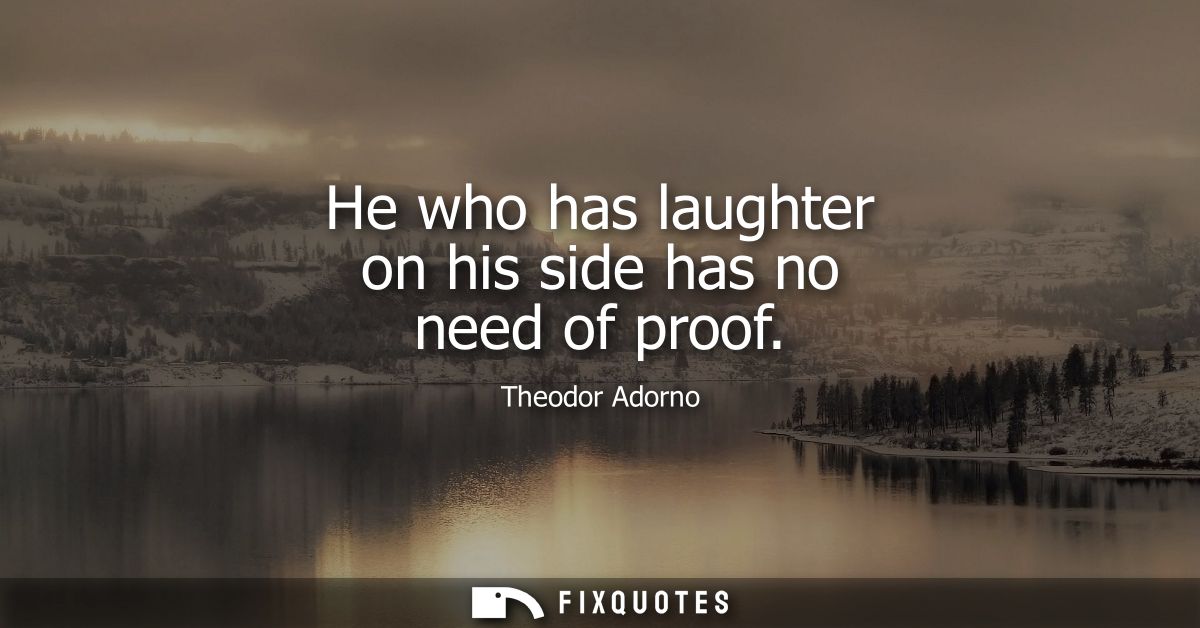
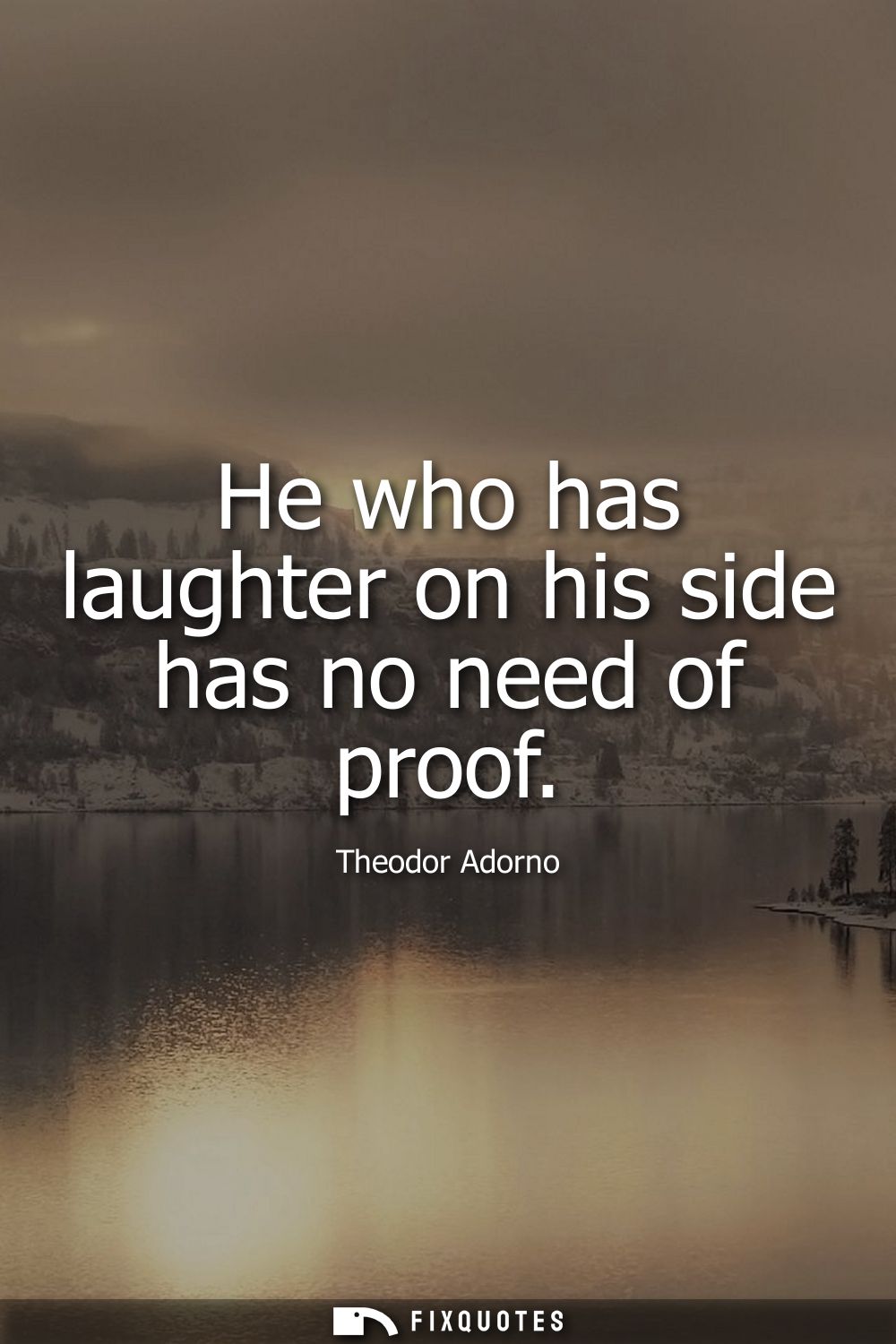
"He who has laughter on his side has no need of proof"
About this Quote
Laughter is Adorno's most elegant warning label: the joke can win the room before the argument even enters it. "He who has laughter on his side has no need of proof" reads like a throwaway line, but it's really a diagnosis of how authority gets outsourced to mood. If people are amused, they stop auditing. The social cue does the work that evidence should have done. Laughter becomes a shortcut to consensus, a kind of pop referendum conducted in real time.
The intent is double-edged. Adorno isn't praising humor as liberation; he's suspicious of its function inside mass culture. In his world, the culture industry standardizes pleasure the way factories standardize parts. Comedy, especially when packaged and repeatable, trains audiences to accept the frame: who's ridiculous, what's normal, what counts as "common sense". The laugh track isn't just sound; it's social pressure. Once the crowd laughs, dissent feels like being humorless, not being right.
Subtext: ridicule is power. If you can make an opponent look laughable, you don't have to refute them. That lands with particular force in the mid-century context Adorno inhabited, after propaganda had shown how easily publics could be choreographed - not only through fear, but through entertainment, through the pleasurable unity of shared reactions.
Adorno is also pointing inward, at intellectual life. The sharp bon mot, the devastating put-down, the salon-winning quip: they can masquerade as critique while bypassing the hard labor of justification. Laughter, in this sense, isn't the enemy of truth; it's one of the most efficient ways to replace it.
The intent is double-edged. Adorno isn't praising humor as liberation; he's suspicious of its function inside mass culture. In his world, the culture industry standardizes pleasure the way factories standardize parts. Comedy, especially when packaged and repeatable, trains audiences to accept the frame: who's ridiculous, what's normal, what counts as "common sense". The laugh track isn't just sound; it's social pressure. Once the crowd laughs, dissent feels like being humorless, not being right.
Subtext: ridicule is power. If you can make an opponent look laughable, you don't have to refute them. That lands with particular force in the mid-century context Adorno inhabited, after propaganda had shown how easily publics could be choreographed - not only through fear, but through entertainment, through the pleasurable unity of shared reactions.
Adorno is also pointing inward, at intellectual life. The sharp bon mot, the devastating put-down, the salon-winning quip: they can masquerade as critique while bypassing the hard labor of justification. Laughter, in this sense, isn't the enemy of truth; it's one of the most efficient ways to replace it.
Quote Details
| Topic | Witty One-Liners |
|---|---|
| Source | Verified source: Minima Moralia: Reflections from Damaged Life (Theodor Adorno, 1951)
Evidence: He who has laughter on his side has no need of proof. (Aphorism 134 (“Juvenal’s error”) / English ed. commonly cited as p. 210). This line appears in Theodor W. Adorno’s Minima Moralia in the section/aphorism titled “Juvenal’s error” (often numbered 134 in English editions). The original work was written in the mid-1940s and first published in German in 1951 (Suhrkamp). The popular English translation is by E. F. N. Jephcott (Verso); a mailing-list post explicitly cites it as appearing in “Juvenal’s error” on p. 210 of a Verso printing, matching the quote verbatim. The Marxists.org page reproduces the same sentence within that aphorism, but it is a secondary online reproduction; the primary source is Adorno’s book itself. Other candidates (1) On Beckett, On! (Jean-Michel Rabaté, Laurel Garver, 2025) compilation95.0% ... He who has laughter on his side has no need of proof . -FREUD , “ HUMOUR ” -ADORNO , MINIMA MORALIA LAUGHTER IN .... |
| Cite |
Citation Formats
APA Style (7th ed.)
Adorno, Theodor. (2026, February 27). He who has laughter on his side has no need of proof. FixQuotes. https://fixquotes.com/quotes/he-who-has-laughter-on-his-side-has-no-need-of-28487/
Chicago Style
Adorno, Theodor. "He who has laughter on his side has no need of proof." FixQuotes. February 27, 2026. https://fixquotes.com/quotes/he-who-has-laughter-on-his-side-has-no-need-of-28487/.
MLA Style (9th ed.)
"He who has laughter on his side has no need of proof." FixQuotes, 27 Feb. 2026, https://fixquotes.com/quotes/he-who-has-laughter-on-his-side-has-no-need-of-28487/. Accessed 5 Mar. 2026.
More Quotes by Theodor
Add to List