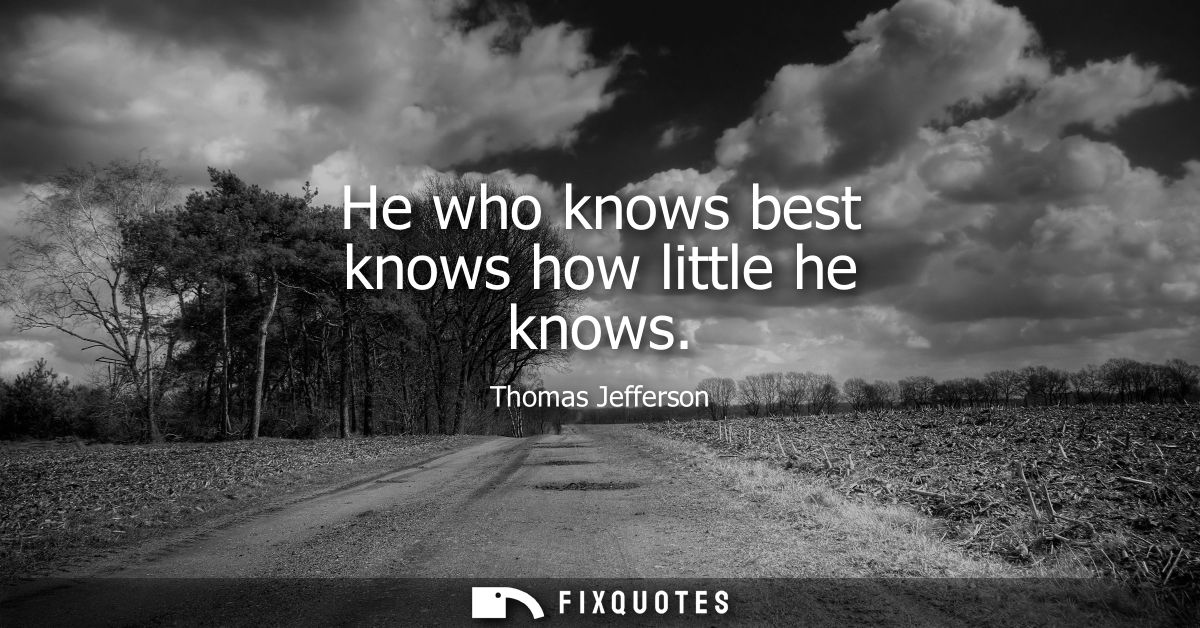
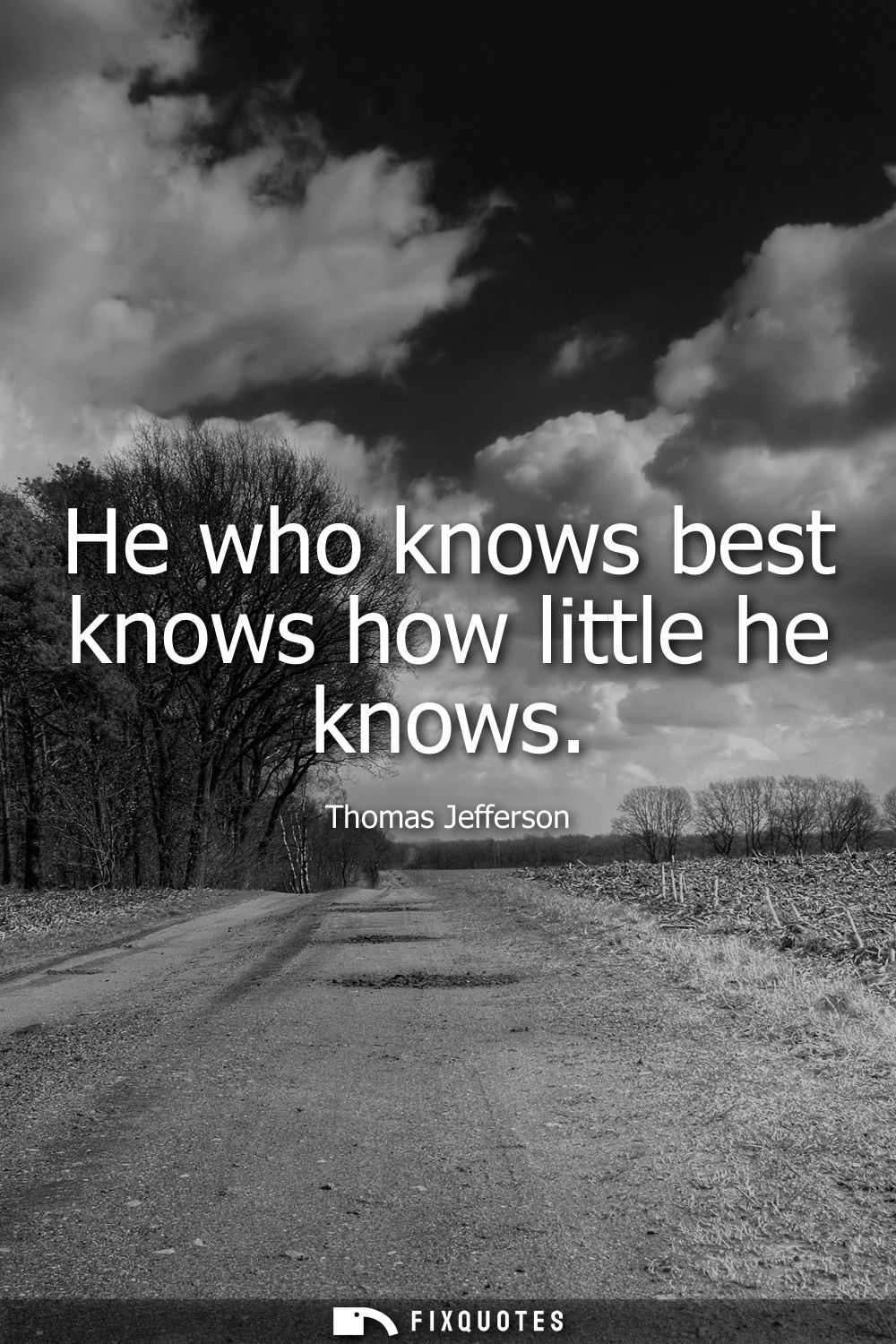
"He who knows best knows how little he knows"
About this Quote
Jefferson’s line lands like a patrician mic drop: the smartest person in the room is the one least tempted to perform being smart. It’s a compact piece of Enlightenment humility, but it’s also a defensive maneuver against dogma. In an era when “knowing” was often tethered to inherited authority (church, crown, class), Jefferson recasts knowledge as a moving target and turns certainty into a liability. The aphorism works because it flatters the listener while warning them: if you feel perfectly sure, you’re probably out over your skis.
The intent is philosophical, but the subtext is political. A republic can’t run on infallible men; it has to run on fallible citizens who revise beliefs as evidence changes. That’s Jefferson’s Enlightenment faith in inquiry, smuggled into a moral maxim: expertise should produce restraint, not swagger. It also subtly inoculates leadership against the cult of the strongman. The best leader, by this logic, is the one aware of the limits of his own perception and therefore more likely to consult, argue, and compromise.
Context complicates the elegance. Jefferson helped architect democratic rhetoric while living inside profound contradictions, including slavery and the selective application of “self-evident” rights. Read in that light, the quote can feel like an ideal he could articulate more cleanly than he could inhabit. Still, its bite endures because it names a psychological truth with civic consequences: humility isn’t just private virtue; it’s infrastructure for a functioning democracy.
The intent is philosophical, but the subtext is political. A republic can’t run on infallible men; it has to run on fallible citizens who revise beliefs as evidence changes. That’s Jefferson’s Enlightenment faith in inquiry, smuggled into a moral maxim: expertise should produce restraint, not swagger. It also subtly inoculates leadership against the cult of the strongman. The best leader, by this logic, is the one aware of the limits of his own perception and therefore more likely to consult, argue, and compromise.
Context complicates the elegance. Jefferson helped architect democratic rhetoric while living inside profound contradictions, including slavery and the selective application of “self-evident” rights. Read in that light, the quote can feel like an ideal he could articulate more cleanly than he could inhabit. Still, its bite endures because it names a psychological truth with civic consequences: humility isn’t just private virtue; it’s infrastructure for a functioning democracy.
Quote Details
| Topic | Wisdom |
|---|---|
| Source | Later attribution: Deadly Sins-Pride and the Love of Words (WILBUR THORNTIZE THORNTON, 2015) modern compilationISBN: 9781514408384 · ID: 3lCwCgAAQBAJ
Evidence: ... Jefferson Λ I do not add within the limits of the law Because law is often but the tyrant's will And always so when it violates the rights of an individual Thomas Jefferson He who knows best knows how little he knows Tom Jefferson I am ... Other candidates (1) The Proceedings... Public Right to the Beach of the Missi... (Thomas Jefferson, 1812)50.0% The wise know their weakness too well to assume infallibility: and he who knows most, knows best how little he knows.... |
| Cite |
Citation Formats
APA Style (7th ed.)
Jefferson, Thomas. (2026, February 15). He who knows best knows how little he knows. FixQuotes. https://fixquotes.com/quotes/he-who-knows-best-knows-how-little-he-knows-36313/
Chicago Style
Jefferson, Thomas. "He who knows best knows how little he knows." FixQuotes. February 15, 2026. https://fixquotes.com/quotes/he-who-knows-best-knows-how-little-he-knows-36313/.
MLA Style (9th ed.)
"He who knows best knows how little he knows." FixQuotes, 15 Feb. 2026, https://fixquotes.com/quotes/he-who-knows-best-knows-how-little-he-knows-36313/. Accessed 26 Mar. 2026.
More Quotes by Thomas
Add to List