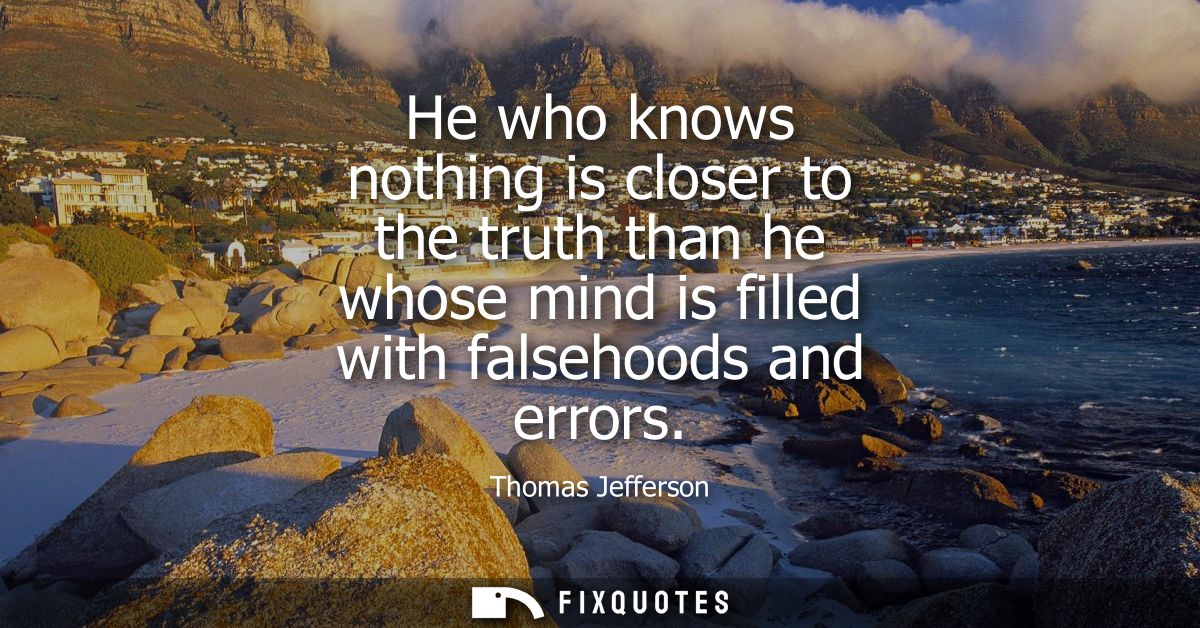
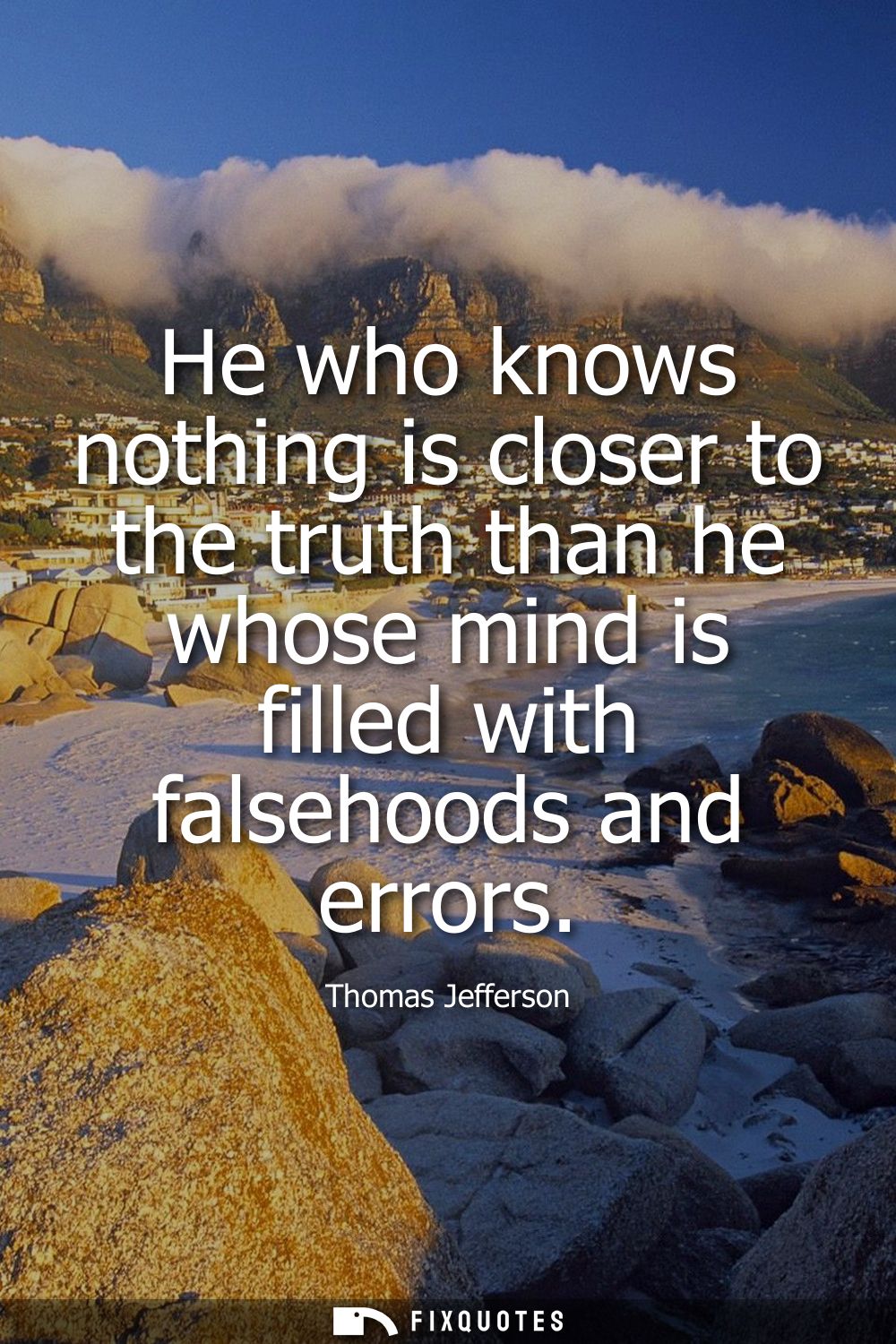
"He who knows nothing is closer to the truth than he whose mind is filled with falsehoods and errors"
About this Quote
Ignorance gets an unexpected promotion here, not because Jefferson is anti-knowledge, but because he’s allergic to counterfeit certainty. The line is a scalpel aimed at a particular kind of danger: the person who thinks they know, whose head is stocked with errors that feel like facts. In Jefferson’s worldview, that’s worse than a blank mind because it blocks revision. You can teach someone who knows nothing; you can’t easily reach someone armored in bad information and smug confidence.
As a political statement, it’s also a quietly severe warning about republics. Democracies don’t collapse only from apathy; they rot when public opinion is organized around myths, propaganda, and convenient narratives that flatter the tribe. Jefferson is sketching a hierarchy of civic risk: the uninformed citizen is a problem, but the misinformed citizen is a weapon, often pointed proudly in the wrong direction.
The subtext carries the Enlightenment’s faith in corrigibility: truth is approachable if you keep the mind porous. That’s why the sentence turns on “closer.” Jefferson isn’t romanticizing ignorance; he’s describing distance from reality. A blank slate sits nearer the starting line than a map drawn wrong.
Context matters, too. Jefferson lived in an era of fierce partisan print culture, conspiracy talk, and ideological trench warfare - conditions that made “falsehoods and errors” not abstract sins but practical threats. Read now, it lands like an early diagnosis of the modern info crisis: the real enemy isn’t not knowing; it’s believing you’re already done learning.
As a political statement, it’s also a quietly severe warning about republics. Democracies don’t collapse only from apathy; they rot when public opinion is organized around myths, propaganda, and convenient narratives that flatter the tribe. Jefferson is sketching a hierarchy of civic risk: the uninformed citizen is a problem, but the misinformed citizen is a weapon, often pointed proudly in the wrong direction.
The subtext carries the Enlightenment’s faith in corrigibility: truth is approachable if you keep the mind porous. That’s why the sentence turns on “closer.” Jefferson isn’t romanticizing ignorance; he’s describing distance from reality. A blank slate sits nearer the starting line than a map drawn wrong.
Context matters, too. Jefferson lived in an era of fierce partisan print culture, conspiracy talk, and ideological trench warfare - conditions that made “falsehoods and errors” not abstract sins but practical threats. Read now, it lands like an early diagnosis of the modern info crisis: the real enemy isn’t not knowing; it’s believing you’re already done learning.
Quote Details
| Topic | Truth |
|---|
More Quotes by Thomas
Add to List