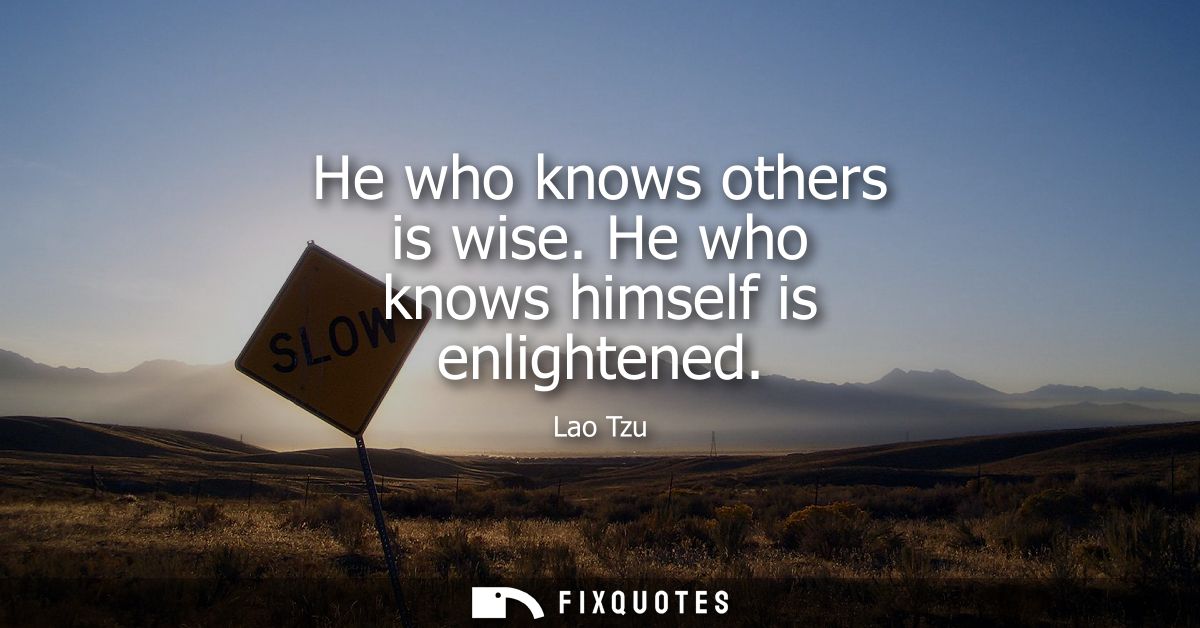
"He who knows others is wise. He who knows himself is enlightened"
About this Quote
Wisdom is social; enlightenment is solitary. Lao Tzu’s line quietly demotes the kind of intelligence that usually wins applause: reading people, mastering systems, collecting insights about the external world. “He who knows others is wise” grants that skill its due, but the sentence is a set-up. The pivot lands on “himself,” and suddenly wisdom looks like a provisional competence, while self-knowledge becomes a different category of achievement altogether.
The subtext is classic Taoist suspicion of ego and overreach. Knowing others can feed control, strategy, and status - all the busywork of a mind trying to bend the world to its will. Knowing yourself, by contrast, exposes the machinery behind that impulse: fear, desire, vanity, the reflex to label and possess. “Enlightened” here isn’t a trophy; it’s a loosening. The person who truly knows himself can stop mistaking every passing mood for a mandate, every ambition for a destiny.
Context matters: Lao Tzu’s Tao Te Ching emerges from a period of political fragmentation and moral argument, when rival schools competed to prescribe order. Against that backdrop, the quote reads like a refusal to join the arms race of cleverness. It proposes an inward criterion no ruler, teacher, or rival can easily exploit. The line works because it flatters the reader less than it challenges them: you can be “wise” and still be lost. Enlightenment begins where your strongest explanations end and your honest attention starts.
The subtext is classic Taoist suspicion of ego and overreach. Knowing others can feed control, strategy, and status - all the busywork of a mind trying to bend the world to its will. Knowing yourself, by contrast, exposes the machinery behind that impulse: fear, desire, vanity, the reflex to label and possess. “Enlightened” here isn’t a trophy; it’s a loosening. The person who truly knows himself can stop mistaking every passing mood for a mandate, every ambition for a destiny.
Context matters: Lao Tzu’s Tao Te Ching emerges from a period of political fragmentation and moral argument, when rival schools competed to prescribe order. Against that backdrop, the quote reads like a refusal to join the arms race of cleverness. It proposes an inward criterion no ruler, teacher, or rival can easily exploit. The line works because it flatters the reader less than it challenges them: you can be “wise” and still be lost. Enlightenment begins where your strongest explanations end and your honest attention starts.
Quote Details
| Topic | Wisdom |
|---|---|
| Source | Verified source: Tao Te Ching (Dao De Jing), Chapter 33 (Lao Tzu, -200)
Evidence: 知人者智,自知者明。 (Chapter 33). The English quote “He who knows others is wise. He who knows himself is enlightened” is a modern translation/paraphrase of the opening line of Chapter 33 of the Dao De Jing (Tao Te Ching). The primary source in Chinese is the Dao De Jing; the line appears as: 知人者智,自知者明 (“One who knows others is wise/clever; one who knows himself is bright/clear/discerning”). The specific English wording varies by translator; e.g., D.C. Lau (1963) renders it differently (“He who knows others is clever; He who knows himself has discernment.”). The 'year' for first publication cannot be pinned to a single date because the Dao De Jing is an ancient text with multiple early manuscript traditions; the page linked includes notes indicating a Western Han-era Mawangdui silk manuscript version (commonly dated to around 2nd century BCE), which is why a circa -200 date is used here. ([daodejing0.online](https://www.daodejing0.online/ddj/chapter/33?utm_source=openai)) Other candidates (1) SAVANTING: Outperforming your Potential (Lauren Holmes, 2019) compilation95.0% ... Lao - Tse again : " He who knows others is wise ; he who knows himself is enlightened . " Lao - Tse , also known ... |
| Cite |
Citation Formats
APA Style (7th ed.)
Tzu, Lao. (2026, February 27). He who knows others is wise. He who knows himself is enlightened. FixQuotes. https://fixquotes.com/quotes/he-who-knows-others-is-wise-he-who-knows-himself-28400/
Chicago Style
Tzu, Lao. "He who knows others is wise. He who knows himself is enlightened." FixQuotes. February 27, 2026. https://fixquotes.com/quotes/he-who-knows-others-is-wise-he-who-knows-himself-28400/.
MLA Style (9th ed.)
"He who knows others is wise. He who knows himself is enlightened." FixQuotes, 27 Feb. 2026, https://fixquotes.com/quotes/he-who-knows-others-is-wise-he-who-knows-himself-28400/. Accessed 5 Apr. 2026.
More Quotes by Lao
Add to List