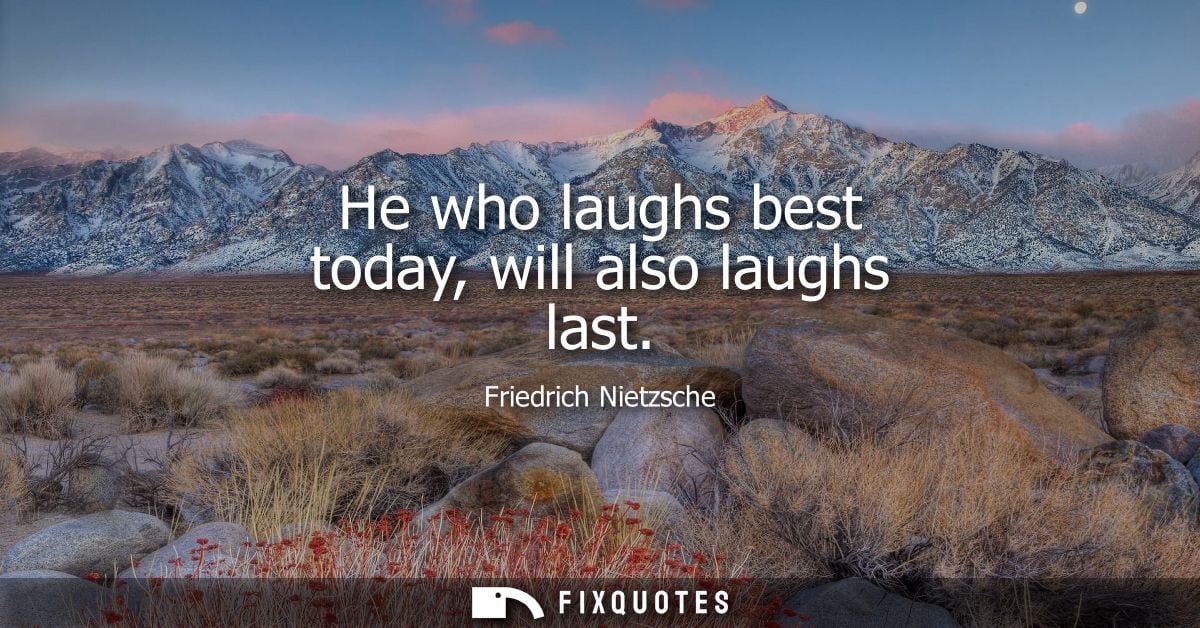
"He who laughs best today, will also laughs last"
About this Quote
Nietzsche’s name attached to this line almost dares you to read it as a smug fortune cookie and then feel embarrassed for doing so. The obvious meaning is moralistic: don’t gloat; time will humble you. But the more Nietzschean charge sits in the grammar of power. “Laughs best” isn’t about being the nicest person in the room; it’s about the winner’s laugh, the laugh that comes from dominance, from thinking you’ve secured the narrative. Nietzsche’s subtext: today’s triumph is rarely final because life is not a court verdict, it’s a contest of forces. The last laugh belongs to whoever can outlast, outinterpret, outcreate.
There’s also a provocation here about ressentiment, the poison of waiting around for cosmic justice. Read one way, “laughs last” flatters the aggrieved with a promise: your time will come. Nietzsche typically distrusts that posture; it’s the psychology of the sidelined turning patience into a weapon. So the line can be taken as either a warning to the triumphant or a parody of the consolations we sell to losers. Both readings fit his habit of writing in aphorisms that can be picked up like coins and then discovered to have two faces.
Context matters: Nietzsche wrote amid Europe’s fraying moral certainties, when “progress” sounded like a sermon. A maxim about laughter becomes a miniature theory of history: victories are provisional, and the only stable advantage is the capacity to transform setbacks into new strength.
There’s also a provocation here about ressentiment, the poison of waiting around for cosmic justice. Read one way, “laughs last” flatters the aggrieved with a promise: your time will come. Nietzsche typically distrusts that posture; it’s the psychology of the sidelined turning patience into a weapon. So the line can be taken as either a warning to the triumphant or a parody of the consolations we sell to losers. Both readings fit his habit of writing in aphorisms that can be picked up like coins and then discovered to have two faces.
Context matters: Nietzsche wrote amid Europe’s fraying moral certainties, when “progress” sounded like a sermon. A maxim about laughter becomes a miniature theory of history: victories are provisional, and the only stable advantage is the capacity to transform setbacks into new strength.
Quote Details
| Topic | Witty One-Liners |
|---|---|
| Source | Help us find the source |
| Cite |
Citation Formats
APA Style (7th ed.)
Nietzsche, Friedrich. (2026, January 15). He who laughs best today, will also laughs last. FixQuotes. https://fixquotes.com/quotes/he-who-laughs-best-today-will-also-laughs-last-34948/
Chicago Style
Nietzsche, Friedrich. "He who laughs best today, will also laughs last." FixQuotes. January 15, 2026. https://fixquotes.com/quotes/he-who-laughs-best-today-will-also-laughs-last-34948/.
MLA Style (9th ed.)
"He who laughs best today, will also laughs last." FixQuotes, 15 Jan. 2026, https://fixquotes.com/quotes/he-who-laughs-best-today-will-also-laughs-last-34948/. Accessed 3 Apr. 2026.
More Quotes by Friedrich
Add to List