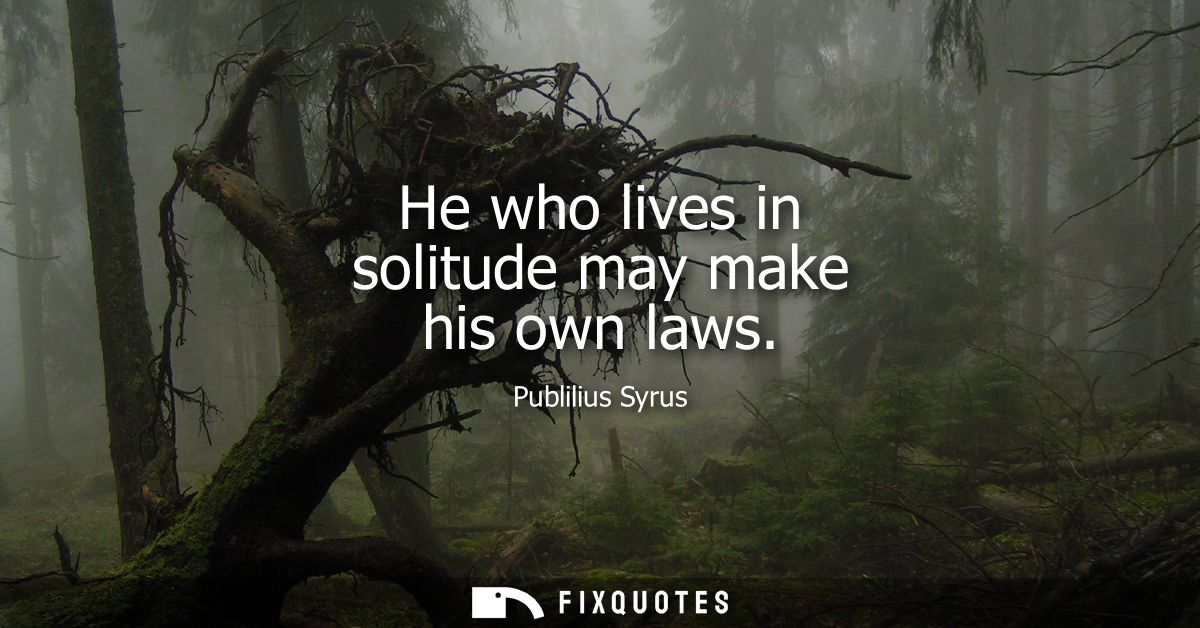
"He who lives in solitude may make his own laws"
About this Quote
Solitude, in Publilius Syrus's hands, isn’t a scented candle lifestyle choice; it’s a loophole in the social contract. "He who lives in solitude may make his own laws" lands with the blunt efficiency of a maxim because it turns privacy into power. The verb "may" is doing double duty: permission and possibility. You can set your own rules when no one’s watching, but you also might drift into a world where rules become optional simply because enforcement disappears.
Syrus wrote as a Roman mimographer turned proverb-machine, a former enslaved person who learned the empire’s real operating system: status, surveillance, reputation. In a society built on public life - the forum, the patron, the household, the gaze of peers - solitude is both refuge and threat. The line flatters the dream of self-governance, then quietly exposes its cost. Laws aren’t just constraints; they’re agreements that make you legible to other people. Exit the crowd and you gain freedom, but you also lose the friction that keeps the self from becoming its own alibi.
The subtext is slightly cynical, very Roman: moral behavior is partly architecture. Remove witnesses and incentives shift. Yet there’s a countercharge too. For someone without institutional power, solitude can be the only jurisdiction left. It’s a compact, unsettling reminder that autonomy is easiest when you’re unaccountable - and that the price of belonging is submitting your private logic to public judgment.
Syrus wrote as a Roman mimographer turned proverb-machine, a former enslaved person who learned the empire’s real operating system: status, surveillance, reputation. In a society built on public life - the forum, the patron, the household, the gaze of peers - solitude is both refuge and threat. The line flatters the dream of self-governance, then quietly exposes its cost. Laws aren’t just constraints; they’re agreements that make you legible to other people. Exit the crowd and you gain freedom, but you also lose the friction that keeps the self from becoming its own alibi.
The subtext is slightly cynical, very Roman: moral behavior is partly architecture. Remove witnesses and incentives shift. Yet there’s a countercharge too. For someone without institutional power, solitude can be the only jurisdiction left. It’s a compact, unsettling reminder that autonomy is easiest when you’re unaccountable - and that the price of belonging is submitting your private logic to public judgment.
Quote Details
| Topic | Wisdom |
|---|---|
| Source | Help us find the source |
| Cite |
Citation Formats
APA Style (7th ed.)
Syrus, Publilius. (2026, January 17). He who lives in solitude may make his own laws. FixQuotes. https://fixquotes.com/quotes/he-who-lives-in-solitude-may-make-his-own-laws-33024/
Chicago Style
Syrus, Publilius. "He who lives in solitude may make his own laws." FixQuotes. January 17, 2026. https://fixquotes.com/quotes/he-who-lives-in-solitude-may-make-his-own-laws-33024/.
MLA Style (9th ed.)
"He who lives in solitude may make his own laws." FixQuotes, 17 Jan. 2026, https://fixquotes.com/quotes/he-who-lives-in-solitude-may-make-his-own-laws-33024/. Accessed 21 Mar. 2026.
More Quotes by Publilius
Add to List