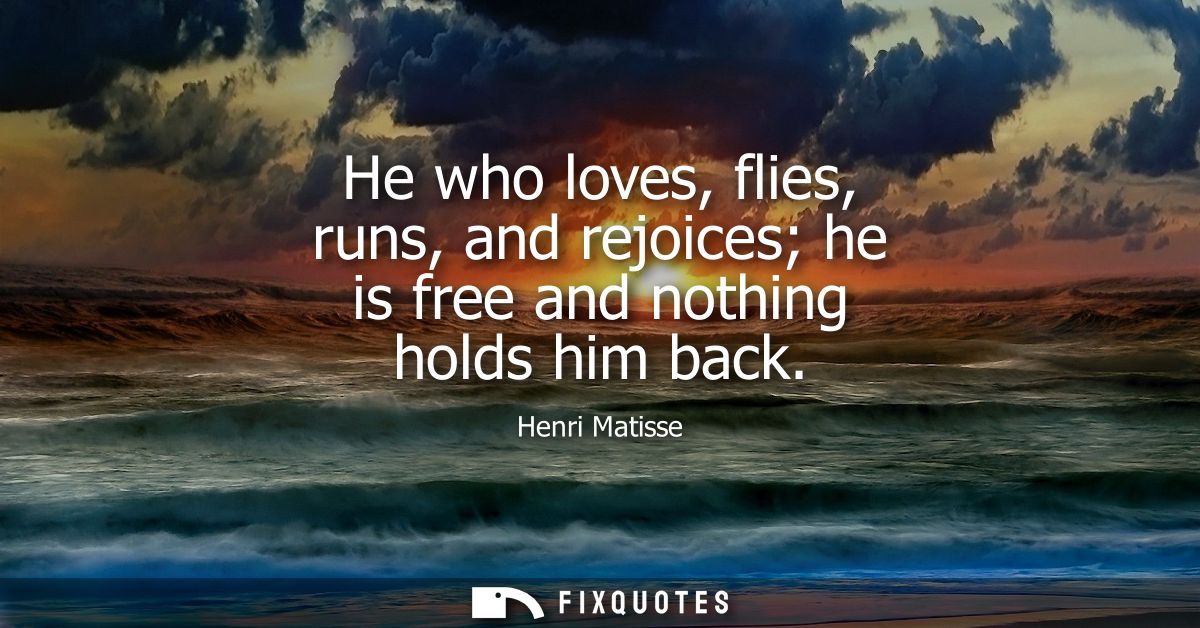
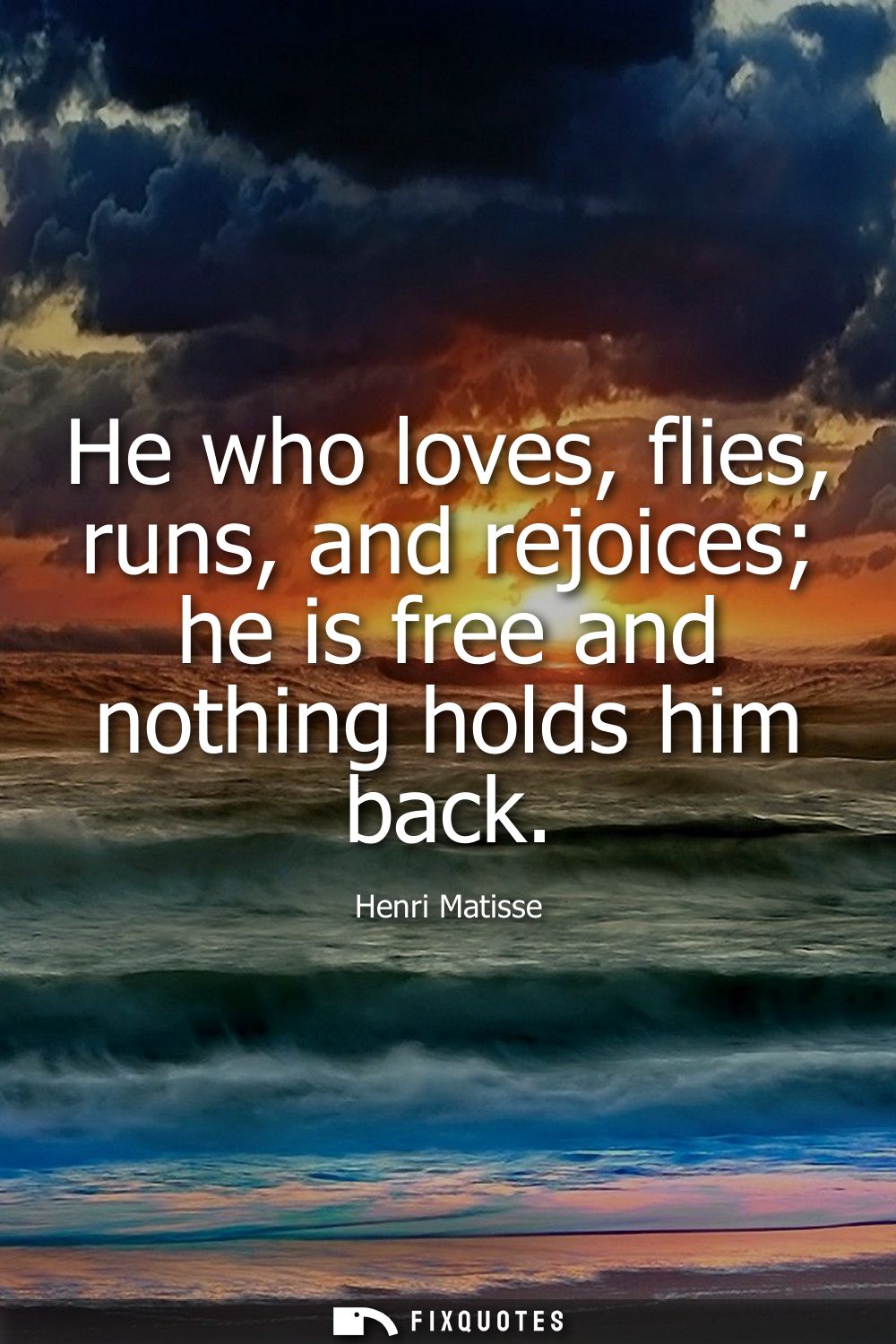
"He who loves, flies, runs, and rejoices; he is free and nothing holds him back"
About this Quote
The subtext is quietly defiant. Matisse spent much of his career pushing against constraint: academic rules, moral seriousness, the expectation that art must earn its gravity through darkness. Later, even illness and limited mobility didn’t halt his output; the cut-outs arrive as proof that restriction can be negotiated, even converted into a new kind of freedom. So when he says “he is free and nothing holds him back,” it reads less like self-help and more like an artist’s work ethic dressed as lyricism. Love becomes a discipline: the commitment that keeps you moving when circumstances, critics, or your own doubt try to pin you down.
Context matters, too. Early 20th-century Europe is a machine for pressure - rapid modernity, war, ideological hardening. Matisse answers with a counter-program: liberation through pleasure, color, and attention. The sentence works because it’s not sentimental; it’s kinetic. It makes freedom sound earned, like a practiced leap rather than a granted right.
Quote Details
| Topic | Love |
|---|---|
| Source | Help us find the source |
| Cite |
Citation Formats
APA Style (7th ed.)
Matisse, Henri. (2026, January 16). He who loves, flies, runs, and rejoices; he is free and nothing holds him back. FixQuotes. https://fixquotes.com/quotes/he-who-loves-flies-runs-and-rejoices-he-is-free-90330/
Chicago Style
Matisse, Henri. "He who loves, flies, runs, and rejoices; he is free and nothing holds him back." FixQuotes. January 16, 2026. https://fixquotes.com/quotes/he-who-loves-flies-runs-and-rejoices-he-is-free-90330/.
MLA Style (9th ed.)
"He who loves, flies, runs, and rejoices; he is free and nothing holds him back." FixQuotes, 16 Jan. 2026, https://fixquotes.com/quotes/he-who-loves-flies-runs-and-rejoices-he-is-free-90330/. Accessed 21 Mar. 2026.