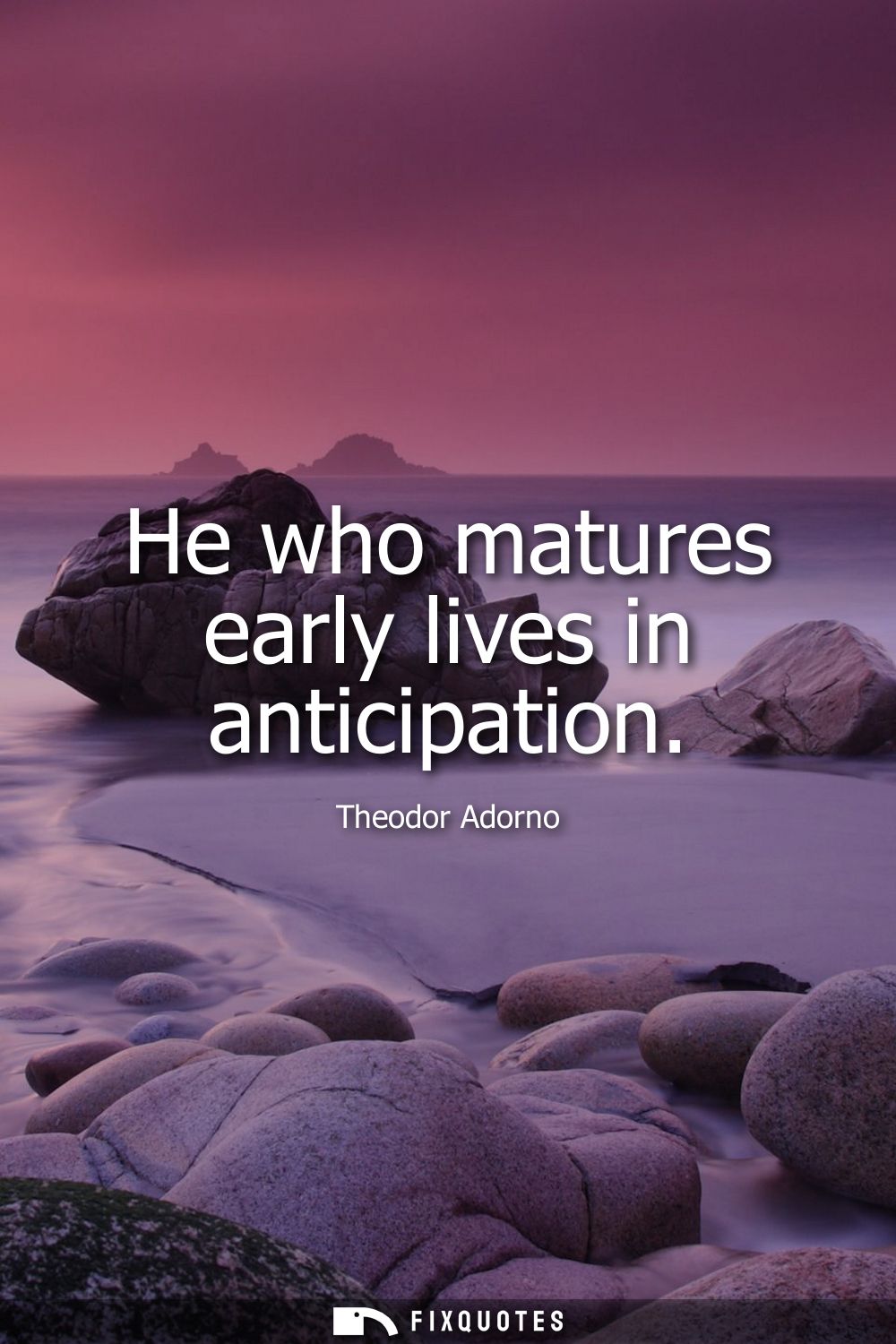
"He who matures early lives in anticipation"
About this Quote
Early maturity sounds like a blessing until Adorno turns it into a diagnosis: a life spent rehearsing itself. "He who matures early lives in anticipation" lands with the Frankfurt School's signature suspicion toward anything that looks like smooth adjustment. To mature "early" is not simply to grow up fast; it's to internalize the adult world before you've had a chance to test it, to let society's script get into you ahead of experience. The reward is competence. The cost is presence.
Adorno's sting is in the verb choice. "Lives" should imply immediacy, risk, contact. Instead it gets tethered to "anticipation" - a future-leaning posture where existence becomes preemptive: planning, performing, bracing, optimizing. The subtext is that modern life trains people to become their own managers, converting childhood's open-ended time into a kind of early professionalization. You don't inhabit a moment; you audit it for what it will mean later.
Context matters because Adorno is writing in the long shadow of mass culture, authoritarianism, and the commodification of inner life. His broader project keeps returning to how capitalism colonizes subjectivity: even our feelings arrive preformatted. Early maturity becomes less a personal trait than a social achievement badge, prized because it produces compliant adults who don't need to be coerced; they self-regulate.
The irony is cruel: the "mature" person is supposedly ahead of the curve, yet ends up stuck in perpetual waiting, treating life as a runway for a future that never quite arrives.
Adorno's sting is in the verb choice. "Lives" should imply immediacy, risk, contact. Instead it gets tethered to "anticipation" - a future-leaning posture where existence becomes preemptive: planning, performing, bracing, optimizing. The subtext is that modern life trains people to become their own managers, converting childhood's open-ended time into a kind of early professionalization. You don't inhabit a moment; you audit it for what it will mean later.
Context matters because Adorno is writing in the long shadow of mass culture, authoritarianism, and the commodification of inner life. His broader project keeps returning to how capitalism colonizes subjectivity: even our feelings arrive preformatted. Early maturity becomes less a personal trait than a social achievement badge, prized because it produces compliant adults who don't need to be coerced; they self-regulate.
The irony is cruel: the "mature" person is supposedly ahead of the curve, yet ends up stuck in perpetual waiting, treating life as a runway for a future that never quite arrives.
Quote Details
| Topic | Youth |
|---|---|
| Source | Help us find the source |
| Cite |
Citation Formats
APA Style (7th ed.)
Adorno, Theodor. (2026, January 17). He who matures early lives in anticipation. FixQuotes. https://fixquotes.com/quotes/he-who-matures-early-lives-in-anticipation-28490/
Chicago Style
Adorno, Theodor. "He who matures early lives in anticipation." FixQuotes. January 17, 2026. https://fixquotes.com/quotes/he-who-matures-early-lives-in-anticipation-28490/.
MLA Style (9th ed.)
"He who matures early lives in anticipation." FixQuotes, 17 Jan. 2026, https://fixquotes.com/quotes/he-who-matures-early-lives-in-anticipation-28490/. Accessed 31 Mar. 2026.
More Quotes by Theodor
Add to List