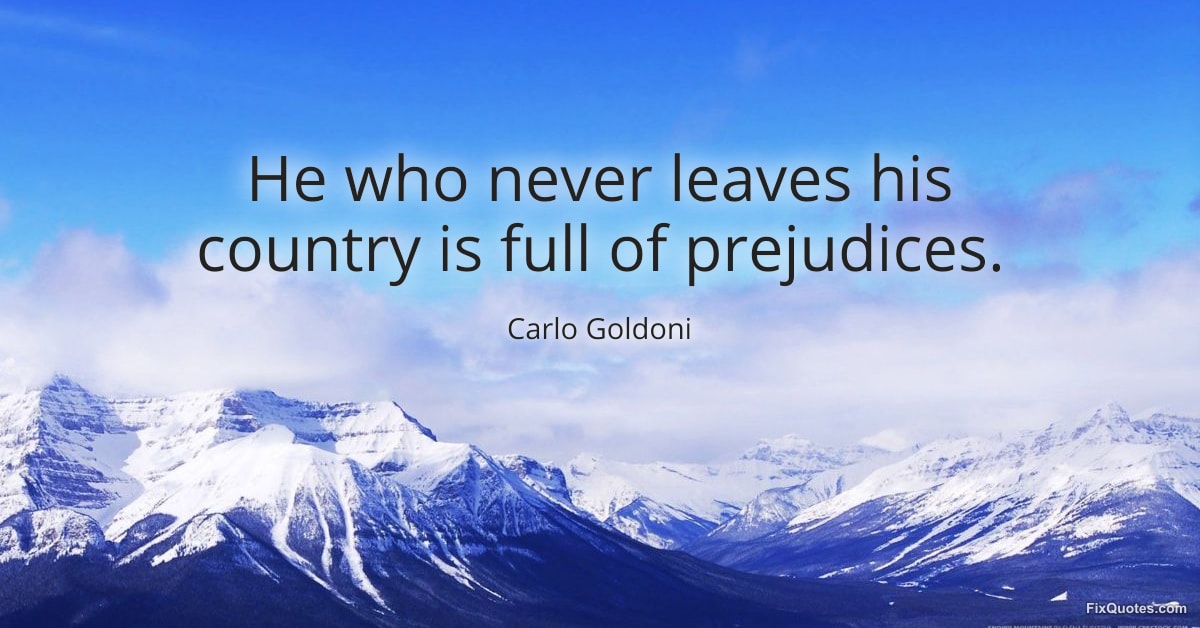
"He who never leaves his country is full of prejudices"
About this Quote
Goldoni lands the jab with a playwright’s economy: the man who stays put isn’t merely uninformed, he’s “full” of prejudice, stuffed with assumptions the way a closed room gets stale. The line works because it refuses the comforting idea that bias is a moral defect only bad people have. Goldoni frames prejudice as a predictable byproduct of immobility. If your world never changes, your mind fills in the gaps with folklore, fear, and flattering myths about “us” versus “them.”
As an 18th-century Venetian, Goldoni wrote in a Europe where borders were porous for merchants, soldiers, and aristocrats, yet psychologically rigid in the way cities and courts caricatured one another. His comedies thrived on social types - the braggart, the miser, the provincial - and this maxim reads like a line aimed at those very characters: people whose certainty is inversely proportional to their experience. Travel here isn’t tourism; it’s exposure to contradiction, the rude discovery that other societies function without your customs, your church, your dialect, your hierarchy.
The subtext is also pointedly civic. Venice lived on exchange: goods, languages, schemes, and gossip. To never leave your country is to opt out of the encounter that keeps a cosmopolitan republic alive. Goldoni is not romanticizing foreignness so much as diagnosing nationalism before it hardens into 19th-century ideology. He’s warning that prejudice isn’t just personal ignorance; it’s what happens when a society rewards comfort over contact, and calls that comfort “common sense.”
As an 18th-century Venetian, Goldoni wrote in a Europe where borders were porous for merchants, soldiers, and aristocrats, yet psychologically rigid in the way cities and courts caricatured one another. His comedies thrived on social types - the braggart, the miser, the provincial - and this maxim reads like a line aimed at those very characters: people whose certainty is inversely proportional to their experience. Travel here isn’t tourism; it’s exposure to contradiction, the rude discovery that other societies function without your customs, your church, your dialect, your hierarchy.
The subtext is also pointedly civic. Venice lived on exchange: goods, languages, schemes, and gossip. To never leave your country is to opt out of the encounter that keeps a cosmopolitan republic alive. Goldoni is not romanticizing foreignness so much as diagnosing nationalism before it hardens into 19th-century ideology. He’s warning that prejudice isn’t just personal ignorance; it’s what happens when a society rewards comfort over contact, and calls that comfort “common sense.”
Quote Details
| Topic | Travel |
|---|---|
| Source | Verified source: Pamela (Pamela nubile) (Carlo Goldoni, 1750)
Evidence: Chi non esce dal suo paese, vive pieno di pregiudizi. (Act I, Scene 14). The English quote “He who never leaves his country is full of prejudices” is a translation of this line. Multiple secondary references (quote sites) attribute it to Goldoni’s play commonly titled “Pamela” / “Pamela nubile” (1750) and locate it at Act I, Scene 14. Wikiquote gives the Italian original plus the Act/Scene location, but it is not itself a primary text edition; I could not, within this search session, access a digitized scan of a 1750 printed edition with stable page numbering to confirm the *first printed appearance* and page number. A non-scan transcription (IntraText) reproduces the dialogue including this exact sentence, but I could not open it directly due to a fetch/encoding error in the tool. For publication-year verification, general reference works also describe Goldoni’s “La Pamela / Pamela nubile” as written and performed in 1750. Other candidates (1) The Rotarian (1918) compilation95.0% ... He who never leaves his country is full of prejudices. — (Carlo Goldoni) The world is a great book, of which they... |
| Cite |
Citation Formats
APA Style (7th ed.)
Goldoni, Carlo. (2026, February 11). He who never leaves his country is full of prejudices. FixQuotes. https://fixquotes.com/quotes/he-who-never-leaves-his-country-is-full-of-38900/
Chicago Style
Goldoni, Carlo. "He who never leaves his country is full of prejudices." FixQuotes. February 11, 2026. https://fixquotes.com/quotes/he-who-never-leaves-his-country-is-full-of-38900/.
MLA Style (9th ed.)
"He who never leaves his country is full of prejudices." FixQuotes, 11 Feb. 2026, https://fixquotes.com/quotes/he-who-never-leaves-his-country-is-full-of-38900/. Accessed 3 Apr. 2026.
More Quotes by Carlo
Add to List