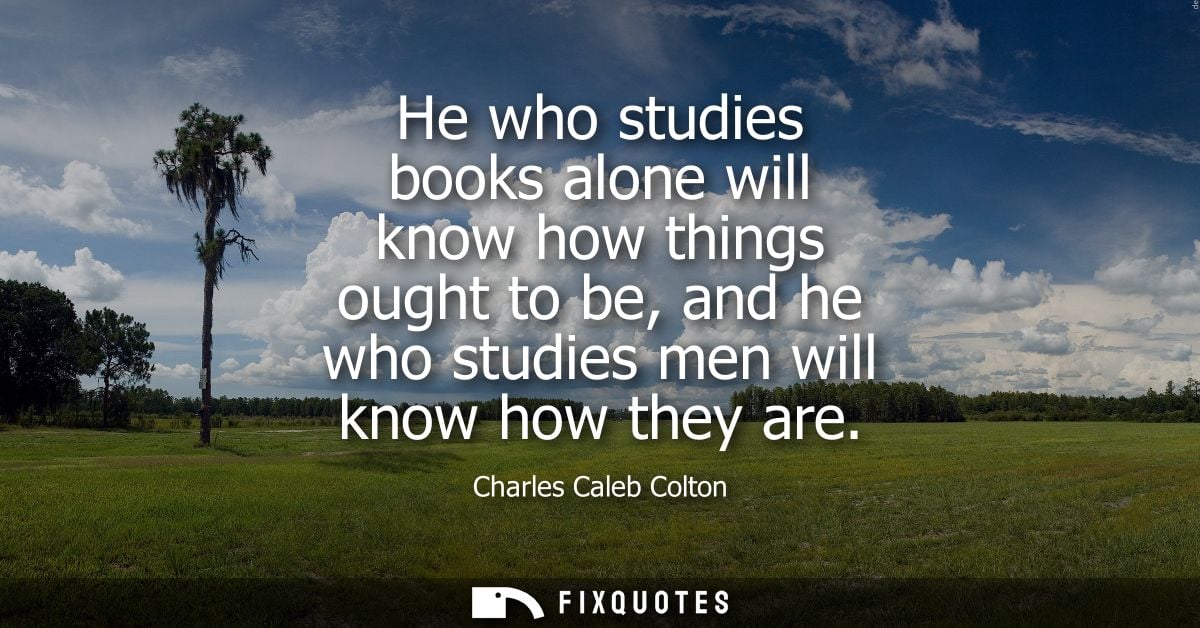
"He who studies books alone will know how things ought to be, and he who studies men will know how they are"
About this Quote
The construction is deliberately symmetrical, almost proverb-like, which gives it the authority of common sense while smuggling in a sharper critique. “Books alone” is the tell. Colton isn’t dismissing texts; he’s warning against a closed-loop education where knowledge never has to answer to messy evidence. “Men” here means people in the raw: motives, contradictions, self-justifications, the way ethics bend under inconvenience. Studying men is not just social observation; it’s an education in compromise, in the ways institutions and individuals rationalize the gap between virtue and behavior.
Subtextually, the quote targets a certain species of armchair reformer: those who can design perfect societies in prose yet misread the actual incentives and fears that drive human action. It’s also an admonition to the reader’s ego. If books make you feel wise, people will make you feel accurate. Colton’s intent lands as a push toward applied judgment: ideas need contact with reality, and morality needs a theory of human nature.
Quote Details
| Topic | Wisdom |
|---|---|
| Source | Help us find the source |
| Cite |
Citation Formats
APA Style (7th ed.)
Colton, Charles Caleb. (2026, January 17). He who studies books alone will know how things ought to be, and he who studies men will know how they are. FixQuotes. https://fixquotes.com/quotes/he-who-studies-books-alone-will-know-how-things-75646/
Chicago Style
Colton, Charles Caleb. "He who studies books alone will know how things ought to be, and he who studies men will know how they are." FixQuotes. January 17, 2026. https://fixquotes.com/quotes/he-who-studies-books-alone-will-know-how-things-75646/.
MLA Style (9th ed.)
"He who studies books alone will know how things ought to be, and he who studies men will know how they are." FixQuotes, 17 Jan. 2026, https://fixquotes.com/quotes/he-who-studies-books-alone-will-know-how-things-75646/. Accessed 12 Feb. 2026.