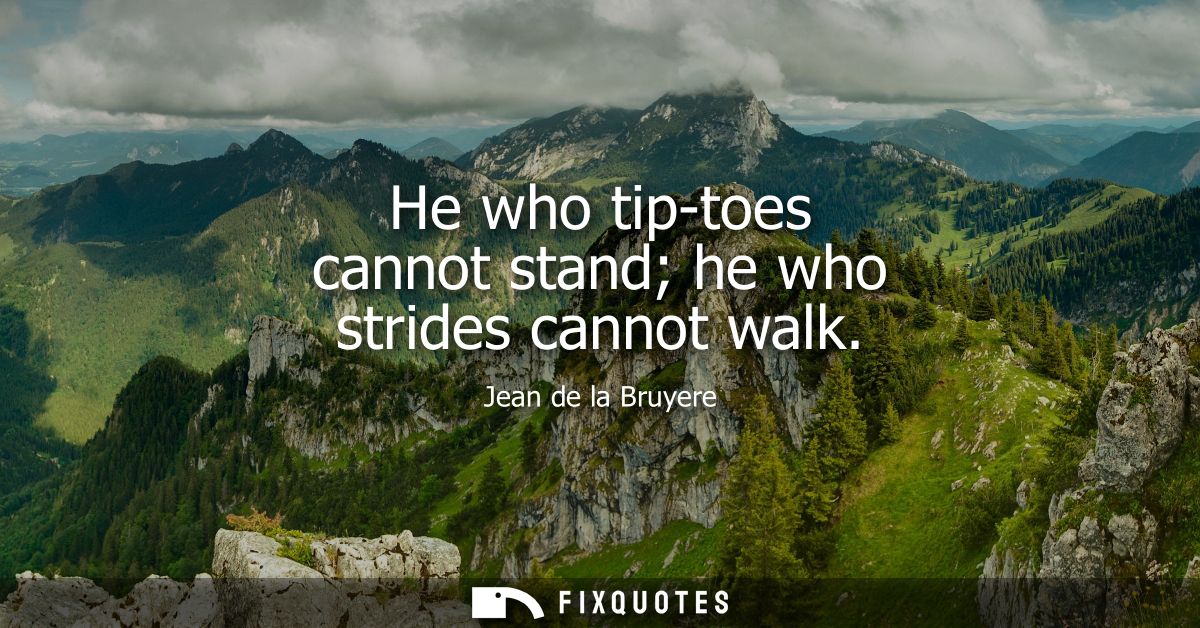
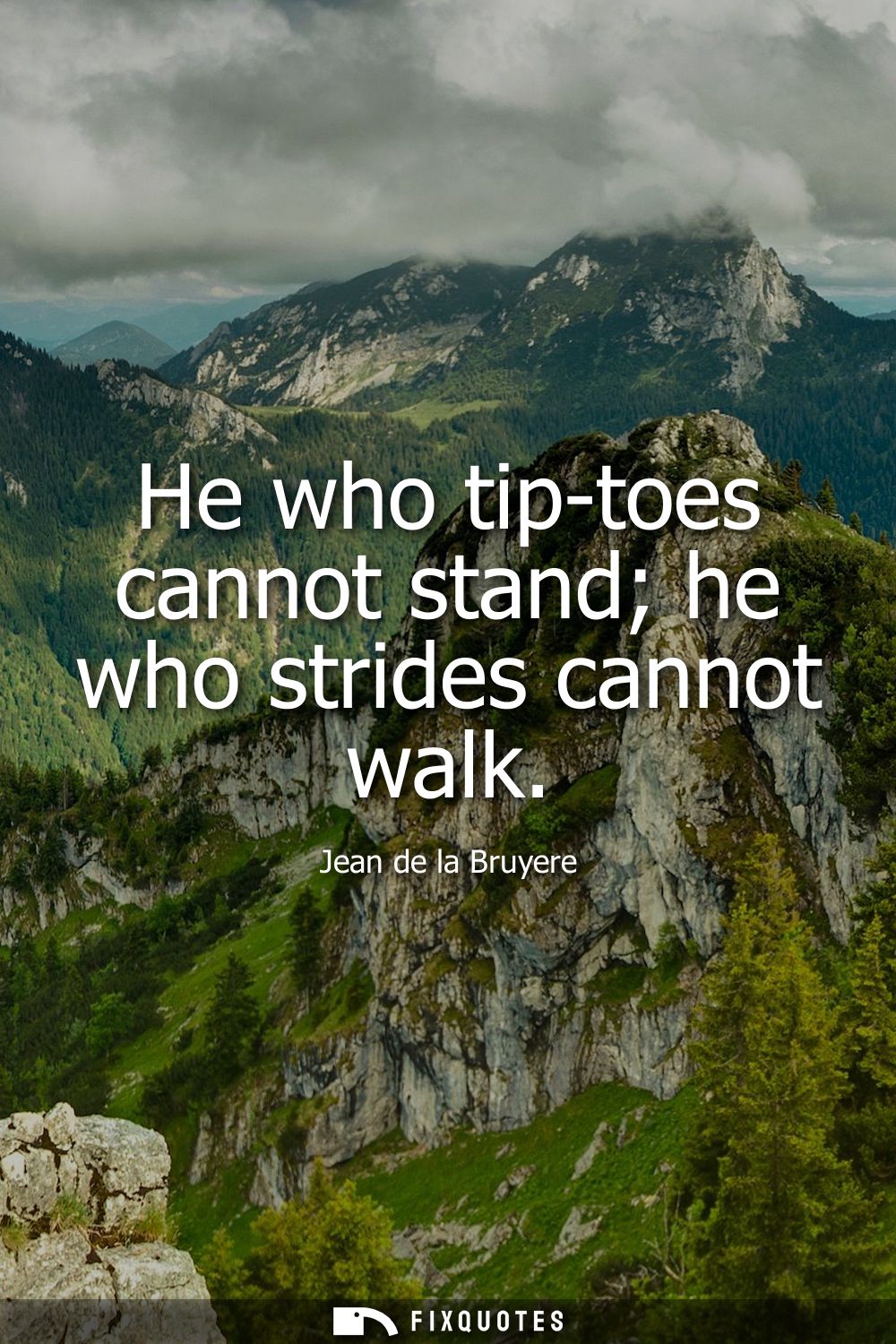
"He who tip-toes cannot stand; he who strides cannot walk"
About this Quote
La Bruyere’s line lands like a paradox you can carry in your pocket: the body moves, and suddenly it’s a moral philosophy. Tip-toeing is what you do when you’re trying not to be seen, when you want the benefits of presence without the costs of commitment. But tip-toeing, he argues, is structurally unstable. The person who constantly hedges, qualifies, and seeks to offend no one ends up unable to “stand” for anything at all. Caution becomes collapse.
Then he flips the vice: the one who “strides” can’t walk. Striding is performance - the exaggerated gait of ambition, certainty, conquest. It’s the person who turns every conversation into a declaration and every room into a stage. A stride covers ground fast, but it sacrifices the ordinary human rhythm that makes sustained travel possible. Walking is the unglamorous discipline of living among others: adjusting pace, watching footing, absorbing detail. The strider burns out, missteps, or tramples.
The intent is less self-help than social diagnosis, very in keeping with a 17th-century French moralist writing in the shadow of court culture, where survival demanded both tact and display. La Bruyere is warning against two courtly temptations: the cowardice of perpetual discretion and the vanity of perpetual assertion. The subtext is that virtue isn’t an extreme posture; it’s a practiced gait. Stability requires enough firmness to stand and enough modesty to keep walking.
Then he flips the vice: the one who “strides” can’t walk. Striding is performance - the exaggerated gait of ambition, certainty, conquest. It’s the person who turns every conversation into a declaration and every room into a stage. A stride covers ground fast, but it sacrifices the ordinary human rhythm that makes sustained travel possible. Walking is the unglamorous discipline of living among others: adjusting pace, watching footing, absorbing detail. The strider burns out, missteps, or tramples.
The intent is less self-help than social diagnosis, very in keeping with a 17th-century French moralist writing in the shadow of court culture, where survival demanded both tact and display. La Bruyere is warning against two courtly temptations: the cowardice of perpetual discretion and the vanity of perpetual assertion. The subtext is that virtue isn’t an extreme posture; it’s a practiced gait. Stability requires enough firmness to stand and enough modesty to keep walking.
Quote Details
| Topic | Wisdom |
|---|---|
| Source | Help us find the source |
| Cite |
Citation Formats
APA Style (7th ed.)
Bruyère, Jean de La. (2026, January 14). He who tip-toes cannot stand; he who strides cannot walk. FixQuotes. https://fixquotes.com/quotes/he-who-tip-toes-cannot-stand-he-who-strides-2671/
Chicago Style
Bruyère, Jean de La. "He who tip-toes cannot stand; he who strides cannot walk." FixQuotes. January 14, 2026. https://fixquotes.com/quotes/he-who-tip-toes-cannot-stand-he-who-strides-2671/.
MLA Style (9th ed.)
"He who tip-toes cannot stand; he who strides cannot walk." FixQuotes, 14 Jan. 2026, https://fixquotes.com/quotes/he-who-tip-toes-cannot-stand-he-who-strides-2671/. Accessed 12 Feb. 2026.
More Quotes by Jean
Add to List