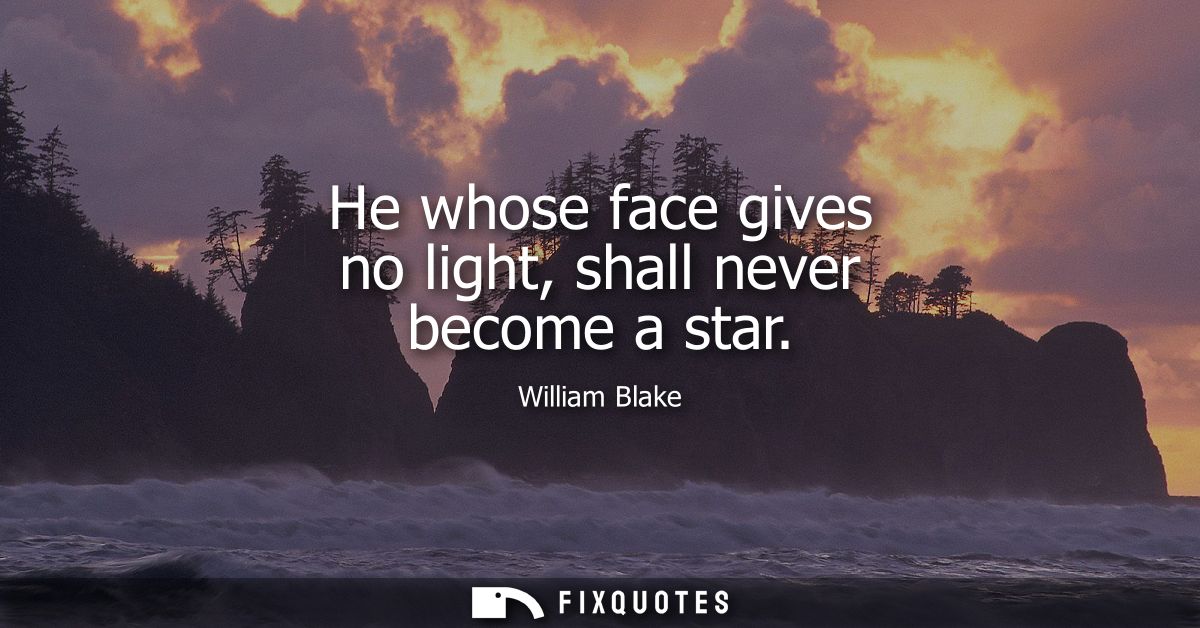
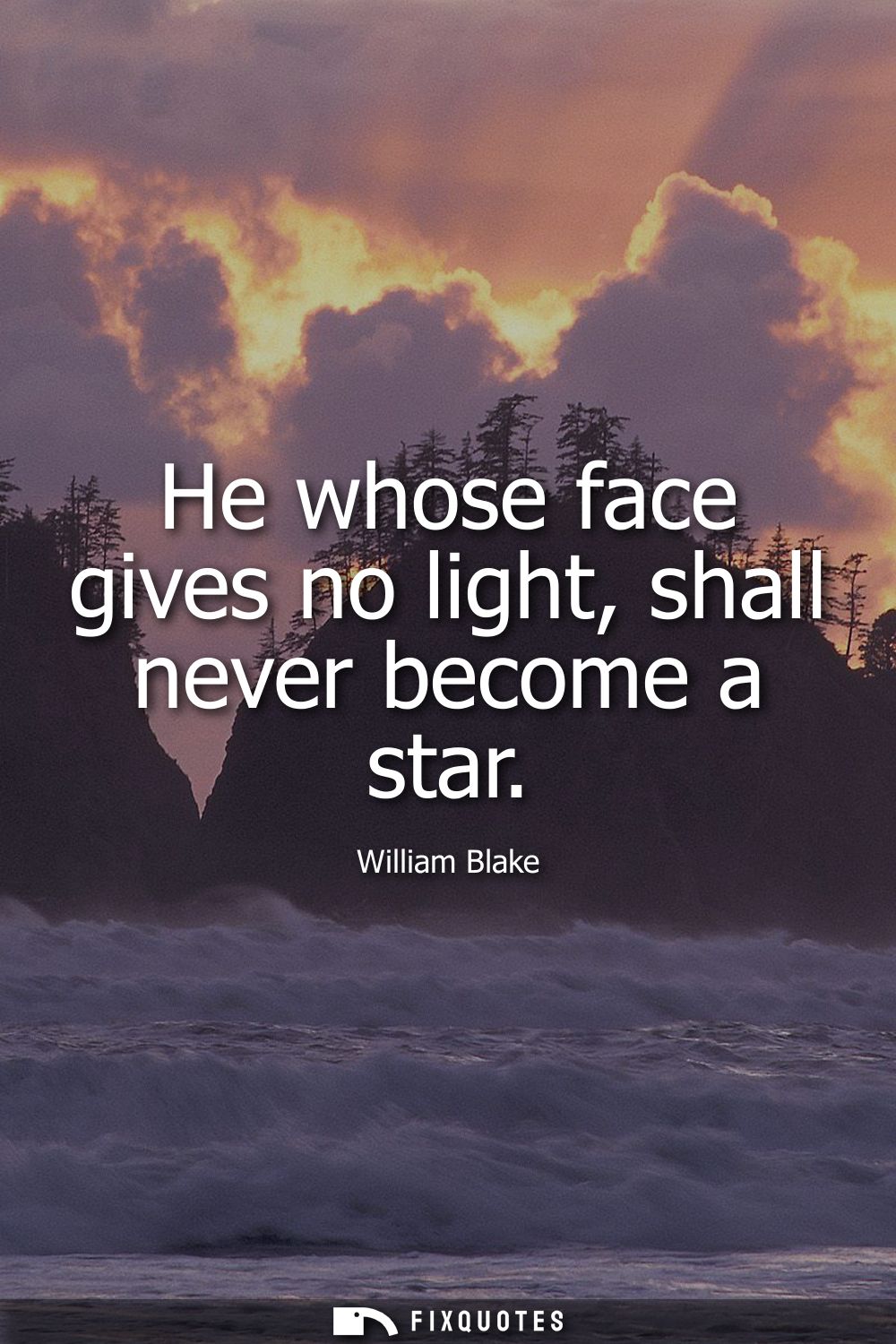
"He whose face gives no light, shall never become a star"
About this Quote
Blake’s line is a small provocation disguised as a compliment: stardom isn’t granted, it’s generated. “Face” here isn’t just a literal visage; it’s presence, expression, the outward evidence of inner fire. If your face “gives no light” you’re not merely overlooked by the crowd - you’re spiritually dim, sealed off from the imaginative energy Blake treats as the only real currency. In a culture that prized polish, propriety, and reason, Blake keeps arguing for radiance: the dangerous, inconvenient kind that makes institutions nervous.
The subtext is anti-passive. Talent, in Blake’s cosmology, isn’t a private possession you hoard until the world discovers it. It’s an emanation. Light has to leak. The line carries a moral edge too: a face without light suggests a life without vision, without the capacity to see beyond the deadened surfaces of custom. “Star” becomes more than fame; it’s a symbol of the eternal, the prophetic, the thing that guides. He’s implicitly sorting people into those who illuminate and those who merely reflect.
Context matters because Blake wrote against an era of mechanization and social discipline - early industrial modernity pushing humans toward function and conformity. His Romantic insistence on imagination as a divine force turns charisma into a spiritual obligation. The sentence works because it compresses that whole argument into a single, public-facing image: what you carry inside only counts if it alters the air around you.
The subtext is anti-passive. Talent, in Blake’s cosmology, isn’t a private possession you hoard until the world discovers it. It’s an emanation. Light has to leak. The line carries a moral edge too: a face without light suggests a life without vision, without the capacity to see beyond the deadened surfaces of custom. “Star” becomes more than fame; it’s a symbol of the eternal, the prophetic, the thing that guides. He’s implicitly sorting people into those who illuminate and those who merely reflect.
Context matters because Blake wrote against an era of mechanization and social discipline - early industrial modernity pushing humans toward function and conformity. His Romantic insistence on imagination as a divine force turns charisma into a spiritual obligation. The sentence works because it compresses that whole argument into a single, public-facing image: what you carry inside only counts if it alters the air around you.
Quote Details
| Topic | Wisdom |
|---|---|
| Source | Help us find the source |
| Cite |
Citation Formats
APA Style (7th ed.)
Blake, William. (2026, January 15). He whose face gives no light, shall never become a star. FixQuotes. https://fixquotes.com/quotes/he-whose-face-gives-no-light-shall-never-become-a-16020/
Chicago Style
Blake, William. "He whose face gives no light, shall never become a star." FixQuotes. January 15, 2026. https://fixquotes.com/quotes/he-whose-face-gives-no-light-shall-never-become-a-16020/.
MLA Style (9th ed.)
"He whose face gives no light, shall never become a star." FixQuotes, 15 Jan. 2026, https://fixquotes.com/quotes/he-whose-face-gives-no-light-shall-never-become-a-16020/. Accessed 14 Feb. 2026.
More Quotes by William
Add to List