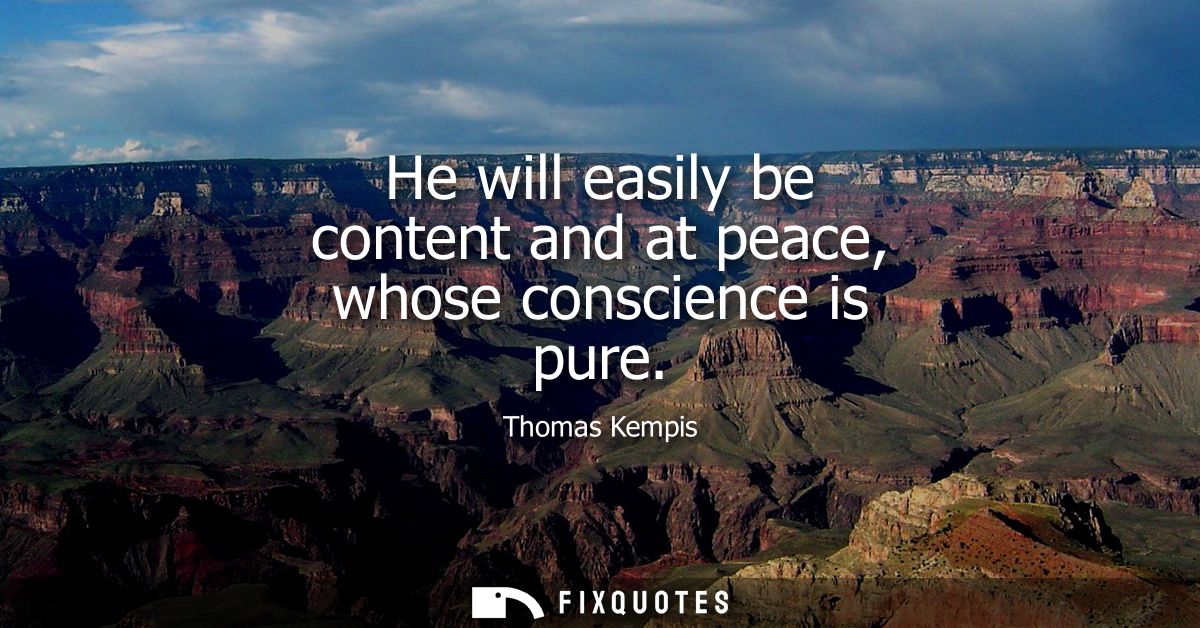
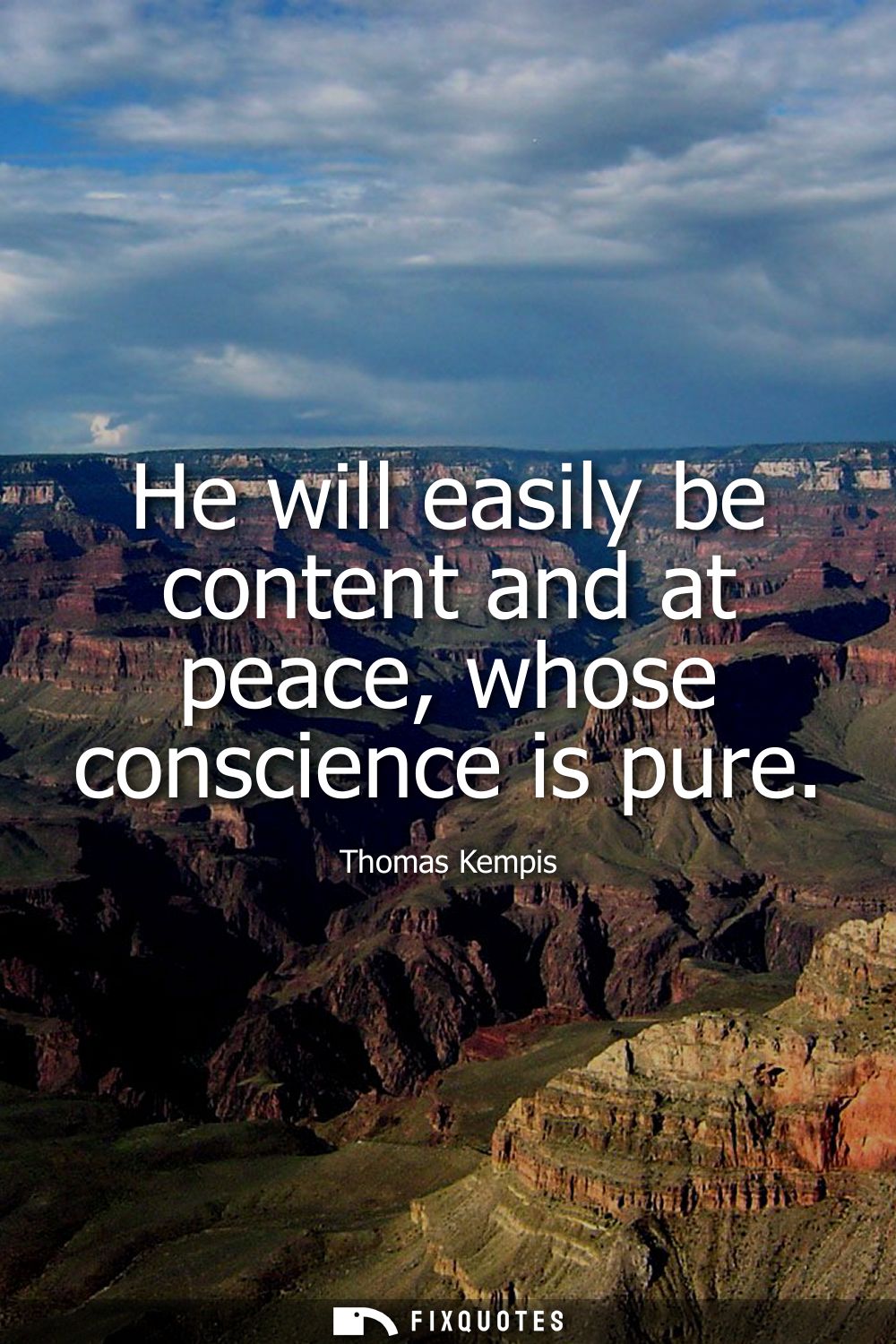
"He will easily be content and at peace whose conscience is pure"
About this Quote
Peace, for Thomas a Kempis, is not a vibe; it is a moral consequence. The line lands with the calm authority of a writer who assumes the real battlefield is internal, and that the verdict that matters is handed down by conscience, not by the crowd. “Easily” is doing sly work here: it suggests that tranquility isn’t a luxury for the lucky or the disciplined-but-still-striving. It’s the natural, almost effortless state of someone whose inner ledger has been cleared.
That phrasing also contains an implicit rebuke to the medieval and modern habit of outsourcing serenity to external fixes: status, praise, possessions, even pious performance. Kempis, writing in the devotional tradition of The Imitation of Christ (early 15th century), is steeped in monastic realism about distraction and self-deception. He’s not promising comfort; he’s promising a kind of unbribable steadiness. “Content” and “at peace” are paired like twin dividends of integrity: one speaks to desire (what you want), the other to fear (what you dread). A pure conscience disarms both.
The subtext is stringent: if you are restless, check your life before you blame your circumstances. That can sound severe, even psychologically naive to contemporary ears that understand anxiety as more than guilt. Yet the quote’s power comes from its austerity. It offers a brutally simple metric for the quality of one’s days: not how well you are doing, but how truthfully you are living when no one is watching.
That phrasing also contains an implicit rebuke to the medieval and modern habit of outsourcing serenity to external fixes: status, praise, possessions, even pious performance. Kempis, writing in the devotional tradition of The Imitation of Christ (early 15th century), is steeped in monastic realism about distraction and self-deception. He’s not promising comfort; he’s promising a kind of unbribable steadiness. “Content” and “at peace” are paired like twin dividends of integrity: one speaks to desire (what you want), the other to fear (what you dread). A pure conscience disarms both.
The subtext is stringent: if you are restless, check your life before you blame your circumstances. That can sound severe, even psychologically naive to contemporary ears that understand anxiety as more than guilt. Yet the quote’s power comes from its austerity. It offers a brutally simple metric for the quality of one’s days: not how well you are doing, but how truthfully you are living when no one is watching.
Quote Details
| Topic | Honesty & Integrity |
|---|---|
| Source | Help us find the source |
| Cite |
Citation Formats
APA Style (7th ed.)
Kempis, Thomas. (2026, February 16). He will easily be content and at peace whose conscience is pure. FixQuotes. https://fixquotes.com/quotes/he-will-easily-be-content-and-at-peace-whose-3906/
Chicago Style
Kempis, Thomas. "He will easily be content and at peace whose conscience is pure." FixQuotes. February 16, 2026. https://fixquotes.com/quotes/he-will-easily-be-content-and-at-peace-whose-3906/.
MLA Style (9th ed.)
"He will easily be content and at peace whose conscience is pure." FixQuotes, 16 Feb. 2026, https://fixquotes.com/quotes/he-will-easily-be-content-and-at-peace-whose-3906/. Accessed 28 Mar. 2026.
More Quotes by Thomas
Add to List