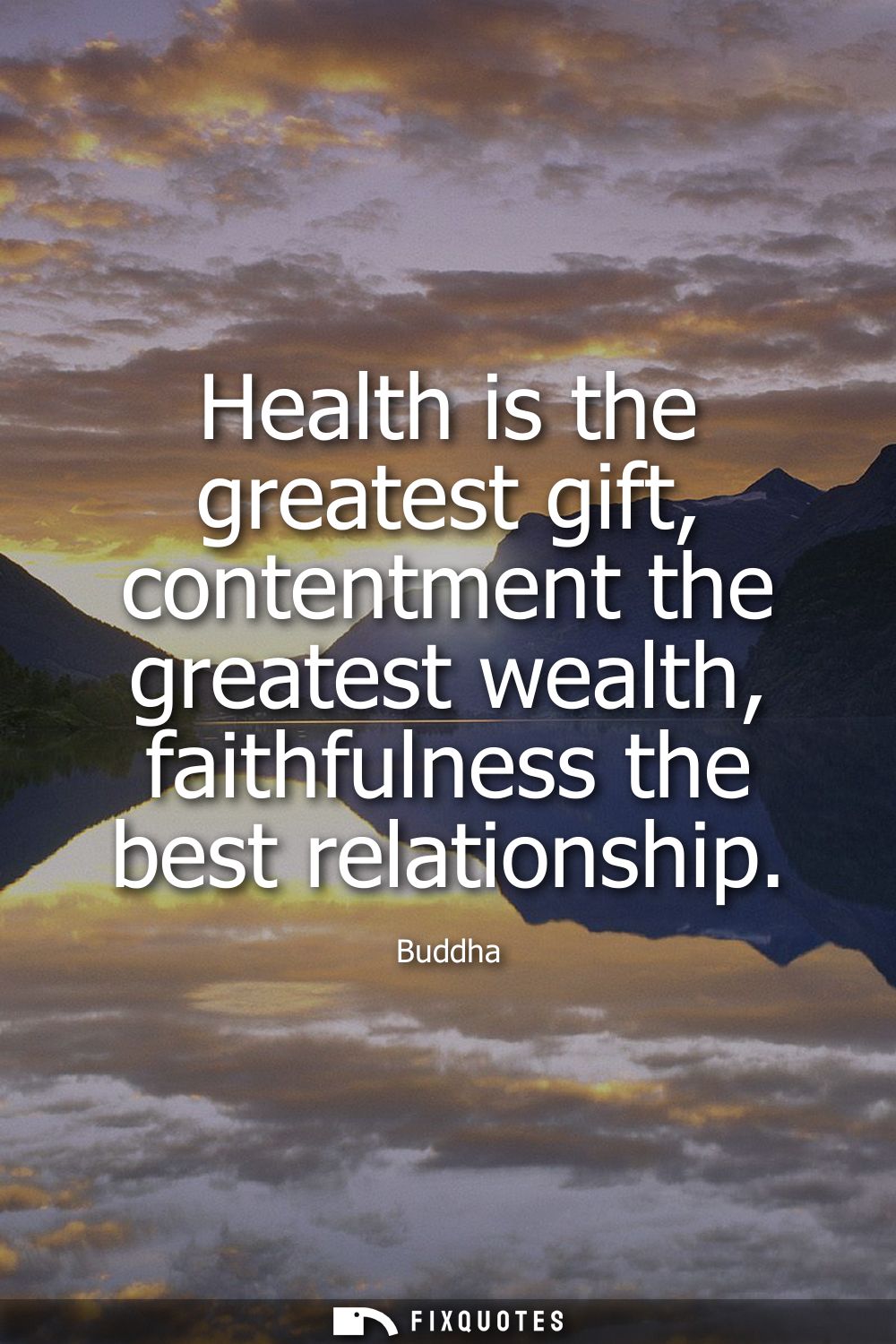
"Health is the greatest gift, contentment the greatest wealth, faithfulness the best relationship"
About this Quote
Then comes the sharper turn: “contentment” as “wealth.” Not aspiration, not accumulation, not the thrill of wanting-more, but the ability to stop grasping. In a culture of endless desire (ancient marketplaces, modern feeds), this is a subversive definition: poverty and riches become less about possession than about appetite. The subtext isn’t “be satisfied with less” as resignation; it’s “wanting is the engine of suffering,” and the only durable surplus is a mind that isn’t constantly in deficit.
“Faithfulness” as “the best relationship” lands like a social ethic built from inner training. It’s not romance as fireworks; it’s reliability as refuge. In the Buddhist context, faithfulness points beyond sexual fidelity toward steadiness: keeping vows, practicing right speech, honoring community, staying true to the path. Read together, the triad sketches a politics of the self: care for the fragile body, disarm craving, and make your commitments trustworthy. That’s how a life stops wobbling.
Quote Details
| Topic | Wisdom |
|---|---|
| Source | Help us find the source |
| Cite |
Citation Formats
APA Style (7th ed.)
Buddha. (2026, January 15). Health is the greatest gift, contentment the greatest wealth, faithfulness the best relationship. FixQuotes. https://fixquotes.com/quotes/health-is-the-greatest-gift-contentment-the-22163/
Chicago Style
Buddha. "Health is the greatest gift, contentment the greatest wealth, faithfulness the best relationship." FixQuotes. January 15, 2026. https://fixquotes.com/quotes/health-is-the-greatest-gift-contentment-the-22163/.
MLA Style (9th ed.)
"Health is the greatest gift, contentment the greatest wealth, faithfulness the best relationship." FixQuotes, 15 Jan. 2026, https://fixquotes.com/quotes/health-is-the-greatest-gift-contentment-the-22163/. Accessed 8 Mar. 2026.