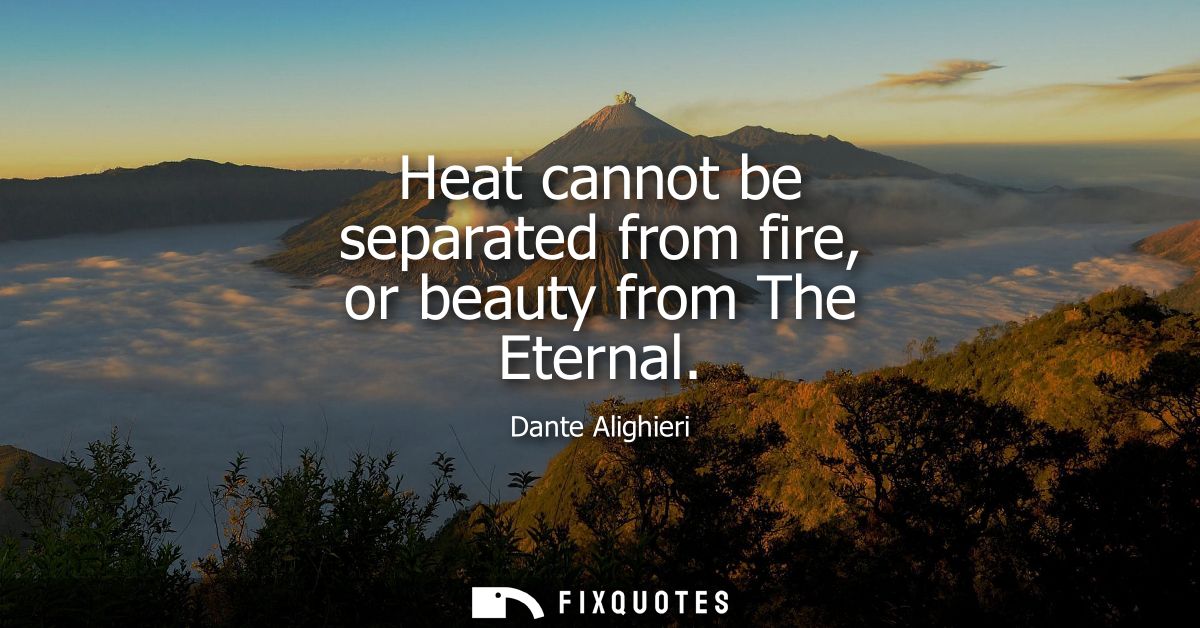
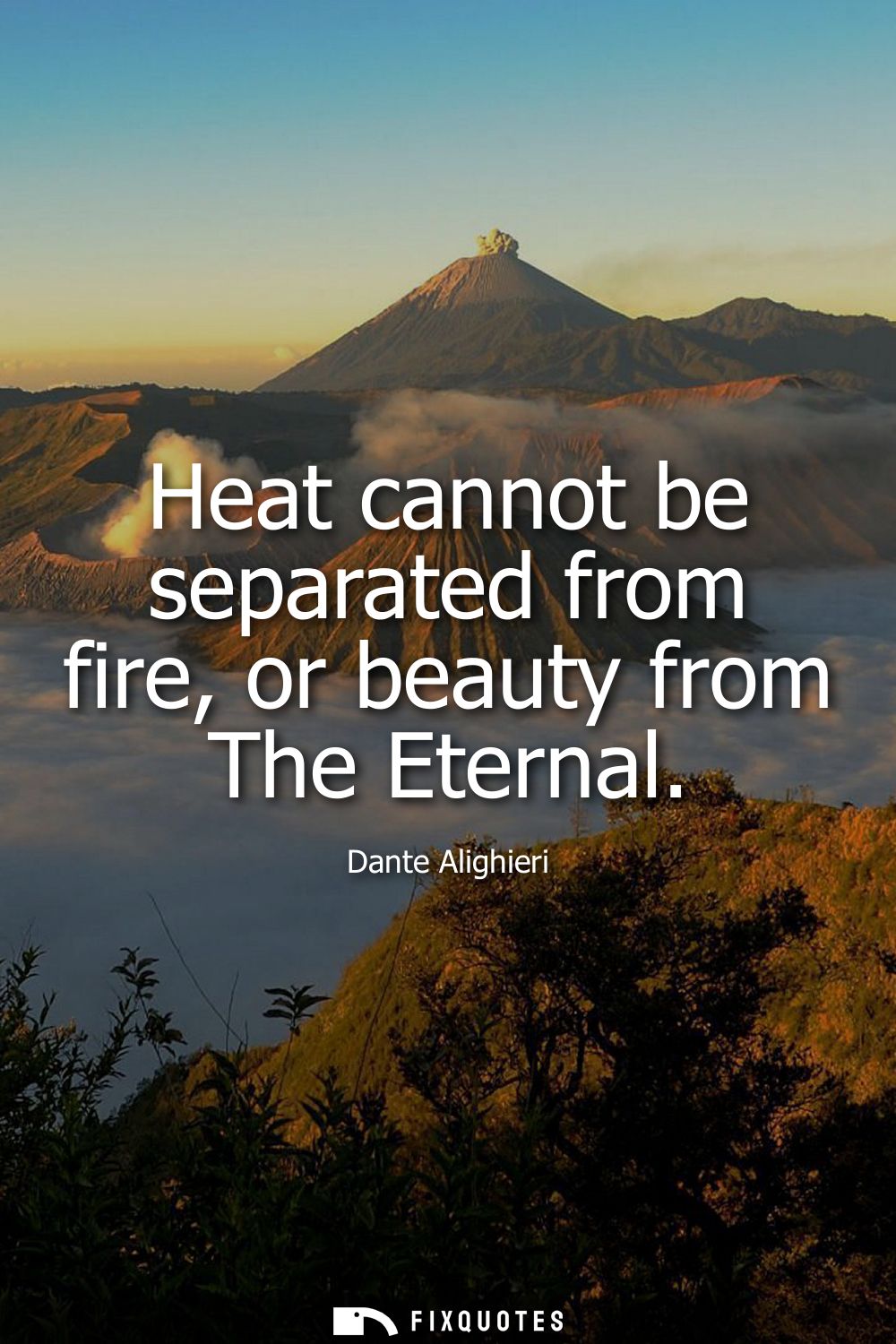
"Heat cannot be separated from fire, or beauty from The Eternal"
About this Quote
Dante’s line works like a theological mic drop disguised as a physics lesson: some unions aren’t optional, and trying to pry them apart isn’t “critical thinking” so much as category error. Heat isn’t an accessory fire puts on; it’s fire’s signature. By pairing that with “beauty” and “The Eternal,” Dante smuggles a metaphysical claim through a sensory certainty. You don’t argue with heat. You feel it. The quote recruits that immediacy to make an argument about God (or the divine order) feel less like doctrine and more like plain perception.
The subtext is quietly polemical. Medieval Italy was a battleground of competing authorities - church, empire, city-state - and competing philosophies about where value originates. Dante’s Commedia is obsessed with misdirected desire: people chasing shimmer without source, treating beauty as a self-contained commodity. This aphorism insists beauty isn’t merely in the eye; it’s in the cosmos. If beauty is real, it points beyond itself, back to the Eternal as its generating “fire.”
The phrasing matters. “Cannot be separated” is both logical and moral: the separation is not just impossible, it’s spiritually wrongheaded. Dante is also elevating aesthetics into evidence. Beauty isn’t decoration; it’s a trace, a heat-haze of divinity in the created world. In a poem that turns the afterlife into an argument, that’s clever rhetoric: he grounds transcendence in something as undeniable as warmth on your skin.
The subtext is quietly polemical. Medieval Italy was a battleground of competing authorities - church, empire, city-state - and competing philosophies about where value originates. Dante’s Commedia is obsessed with misdirected desire: people chasing shimmer without source, treating beauty as a self-contained commodity. This aphorism insists beauty isn’t merely in the eye; it’s in the cosmos. If beauty is real, it points beyond itself, back to the Eternal as its generating “fire.”
The phrasing matters. “Cannot be separated” is both logical and moral: the separation is not just impossible, it’s spiritually wrongheaded. Dante is also elevating aesthetics into evidence. Beauty isn’t decoration; it’s a trace, a heat-haze of divinity in the created world. In a poem that turns the afterlife into an argument, that’s clever rhetoric: he grounds transcendence in something as undeniable as warmth on your skin.
Quote Details
| Topic | God |
|---|---|
| Source | Help us find the source |
| Cite |
Citation Formats
APA Style (7th ed.)
Alighieri, Dante. (2026, January 15). Heat cannot be separated from fire, or beauty from The Eternal. FixQuotes. https://fixquotes.com/quotes/heat-cannot-be-separated-from-fire-or-beauty-from-30709/
Chicago Style
Alighieri, Dante. "Heat cannot be separated from fire, or beauty from The Eternal." FixQuotes. January 15, 2026. https://fixquotes.com/quotes/heat-cannot-be-separated-from-fire-or-beauty-from-30709/.
MLA Style (9th ed.)
"Heat cannot be separated from fire, or beauty from The Eternal." FixQuotes, 15 Jan. 2026, https://fixquotes.com/quotes/heat-cannot-be-separated-from-fire-or-beauty-from-30709/. Accessed 12 Feb. 2026.
More Quotes by Dante
Add to List