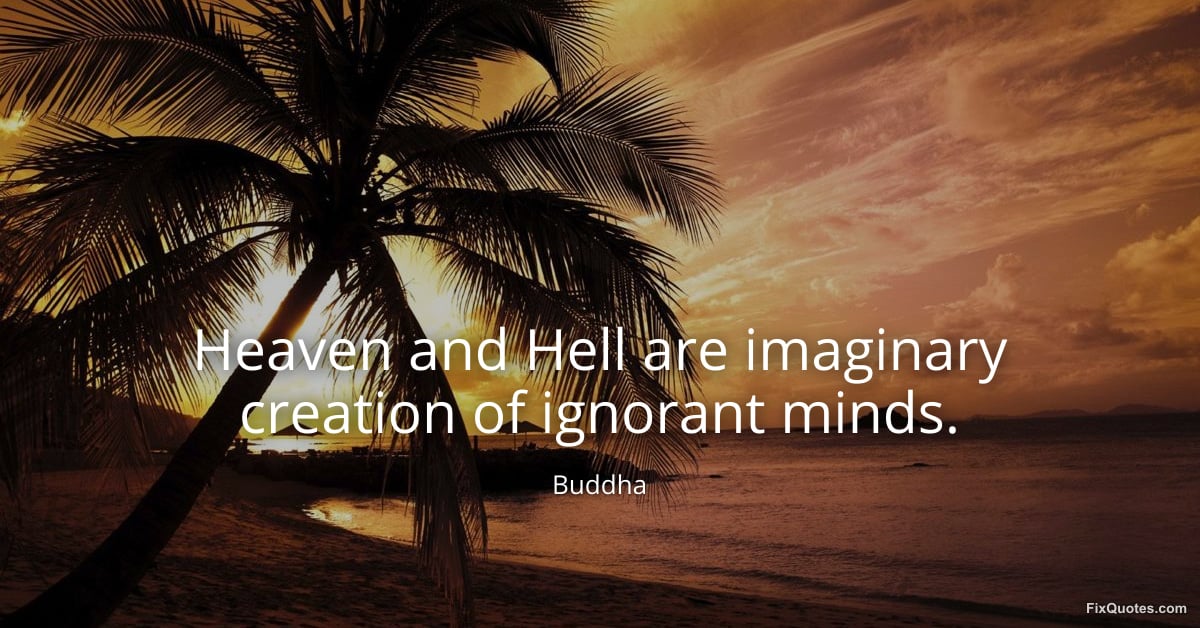
"Heaven and Hell are imaginary creation of ignorant minds"
About this Quote
It lands like a hammer blow against priestly authority. Put a line like this in the mouth of Buddha, and its force is not just metaphysical skepticism; it is social rebellion. Heaven and Hell, in this framing, are not sacred destinations but tools - stories built by "ignorant minds" to explain suffering, reward obedience, and frighten people into moral compliance. The insult matters. "Ignorant" turns the problem away from cosmic mystery and toward human confusion. Error, not evil, is the engine.
That fits the deeper architecture of Buddhist thought. Early Buddhism is far less interested in divine judgment than in causation: why suffering arises, how craving sustains it, how disciplined awareness can end it. A worldview organized around karmic process leaves little room for eternal punishment handed down by a supernatural ruler. The point is practical liberation, not theological spectacle.
The quote also has the rhetorical bluntness of a reformer trying to break a habit of mind. Religious cultures often traffic in vivid afterlife imagery because fear is memorable. Buddha's teaching, at least in popular understanding, cuts against that instinct. It redirects attention from unseen realms to the felt reality of the present moment: your attachments, your delusions, your capacity for awakening. Stop fantasizing about postmortem reward and punishment; deal with the machinery of suffering here.
Historically, that stance would have challenged the ritual and metaphysical assumptions of ancient India, where spiritual authority was often tied to claims about cosmic order. The line endures because it strips religion to a hard question: does belief clarify the mind, or merely decorate fear?
That fits the deeper architecture of Buddhist thought. Early Buddhism is far less interested in divine judgment than in causation: why suffering arises, how craving sustains it, how disciplined awareness can end it. A worldview organized around karmic process leaves little room for eternal punishment handed down by a supernatural ruler. The point is practical liberation, not theological spectacle.
The quote also has the rhetorical bluntness of a reformer trying to break a habit of mind. Religious cultures often traffic in vivid afterlife imagery because fear is memorable. Buddha's teaching, at least in popular understanding, cuts against that instinct. It redirects attention from unseen realms to the felt reality of the present moment: your attachments, your delusions, your capacity for awakening. Stop fantasizing about postmortem reward and punishment; deal with the machinery of suffering here.
Historically, that stance would have challenged the ritual and metaphysical assumptions of ancient India, where spiritual authority was often tied to claims about cosmic order. The line endures because it strips religion to a hard question: does belief clarify the mind, or merely decorate fear?
Quote Details
| Topic | Deep |
|---|---|
| Source | Help us find the source |
| Cite |
Citation Formats
APA Style (7th ed.)
Buddha. (2026, March 10). Heaven and Hell are imaginary creation of ignorant minds. FixQuotes. https://fixquotes.com/quotes/heaven-and-hell-are-imaginary-creation-of-185891/
Chicago Style
Buddha. "Heaven and Hell are imaginary creation of ignorant minds." FixQuotes. March 10, 2026. https://fixquotes.com/quotes/heaven-and-hell-are-imaginary-creation-of-185891/.
MLA Style (9th ed.)
"Heaven and Hell are imaginary creation of ignorant minds." FixQuotes, 10 Mar. 2026, https://fixquotes.com/quotes/heaven-and-hell-are-imaginary-creation-of-185891/. Accessed 3 Apr. 2026.
More Quotes by Buddha
Add to List