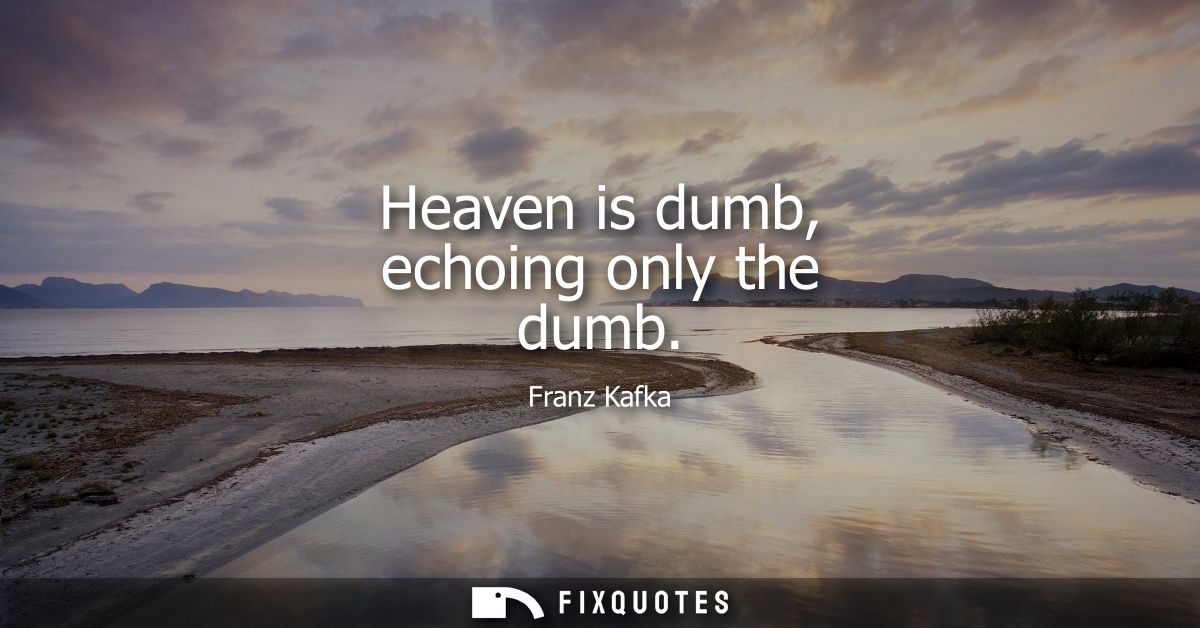
"Heaven is dumb, echoing only the dumb"
About this Quote
Heaven is supposed to be the ultimate answer key, the place where meaning resolves. Kafka flips that expectation into a dead-end acoustic chamber: heaven is not wise, not speaking, not even listening. It is "dumb" in the double sense, mute and stupid. The sting lands in the second clause, where the afterlife becomes an echo that can only return what it receives. If you send up confusion, fear, platitudes, obedience, you don't get revelation back; you get your own dullness amplified into something that feels like authority.
The line works because it weaponizes a religious image without bothering to argue theology. Kafka doesn't need to deny heaven; he just hollows it out. This is classic Kafka subtext: institutions that claim transcendence end up behaving like bureaucracy, reproducing the language of the petitioners and calling it truth. An echo is also a kind of non-answer that mimics responsiveness. That's how power can feel in Kafka: it repeats you back to yourself until you mistake repetition for judgment.
Context matters. Kafka wrote from within a modernity where inherited certainties (God, law, family roles) still loomed but no longer reliably delivered meaning. As a German-speaking Jew in Prague, watching authority structures grind on with surreal confidence, he developed a sensitivity to systems that promise salvation yet offer only procedure. "Heaven is dumb" is not mere nihilism; it's a diagnosis of projection. We invent a higher court, then discover it's staffed by our own limitations.
The line works because it weaponizes a religious image without bothering to argue theology. Kafka doesn't need to deny heaven; he just hollows it out. This is classic Kafka subtext: institutions that claim transcendence end up behaving like bureaucracy, reproducing the language of the petitioners and calling it truth. An echo is also a kind of non-answer that mimics responsiveness. That's how power can feel in Kafka: it repeats you back to yourself until you mistake repetition for judgment.
Context matters. Kafka wrote from within a modernity where inherited certainties (God, law, family roles) still loomed but no longer reliably delivered meaning. As a German-speaking Jew in Prague, watching authority structures grind on with surreal confidence, he developed a sensitivity to systems that promise salvation yet offer only procedure. "Heaven is dumb" is not mere nihilism; it's a diagnosis of projection. We invent a higher court, then discover it's staffed by our own limitations.
Quote Details
| Topic | Deep |
|---|---|
| Source | Help us find the source |
| Cite |
Citation Formats
APA Style (7th ed.)
Kafka, Franz. (2026, January 18). Heaven is dumb, echoing only the dumb. FixQuotes. https://fixquotes.com/quotes/heaven-is-dumb-echoing-only-the-dumb-7015/
Chicago Style
Kafka, Franz. "Heaven is dumb, echoing only the dumb." FixQuotes. January 18, 2026. https://fixquotes.com/quotes/heaven-is-dumb-echoing-only-the-dumb-7015/.
MLA Style (9th ed.)
"Heaven is dumb, echoing only the dumb." FixQuotes, 18 Jan. 2026, https://fixquotes.com/quotes/heaven-is-dumb-echoing-only-the-dumb-7015/. Accessed 12 Mar. 2026.
More Quotes by Franz
Add to List