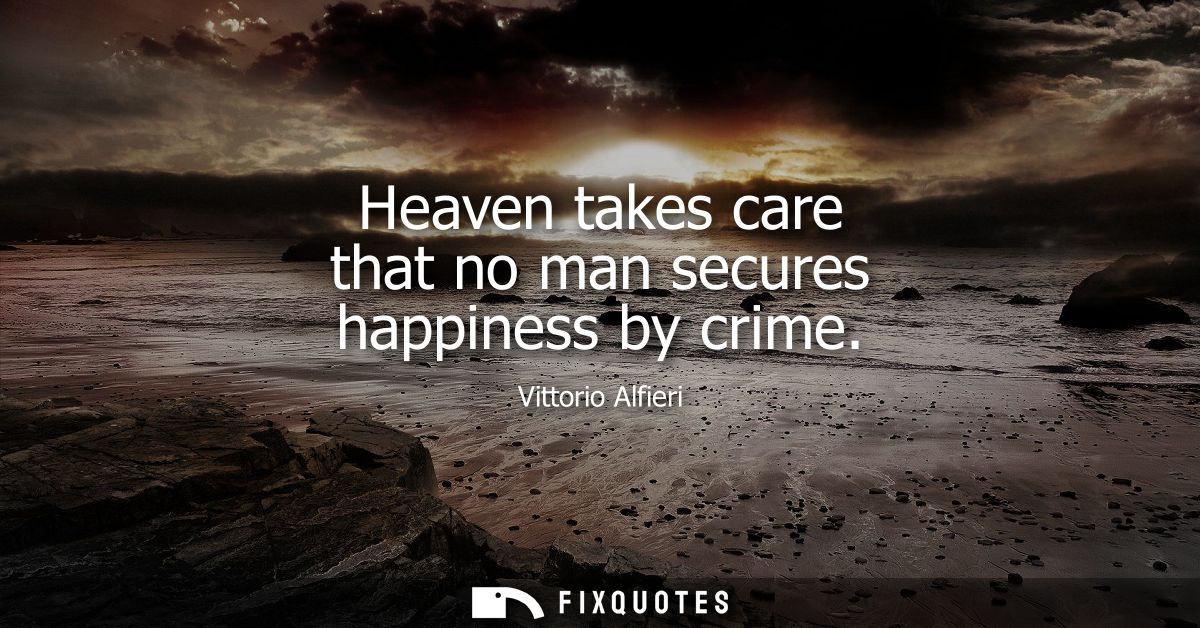
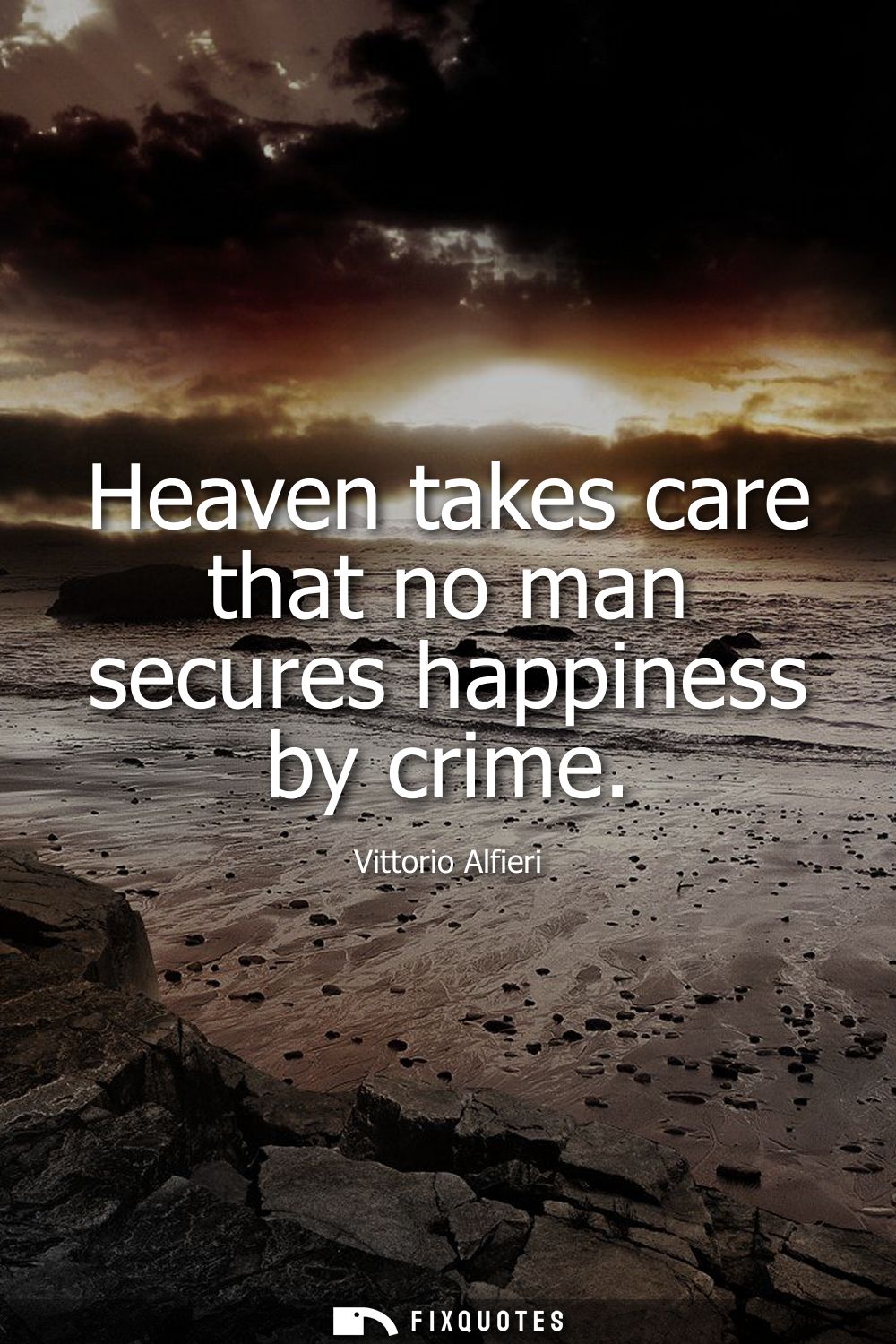
"Heaven takes care that no man secures happiness by crime"
About this Quote
Alfieri’s line has the crisp, punitive geometry of classical tragedy: you can break the law, you can break people, you can even win for a while, but you cannot convert wrongdoing into a stable life. “Heaven takes care” is doing double duty. It’s a statement of metaphysical supervision, yes, but it’s also a stage manager’s promise to the audience: the moral ledger will balance by curtain call. In drama, that assurance isn’t theology so much as structure. The universe becomes a plot engine that prevents the scandal of a villain’s contentment.
The subtext is less pious than political. Alfieri wrote in an era when aristocratic privilege could look like crime with good manners - power insulated from consequence. By invoking “Heaven,” he sidesteps naming kings, courts, or regimes while still insisting on accountability that earthly institutions often failed to deliver. The sentence offers consolation to the powerless and a warning to the powerful, framed as inevitability rather than protest.
Its real bite is psychological: the claim isn’t merely that criminals get punished; it’s that happiness itself is inaccessible through violation. Even if the state never catches you, the spoils don’t settle into peace. Guilt, paranoia, the brittle need to keep winning - these are the internal furies that make “care” feel less like divine mercy and more like enforcement. Alfieri’s tragedian instinct is to make justice feel natural, almost automatic, so the audience leaves believing the world is harsher than it is - but also, crucially, more legible.
The subtext is less pious than political. Alfieri wrote in an era when aristocratic privilege could look like crime with good manners - power insulated from consequence. By invoking “Heaven,” he sidesteps naming kings, courts, or regimes while still insisting on accountability that earthly institutions often failed to deliver. The sentence offers consolation to the powerless and a warning to the powerful, framed as inevitability rather than protest.
Its real bite is psychological: the claim isn’t merely that criminals get punished; it’s that happiness itself is inaccessible through violation. Even if the state never catches you, the spoils don’t settle into peace. Guilt, paranoia, the brittle need to keep winning - these are the internal furies that make “care” feel less like divine mercy and more like enforcement. Alfieri’s tragedian instinct is to make justice feel natural, almost automatic, so the audience leaves believing the world is harsher than it is - but also, crucially, more legible.
Quote Details
| Topic | Justice |
|---|---|
| Source | Help us find the source |
| Cite |
Citation Formats
APA Style (7th ed.)
Alfieri, Vittorio. (2026, January 16). Heaven takes care that no man secures happiness by crime. FixQuotes. https://fixquotes.com/quotes/heaven-takes-care-that-no-man-secures-happiness-129673/
Chicago Style
Alfieri, Vittorio. "Heaven takes care that no man secures happiness by crime." FixQuotes. January 16, 2026. https://fixquotes.com/quotes/heaven-takes-care-that-no-man-secures-happiness-129673/.
MLA Style (9th ed.)
"Heaven takes care that no man secures happiness by crime." FixQuotes, 16 Jan. 2026, https://fixquotes.com/quotes/heaven-takes-care-that-no-man-secures-happiness-129673/. Accessed 6 Mar. 2026.
More Quotes by Vittorio
Add to List