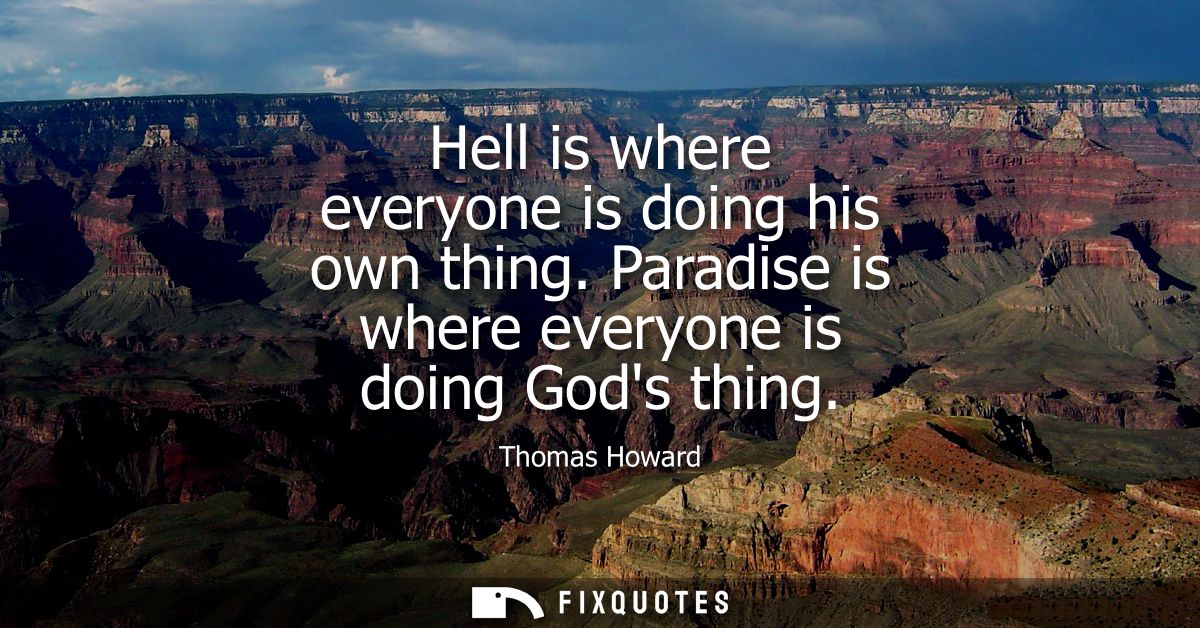
"Hell is where everyone is doing his own thing. Paradise is where everyone is doing God's thing"
About this Quote
Howard's second sentence risks sounding like propaganda until you notice the rhetorical move: "God's thing" isn't pitched as an external imposition but as a shared orientation that makes communion possible. Paradise, here, isn't individual bliss multiplied; it's coordination, consent, and harmony around a center that isn't any one person's ego. The subtext is anti-therapeutic in the contemporary sense: fulfillment doesn't come from intensifying the self but from being re-ordered, even diminished, in service of something transcendent.
As a Christian writer, Howard is also quietly arguing against the late-20th-century drift toward expressive individualism, where identity is treated as a private project and meaning as a personal brand. He compresses a whole theology of sin into a single social image: hell as radical independence, heaven as chosen dependence. It's an intentionally abrasive contrast, meant to make the reader feel how thin "freedom" can become when it has no telos beyond itself.
Quote Details
| Topic | God |
|---|---|
| Source | Help us find the source |
| Cite |
Citation Formats
APA Style (7th ed.)
Howard, Thomas. (2026, January 17). Hell is where everyone is doing his own thing. Paradise is where everyone is doing God's thing. FixQuotes. https://fixquotes.com/quotes/hell-is-where-everyone-is-doing-his-own-thing-71575/
Chicago Style
Howard, Thomas. "Hell is where everyone is doing his own thing. Paradise is where everyone is doing God's thing." FixQuotes. January 17, 2026. https://fixquotes.com/quotes/hell-is-where-everyone-is-doing-his-own-thing-71575/.
MLA Style (9th ed.)
"Hell is where everyone is doing his own thing. Paradise is where everyone is doing God's thing." FixQuotes, 17 Jan. 2026, https://fixquotes.com/quotes/hell-is-where-everyone-is-doing-his-own-thing-71575/. Accessed 7 Mar. 2026.