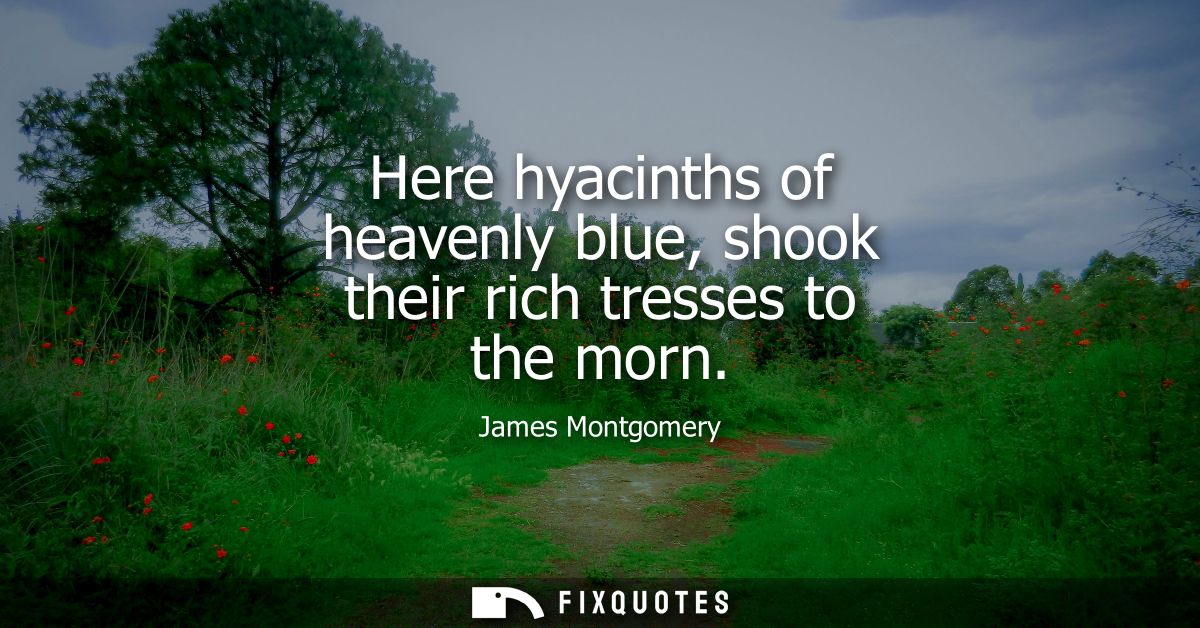
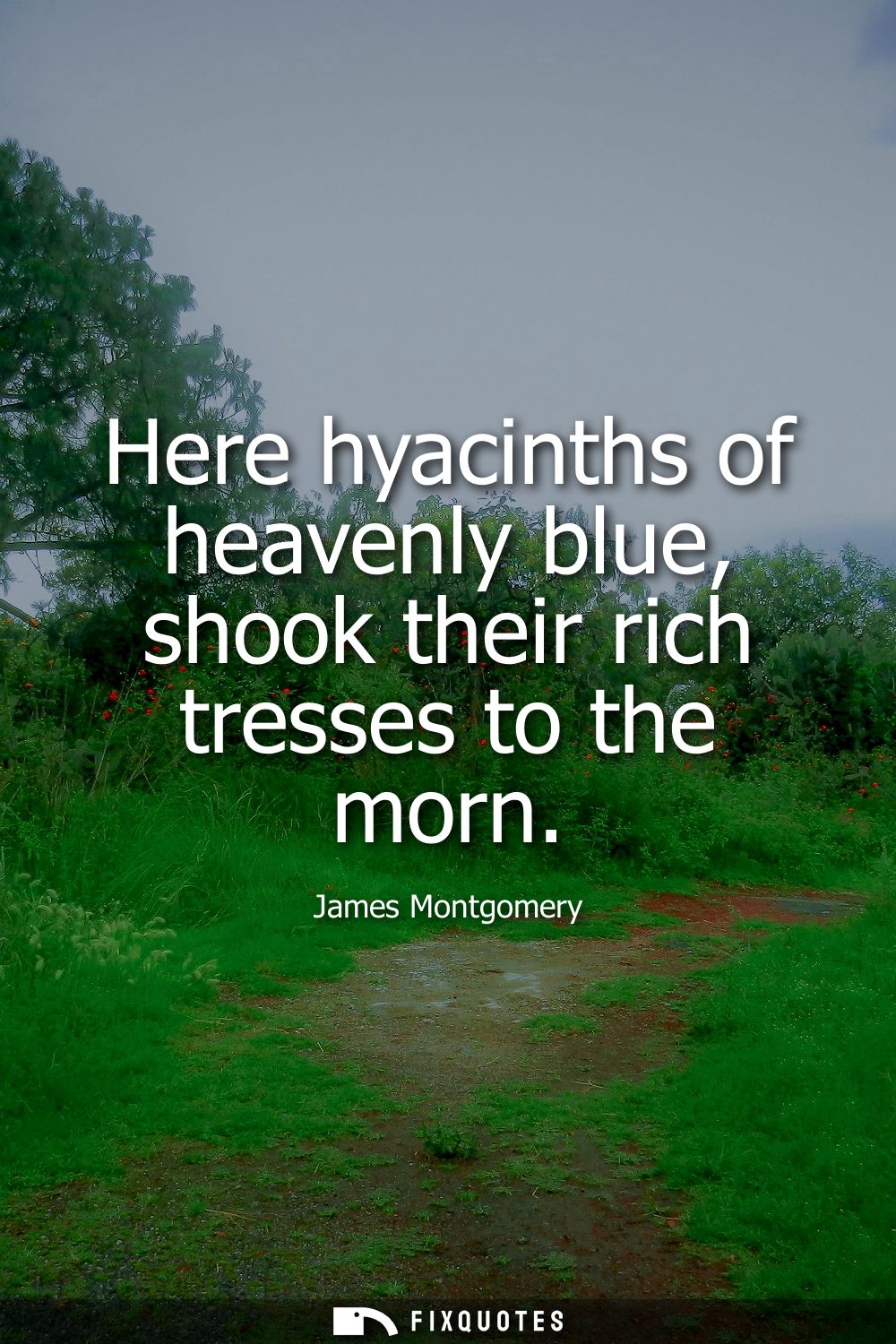
"Here hyacinths of heavenly blue, shook their rich tresses to the morn"
About this Quote
The line’s real engine is the anthropomorphism: the hyacinths “shook their rich tresses to the morn.” Flowers become young women, or at least a feminized figure of beauty, with “tresses” implying hair, vitality, and a kind of conscious display. “Rich” suggests lushness and sensory surplus, but it also smuggles in social texture: richness is a human category, a word from the world of goods and status. Montgomery makes the garden speak the language of culture, not botany, which is precisely the point. He wants a reader to feel that creation is legible, groomed, expressive.
“Morn” matters too. Morning is when the world looks newly made, before labor and history press down. In early 19th-century British verse, that freshness often stands in for spiritual renewal, a quiet corrective to industrial modernity’s grime and speed. The subtext is pastoral reassurance: there exists a realm where beauty rises naturally, where even a simple flower behaves like praise.
Quote Details
| Topic | Nature |
|---|---|
| Source | Help us find the source |
| Cite |
Citation Formats
APA Style (7th ed.)
Montgomery, James. (2026, January 16). Here hyacinths of heavenly blue, shook their rich tresses to the morn. FixQuotes. https://fixquotes.com/quotes/here-hyacinths-of-heavenly-blue-shook-their-rich-135132/
Chicago Style
Montgomery, James. "Here hyacinths of heavenly blue, shook their rich tresses to the morn." FixQuotes. January 16, 2026. https://fixquotes.com/quotes/here-hyacinths-of-heavenly-blue-shook-their-rich-135132/.
MLA Style (9th ed.)
"Here hyacinths of heavenly blue, shook their rich tresses to the morn." FixQuotes, 16 Jan. 2026, https://fixquotes.com/quotes/here-hyacinths-of-heavenly-blue-shook-their-rich-135132/. Accessed 29 Mar. 2026.