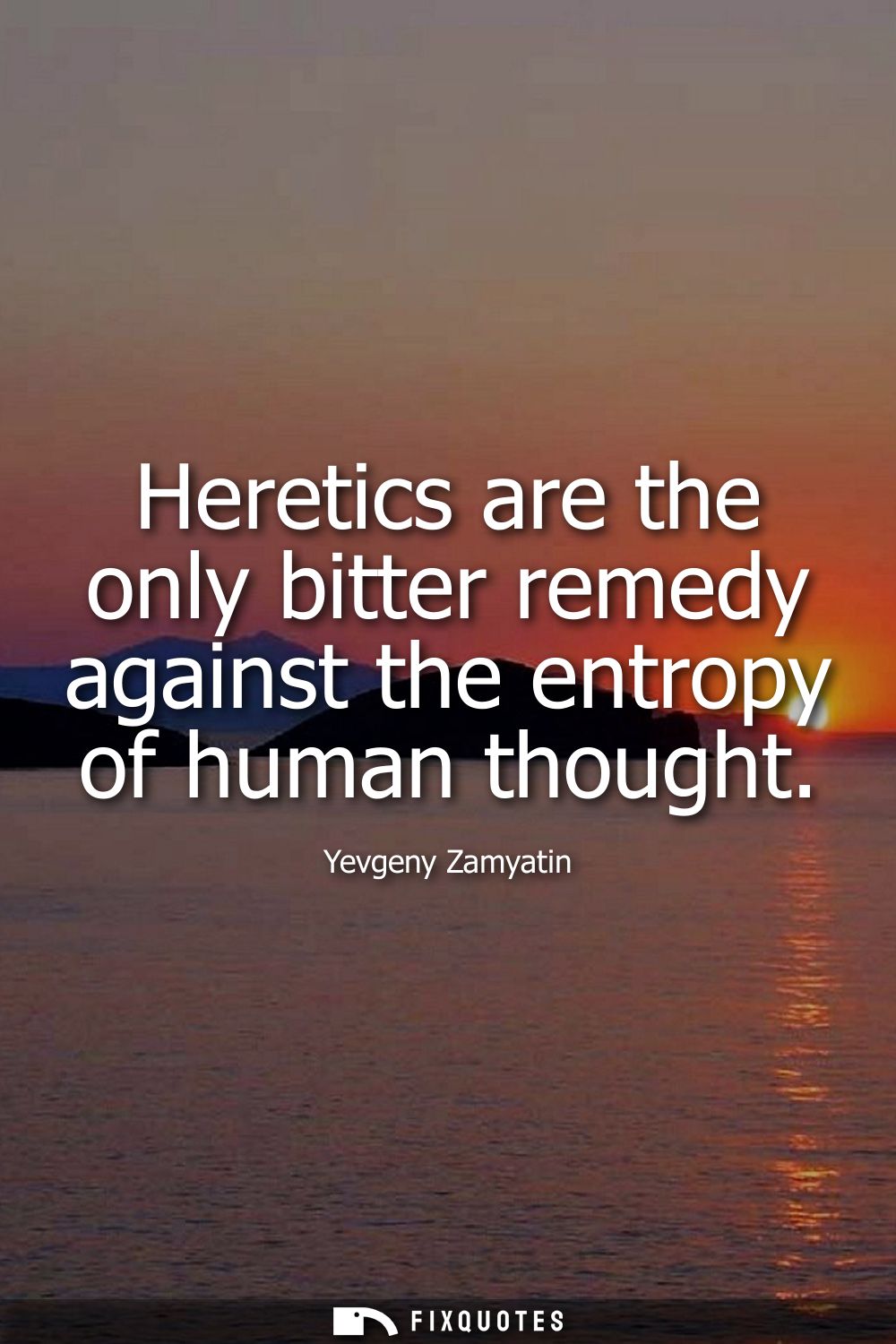
"Heretics are the only bitter remedy against the entropy of human thought"
About this Quote
The “bitter remedy” is doing a lot of moral work. Remedies can be unpleasant and still necessary; bitterness signals both the cost to the dissenter (ostracism, punishment) and the cost to the community (instability, offense, the stress of rethinking). Zamyatin doesn’t romanticize rebellion as pure or fun. He frames it as medicine you take because the alternative is worse: a tranquilized society that mistakes consensus for truth.
Context sharpens the stakes. Zamyatin lived through the Russian Revolution and the tightening ideological discipline that followed, and he wrote We as a warning about a future where rational planning becomes spiritual suffocation. In that light, “heretic” reads as artist, scientist, or citizen refusing the state-approved script. The subtext is blunt: orthodoxy is not a neutral default; it is a machine that produces intellectual decay. Heresy is the only antidote strong enough to sting.
Quote Details
| Topic | Deep |
|---|---|
| Source | Help us find the source |
| Cite |
Citation Formats
APA Style (7th ed.)
Zamyatin, Yevgeny. (2026, January 15). Heretics are the only bitter remedy against the entropy of human thought. FixQuotes. https://fixquotes.com/quotes/heretics-are-the-only-bitter-remedy-against-the-7211/
Chicago Style
Zamyatin, Yevgeny. "Heretics are the only bitter remedy against the entropy of human thought." FixQuotes. January 15, 2026. https://fixquotes.com/quotes/heretics-are-the-only-bitter-remedy-against-the-7211/.
MLA Style (9th ed.)
"Heretics are the only bitter remedy against the entropy of human thought." FixQuotes, 15 Jan. 2026, https://fixquotes.com/quotes/heretics-are-the-only-bitter-remedy-against-the-7211/. Accessed 6 Apr. 2026.