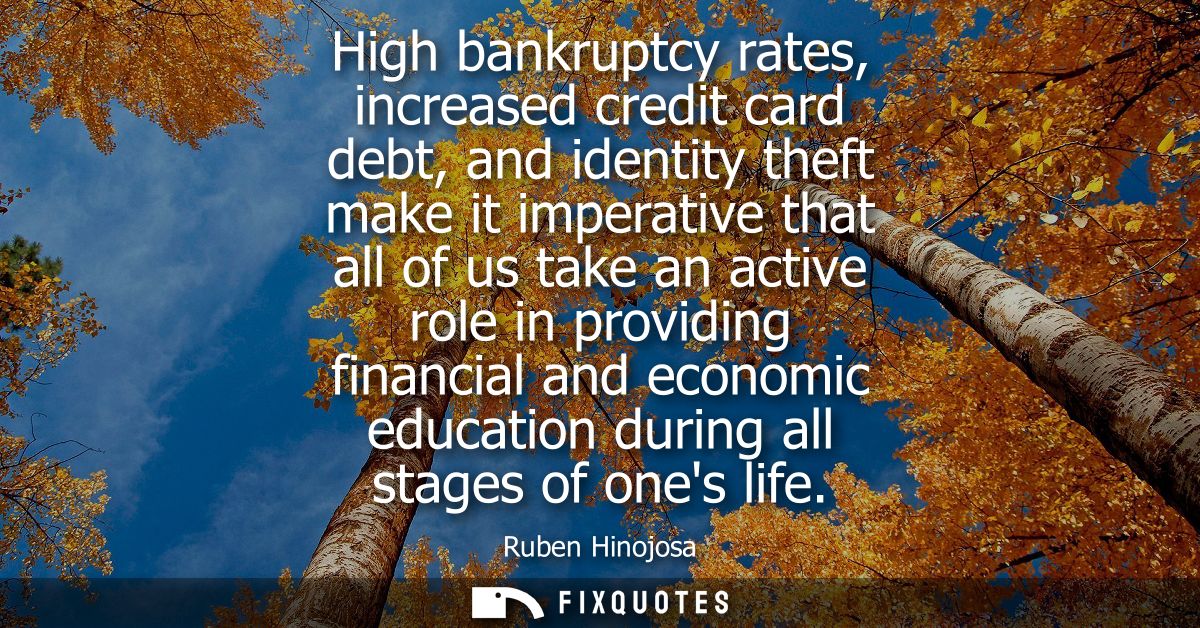
"High bankruptcy rates, increased credit card debt, and identity theft make it imperative that all of us take an active role in providing financial and economic education during all stages of one's life"
About this Quote
The key maneuver is the phrase “imperative that all of us.” It spreads accountability across the whole community, which sounds generous, but also strategically vague. “All of us” can mean schools, parents, employers, banks, nonprofits, and government agencies - everyone and no one at once. That ambiguity is useful in politics: it invites consensus without naming the harder fights, like regulating predatory lending, simplifying consumer disclosures, or strengthening enforcement against fraud. Education is the least controversial tool in the toolbox, and often the cheapest.
“During all stages of one’s life” nods to a reality lawmakers increasingly acknowledge: financial literacy isn’t a one-time class. It’s a moving target shaped by new products, new scams, gig work volatility, and the steady shift of retirement risk from institutions to individuals. The subtext is pragmatic and a little bleak: modern citizenship now includes decoding fine print, or paying for it.
Quote Details
| Topic | Money |
|---|---|
| Source | Help us find the source |
| Cite |
Citation Formats
APA Style (7th ed.)
Hinojosa, Ruben. (2026, January 16). High bankruptcy rates, increased credit card debt, and identity theft make it imperative that all of us take an active role in providing financial and economic education during all stages of one's life. FixQuotes. https://fixquotes.com/quotes/high-bankruptcy-rates-increased-credit-card-debt-83414/
Chicago Style
Hinojosa, Ruben. "High bankruptcy rates, increased credit card debt, and identity theft make it imperative that all of us take an active role in providing financial and economic education during all stages of one's life." FixQuotes. January 16, 2026. https://fixquotes.com/quotes/high-bankruptcy-rates-increased-credit-card-debt-83414/.
MLA Style (9th ed.)
"High bankruptcy rates, increased credit card debt, and identity theft make it imperative that all of us take an active role in providing financial and economic education during all stages of one's life." FixQuotes, 16 Jan. 2026, https://fixquotes.com/quotes/high-bankruptcy-rates-increased-credit-card-debt-83414/. Accessed 29 Mar. 2026.