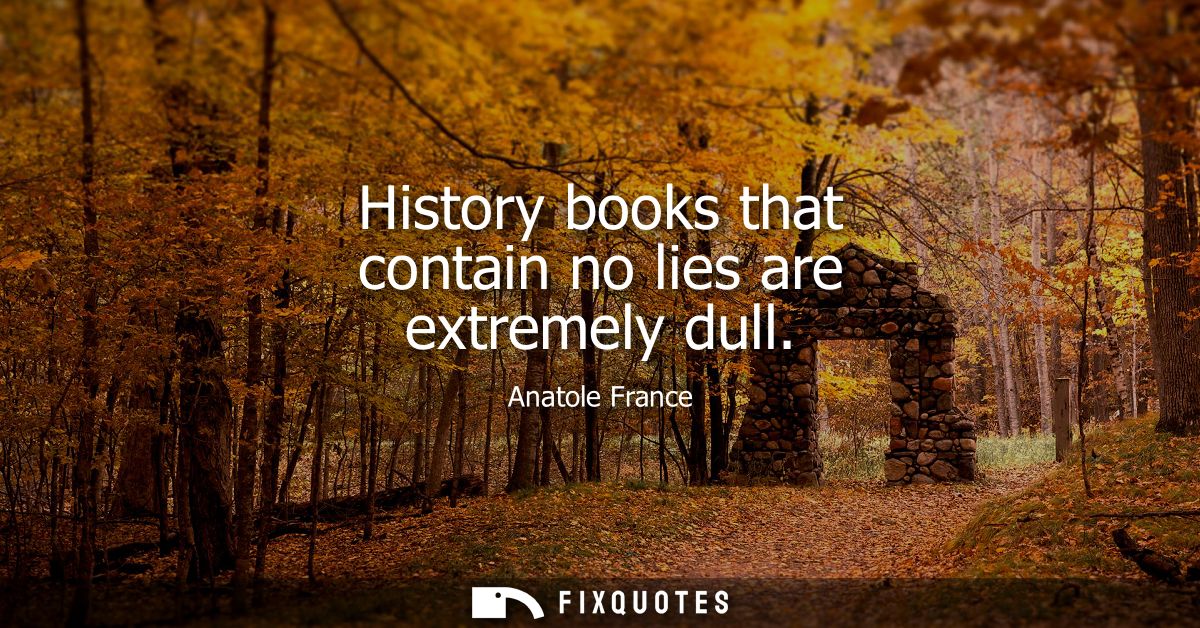
"History books that contain no lies are extremely dull"
About this Quote
Anatole France weaponizes boredom as a moral indictment. If a history book contains "no lies" and is therefore "extremely dull", the joke lands because it flips the pious assumption that truth is inherently compelling. France, a novelist with a skeptic's eye for civic mythmaking, is needling two institutions at once: the historian who pretends to pure objectivity, and the reader who secretly wants narrative heat more than archival accuracy.
The line works because "lies" here is doing double duty. It means outright falsifications, yes, but it also hints at the softer, socially sanctioned distortions that make the past readable: heroic arcs, clean causality, villains conveniently concentrated in one camp, national stories that sound like destiny instead of contingency. A perfectly honest history would have to admit what we hate admitting: motives are mixed, records are incomplete, outcomes are often accidental, and any single account is a selection with sharp edges sanded down. That kind of candor is "dull" only if you're expecting entertainment - or moral reassurance.
Context sharpens the cynicism. France lived through the Third Republic and the Dreyfus Affair, when "History" wasn't neutral scholarship but a battlefield of propaganda, antisemitism, and institutional self-protection. In that climate, truth-telling wasn't just difficult; it was disruptive. The aphorism doesn't celebrate lying so much as expose how much of what passes for historical "interest" is paid for with distortion. It's a warning dressed as a shrug: if you demand a gripping past, check the invoice for what got invented.
The line works because "lies" here is doing double duty. It means outright falsifications, yes, but it also hints at the softer, socially sanctioned distortions that make the past readable: heroic arcs, clean causality, villains conveniently concentrated in one camp, national stories that sound like destiny instead of contingency. A perfectly honest history would have to admit what we hate admitting: motives are mixed, records are incomplete, outcomes are often accidental, and any single account is a selection with sharp edges sanded down. That kind of candor is "dull" only if you're expecting entertainment - or moral reassurance.
Context sharpens the cynicism. France lived through the Third Republic and the Dreyfus Affair, when "History" wasn't neutral scholarship but a battlefield of propaganda, antisemitism, and institutional self-protection. In that climate, truth-telling wasn't just difficult; it was disruptive. The aphorism doesn't celebrate lying so much as expose how much of what passes for historical "interest" is paid for with distortion. It's a warning dressed as a shrug: if you demand a gripping past, check the invoice for what got invented.
Quote Details
| Topic | Truth |
|---|---|
| Source | Help us find the source |
| Cite |
Citation Formats
APA Style (7th ed.)
France, Anatole. (2026, January 18). History books that contain no lies are extremely dull. FixQuotes. https://fixquotes.com/quotes/history-books-that-contain-no-lies-are-extremely-4225/
Chicago Style
France, Anatole. "History books that contain no lies are extremely dull." FixQuotes. January 18, 2026. https://fixquotes.com/quotes/history-books-that-contain-no-lies-are-extremely-4225/.
MLA Style (9th ed.)
"History books that contain no lies are extremely dull." FixQuotes, 18 Jan. 2026, https://fixquotes.com/quotes/history-books-that-contain-no-lies-are-extremely-4225/. Accessed 8 Apr. 2026.
More Quotes by Anatole
Add to List