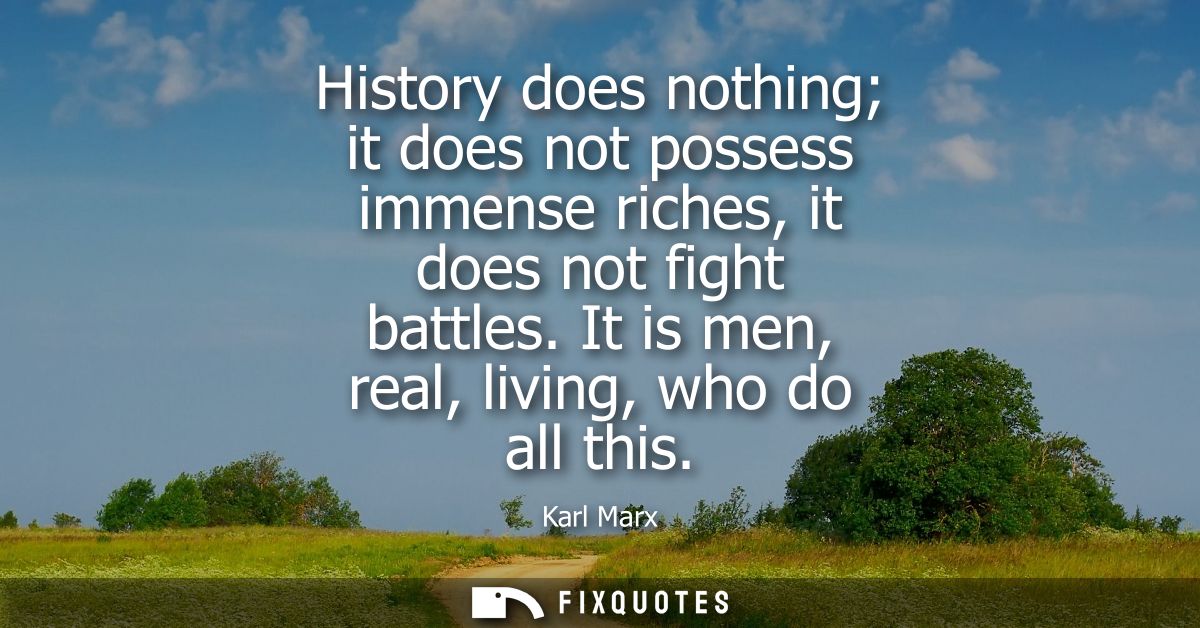
"History does nothing; it does not possess immense riches, it does not fight battles. It is men, real, living, who do all this"
About this Quote
The subtext is a warning about how narratives get weaponized. “History” becomes the perfect ventriloquist’s dummy for elites and states: wars are “inevitable,” inequality is “the tide of progress,” suffering is “the price of modernization.” Marx insists that those are choices made by people inside institutions, under pressures they didn’t choose but can still contest.
Context matters: Marx is arguing against versions of German idealism that treat History as a quasi-spiritual force unfolding toward freedom. He’s also sharpening his own historical materialism: yes, individuals act, but they act within material conditions - property relations, labor systems, class power - that shape what’s thinkable and doable. The line lands because it refuses both fatalism and hero worship. It doesn’t replace “Great Men” theory with “Great History” theory; it drags both back to earth. Agency is human, and that makes responsibility unavoidable.
Quote Details
| Topic | Deep |
|---|---|
| Source | Evidence: ... Karl Marx put it : " History does nothing ; it does not possess immense riches , it does not fight battles . It is men , real , living , who do all this . " Chuck Stephens | Collapseology This word was coined by the Los Angeles Times. Other candidates (1) The Holy Family, or Critique of Critical Critique (Karl Marx, 1845)95.0% History does nothing, it “possesses no immense wealth”, it “wages no battles”. It is man, real, living man who does a... |
| Cite |
Citation Formats
APA Style (7th ed.)
Marx, Karl. (2026, March 14). History does nothing; it does not possess immense riches, it does not fight battles. It is men, real, living, who do all this. FixQuotes. https://fixquotes.com/quotes/history-does-nothing-it-does-not-possess-immense-346/
Chicago Style
Marx, Karl. "History does nothing; it does not possess immense riches, it does not fight battles. It is men, real, living, who do all this." FixQuotes. March 14, 2026. https://fixquotes.com/quotes/history-does-nothing-it-does-not-possess-immense-346/.
MLA Style (9th ed.)
"History does nothing; it does not possess immense riches, it does not fight battles. It is men, real, living, who do all this." FixQuotes, 14 Mar. 2026, https://fixquotes.com/quotes/history-does-nothing-it-does-not-possess-immense-346/. Accessed 25 Mar. 2026.