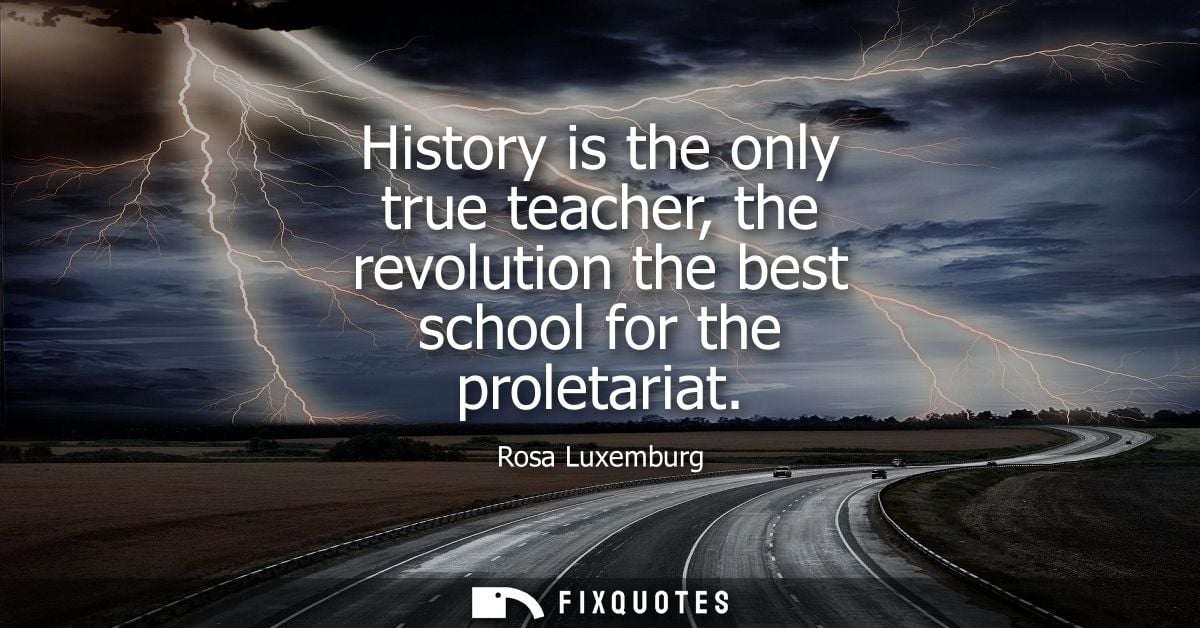
"History is the only true teacher, the revolution the best school for the proletariat"
About this Quote
Then she sharpens the blade: “the revolution the best school for the proletariat.” School is an intentionally domesticated metaphor, and she flips it. Revolution becomes a mass education in solidarity, strategy, and self-government - not because someone lectures, but because people are forced to solve real problems together: distribution, coordination, discipline, dissent. It’s also a rebuke to paternalistic vanguards. The proletariat doesn’t need to be “raised” to consciousness by professionals; it learns by doing, and it learns fast when the stakes are food, freedom, and survival.
The context matters: Luxemburg, writing in the shadow of failed uprisings and the coming catastrophe of World War I, distrusted bureaucratic socialism as much as she despised capitalist repression. The line carries her signature insistence that emancipation can’t be administered from above. It has to be earned in the messy, corrective, sometimes tragic classroom of collective struggle - where mistakes hurt, but passivity kills.
Quote Details
| Topic | Equality |
|---|---|
| Source | Help us find the source |
| Cite |
Citation Formats
APA Style (7th ed.)
Luxemburg, Rosa. (2026, January 15). History is the only true teacher, the revolution the best school for the proletariat. FixQuotes. https://fixquotes.com/quotes/history-is-the-only-true-teacher-the-revolution-71375/
Chicago Style
Luxemburg, Rosa. "History is the only true teacher, the revolution the best school for the proletariat." FixQuotes. January 15, 2026. https://fixquotes.com/quotes/history-is-the-only-true-teacher-the-revolution-71375/.
MLA Style (9th ed.)
"History is the only true teacher, the revolution the best school for the proletariat." FixQuotes, 15 Jan. 2026, https://fixquotes.com/quotes/history-is-the-only-true-teacher-the-revolution-71375/. Accessed 5 Apr. 2026.