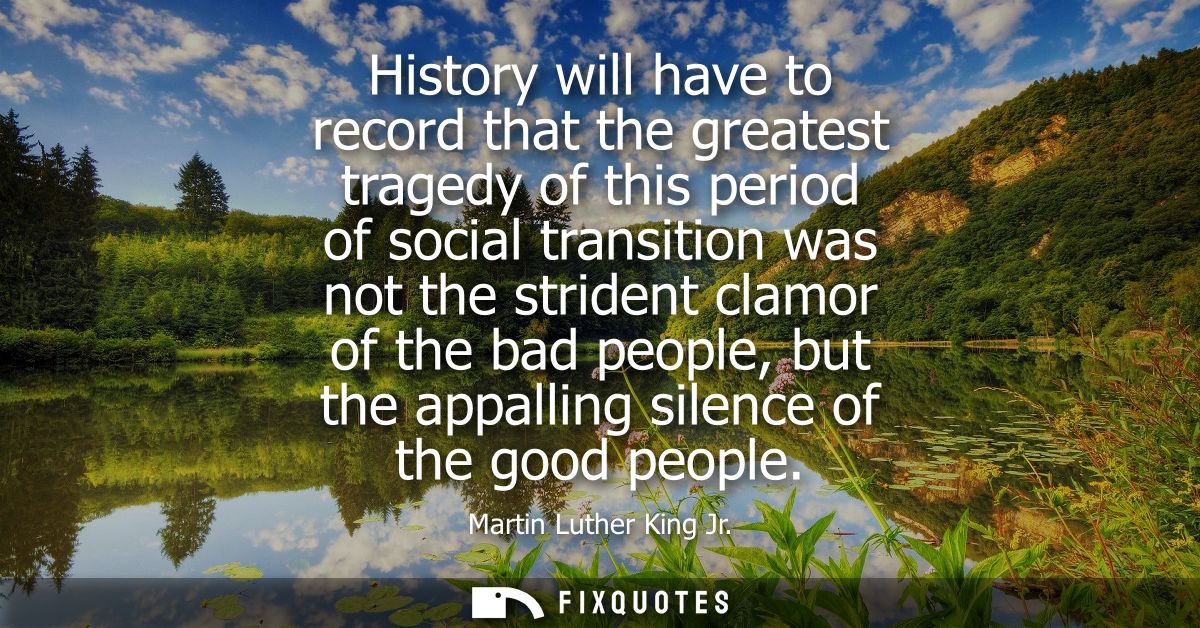
"History will have to record that the greatest tragedy of this period of social transition was not the strident clamor of the bad people, but the appalling silence of the good people"
About this Quote
King is doing something more dangerous than condemning the obvious villains: he is indicting the audience that would rather imagine itself innocent. The line pivots on a moral jujitsu move. “Strident clamor” makes the “bad people” sound almost predictable, even tedious - the noise you expect from segregationists, demagogues, and men who confuse dominance with order. The shock lands on “appalling silence,” a phrase that turns absence into an active force. Silence isn’t neutral here; it’s collaboration by comfort.
The specific intent is pressure, not poetry. King is speaking into a “period of social transition” where moderation marketed itself as prudence: wait, be patient, don’t “agitate,” trust the process. He rejects that alibi. By insisting “history will have to record,” he drags the present into a future tribunal. It’s a preacher’s cadence, but also a strategist’s leverage: he wants institutions, churches, and respectable liberals to fear the moral judgment they can’t control.
The subtext is that evil rarely wins by persuasion; it wins by exhaustion. “Good people” are not absolved by private decency if their public behavior is quiet. In the civil rights context - police violence, legal segregation, and the genteel language of “law and order” - King’s target is the neighbor who dislikes racism yet dislikes disruption more. The tragedy, he implies, is not cruelty’s volume but conscience’s muting.
The specific intent is pressure, not poetry. King is speaking into a “period of social transition” where moderation marketed itself as prudence: wait, be patient, don’t “agitate,” trust the process. He rejects that alibi. By insisting “history will have to record,” he drags the present into a future tribunal. It’s a preacher’s cadence, but also a strategist’s leverage: he wants institutions, churches, and respectable liberals to fear the moral judgment they can’t control.
The subtext is that evil rarely wins by persuasion; it wins by exhaustion. “Good people” are not absolved by private decency if their public behavior is quiet. In the civil rights context - police violence, legal segregation, and the genteel language of “law and order” - King’s target is the neighbor who dislikes racism yet dislikes disruption more. The tragedy, he implies, is not cruelty’s volume but conscience’s muting.
Quote Details
| Topic | Justice |
|---|---|
| Source | Help us find the source |
More Quotes by Martin
Add to List