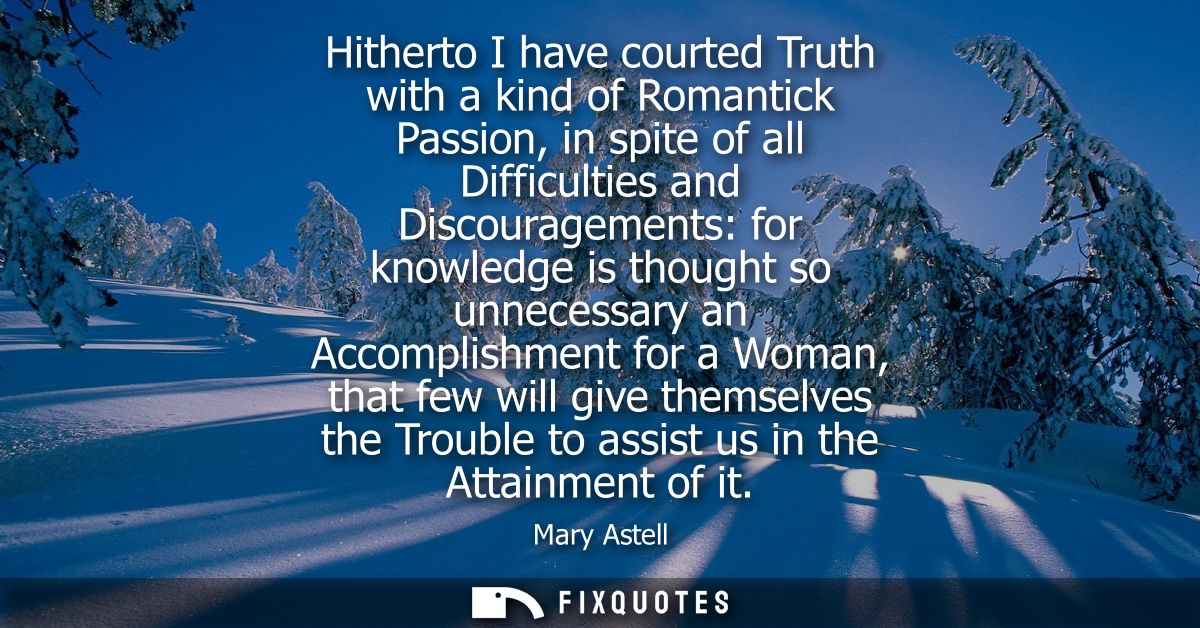
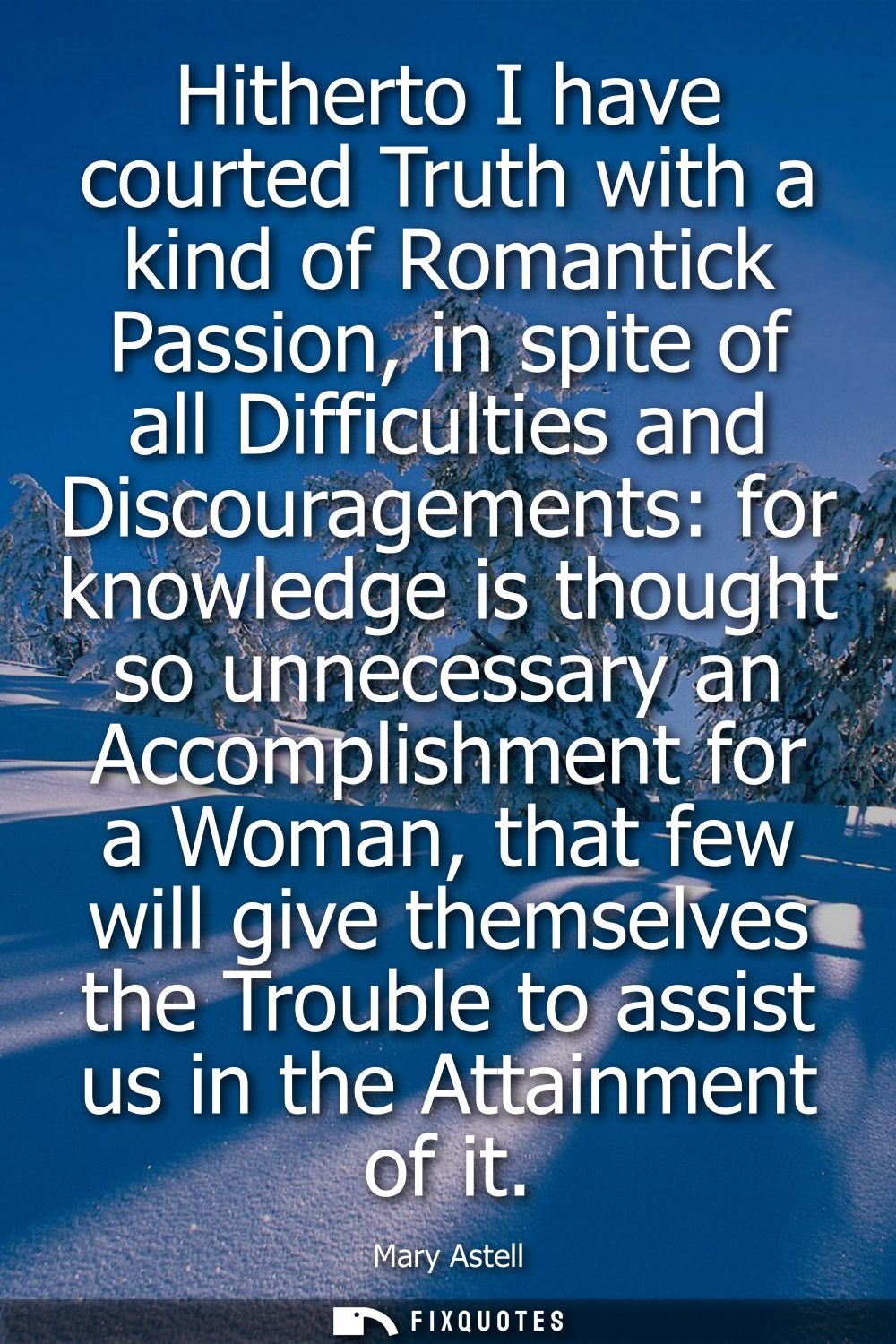
"Hitherto I have courted Truth with a kind of Romantick Passion, in spite of all Difficulties and Discouragements: for knowledge is thought so unnecessary an Accomplishment for a Woman, that few will give themselves the Trouble to assist us in the Attainment of it"
About this Quote
The sting lands in her cool diagnosis of the system around her. "Knowledge is thought so unnecessary an Accomplishment for a Woman" looks like a polite observation; it's an indictment disguised as etiquette. "Accomplishment" was the word of finishing schools and drawing rooms, the ornamental skills women were permitted to display. Astell exposes the fraud: knowledge isn't merely absent from the curriculum, it's actively reclassified as needless, so the lack can be blamed on women rather than on gatekeepers.
Then comes the quiet cruelty of the final clause: "few will give themselves the Trouble to assist us". Her subtext isn't that women are incapable; it's that male effort is rationed by ideology. Denial of education is framed as laziness, practicality, even benevolence. Astell makes it sound petty because it is petty: the intellectual deprivation of half the population justified as not worth the inconvenience.
Context matters: writing in late Stuart England, Astell is among the first English feminists to argue for women's education not as a radical novelty but as a moral and rational necessity. The rhetorical brilliance is that she doesn't beg for entry; she exposes how absurd the locked door looks from the outside.
Quote Details
| Topic | Knowledge |
|---|---|
| Source | A Serious Proposal to the Ladies, Mary Astell, 1694. (Work containing the passage beginning "Hitherto I have courted Truth...") |
| Cite |
Citation Formats
APA Style (7th ed.)
Astell, Mary. (2026, January 16). Hitherto I have courted Truth with a kind of Romantick Passion, in spite of all Difficulties and Discouragements: for knowledge is thought so unnecessary an Accomplishment for a Woman, that few will give themselves the Trouble to assist us in the Attainment of it. FixQuotes. https://fixquotes.com/quotes/hitherto-i-have-courted-truth-with-a-kind-of-88032/
Chicago Style
Astell, Mary. "Hitherto I have courted Truth with a kind of Romantick Passion, in spite of all Difficulties and Discouragements: for knowledge is thought so unnecessary an Accomplishment for a Woman, that few will give themselves the Trouble to assist us in the Attainment of it." FixQuotes. January 16, 2026. https://fixquotes.com/quotes/hitherto-i-have-courted-truth-with-a-kind-of-88032/.
MLA Style (9th ed.)
"Hitherto I have courted Truth with a kind of Romantick Passion, in spite of all Difficulties and Discouragements: for knowledge is thought so unnecessary an Accomplishment for a Woman, that few will give themselves the Trouble to assist us in the Attainment of it." FixQuotes, 16 Jan. 2026, https://fixquotes.com/quotes/hitherto-i-have-courted-truth-with-a-kind-of-88032/. Accessed 2 Apr. 2026.