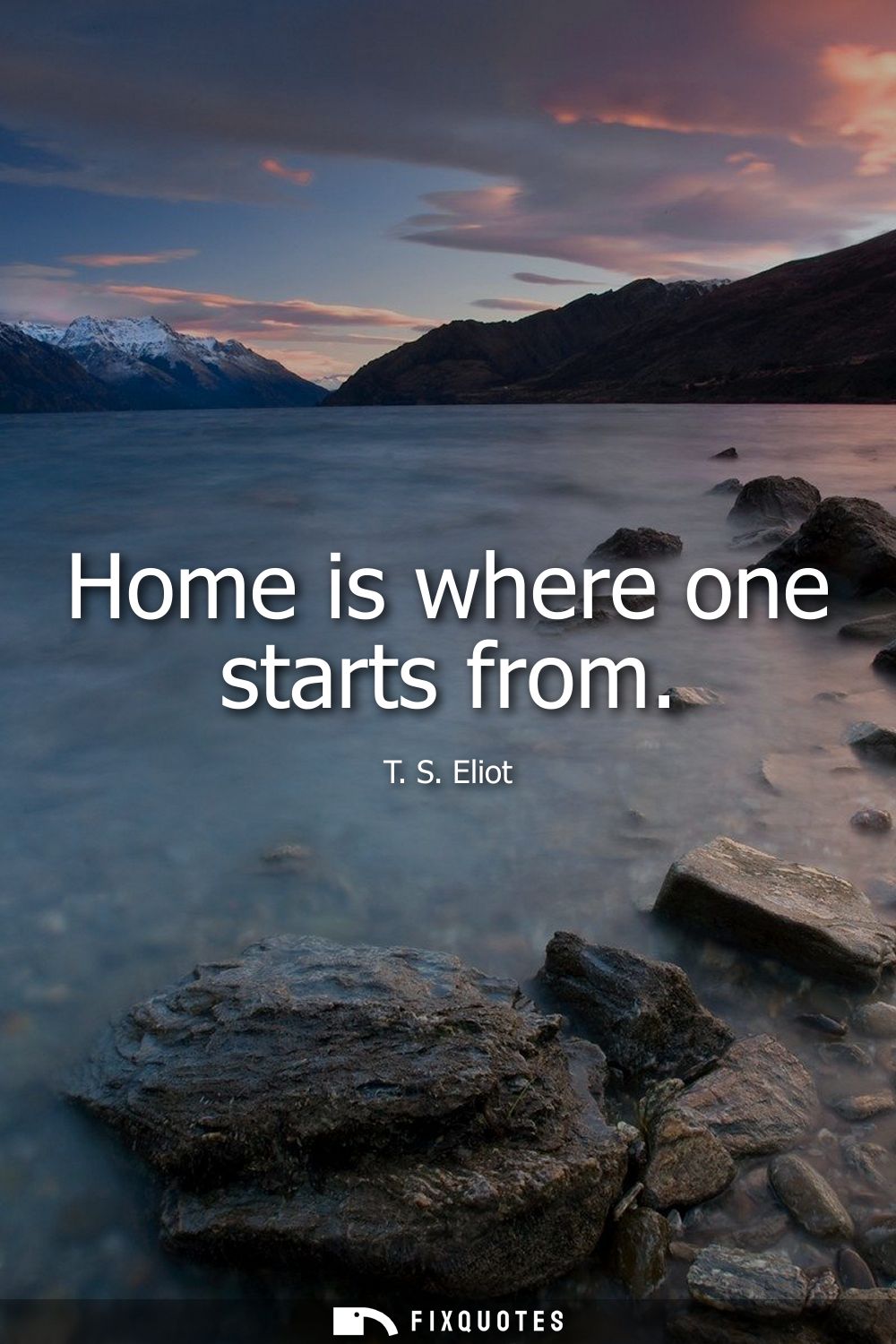
"Home is where one starts from"
About this Quote
A four-word sentence that pretends to be obvious, then quietly detonates. Eliot frames “home” not as a destination but as an origin point, which reverses the usual sentimental gravity of the word. We’re trained to think of home as where you end up: safety, belonging, closure. Eliot’s line insists it’s where you begin - the place that launches you into motion, into history, into the compromises of adulthood. That tiny shift turns home from a comforting noun into a kind of psychological engine.
The intent is characteristically Eliot: to expose how modern identity is built out of departures. “Starts” carries a double charge. It’s literal (the first coordinates of your life) and existential (the baseline assumptions you can’t fully audit: class, language, faith, family myth). “From” matters too; it suggests vector, direction, escape velocity. Home is a point you move away from, and therefore the thing you can never stop measuring yourself against.
Context sharpens the edge. Eliot, the American expatriate who remade himself in Britain, knew home as both inheritance and problem - a site of origins that can feel like a script you’re trying to outwrite. Written in the shadow of war and dislocation, the line also reads as a cool rebuttal to nationalism’s cozy rhetoric: “home” isn’t a flag you wrap around yourself, it’s the place that made you, whether you like it or not. The subtext is unsentimental: you don’t find home; you spend your life negotiating the fact that it started you.
The intent is characteristically Eliot: to expose how modern identity is built out of departures. “Starts” carries a double charge. It’s literal (the first coordinates of your life) and existential (the baseline assumptions you can’t fully audit: class, language, faith, family myth). “From” matters too; it suggests vector, direction, escape velocity. Home is a point you move away from, and therefore the thing you can never stop measuring yourself against.
Context sharpens the edge. Eliot, the American expatriate who remade himself in Britain, knew home as both inheritance and problem - a site of origins that can feel like a script you’re trying to outwrite. Written in the shadow of war and dislocation, the line also reads as a cool rebuttal to nationalism’s cozy rhetoric: “home” isn’t a flag you wrap around yourself, it’s the place that made you, whether you like it or not. The subtext is unsentimental: you don’t find home; you spend your life negotiating the fact that it started you.
Quote Details
| Topic | New Beginnings |
|---|---|
| Source | Help us find the source |
| Cite |
Citation Formats
APA Style (7th ed.)
Eliot, T. S. (2026, January 15). Home is where one starts from. FixQuotes. https://fixquotes.com/quotes/home-is-where-one-starts-from-22305/
Chicago Style
Eliot, T. S. "Home is where one starts from." FixQuotes. January 15, 2026. https://fixquotes.com/quotes/home-is-where-one-starts-from-22305/.
MLA Style (9th ed.)
"Home is where one starts from." FixQuotes, 15 Jan. 2026, https://fixquotes.com/quotes/home-is-where-one-starts-from-22305/. Accessed 26 Mar. 2026.
More Quotes by S. Eliot
Add to List