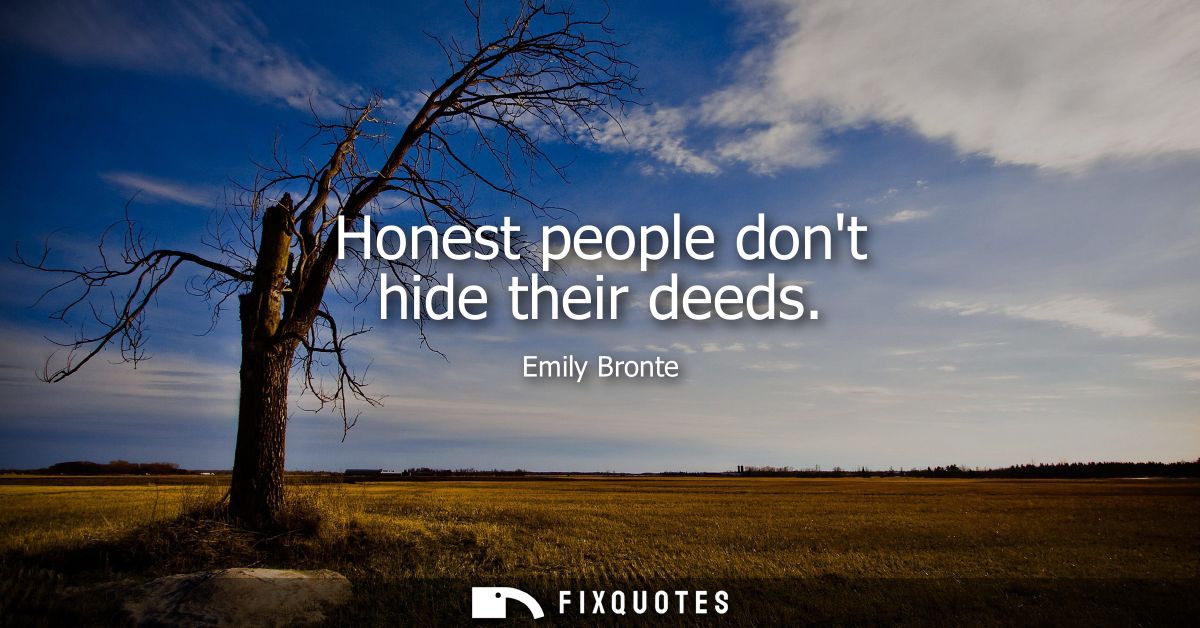
"Honest people don't hide their deeds"
About this Quote
“Honest people don’t hide their deeds” lands with the blunt moral clarity of a maxim, but Bronte’s fiction makes it feel less like a churchyard inscription and more like a dare. The line assumes a world where virtue and transparency line up neatly: if your actions are clean, you can bear daylight. That’s the surface. The sharper subtext is that hiding is never neutral. Secrecy isn’t just a practical choice; it’s evidence, a shadow cast backward onto the act itself.
Coming from Bronte, a novelist obsessed with the private storms people call love, loyalty, and revenge, the sentence also reads as a provocation aimed at her era’s polite hypocrisy. Victorian respectability relied on strategic concealment: the performance of decency mattered as much as decency. Bronte’s phrasing refuses that bargain. “Deeds,” not “thoughts,” keeps the focus on consequences, on what you do in the world rather than what you wish you were. And “don’t” carries an implicit accusation: if you are hiding, you are already indicting yourself.
What makes it work is its weaponized simplicity. It doesn’t argue; it categorizes. You’re either honest and unafraid, or you’re not. That absolutism is emotionally satisfying and socially dangerous, because it ignores the real reasons people conceal: fear, coercion, survival, the desire to protect others. Bronte’s line pressures the reader to ask an uncomfortable question: am I keeping a secret because the world is cruel, or because I am?
Coming from Bronte, a novelist obsessed with the private storms people call love, loyalty, and revenge, the sentence also reads as a provocation aimed at her era’s polite hypocrisy. Victorian respectability relied on strategic concealment: the performance of decency mattered as much as decency. Bronte’s phrasing refuses that bargain. “Deeds,” not “thoughts,” keeps the focus on consequences, on what you do in the world rather than what you wish you were. And “don’t” carries an implicit accusation: if you are hiding, you are already indicting yourself.
What makes it work is its weaponized simplicity. It doesn’t argue; it categorizes. You’re either honest and unafraid, or you’re not. That absolutism is emotionally satisfying and socially dangerous, because it ignores the real reasons people conceal: fear, coercion, survival, the desire to protect others. Bronte’s line pressures the reader to ask an uncomfortable question: am I keeping a secret because the world is cruel, or because I am?
Quote Details
| Topic | Honesty & Integrity |
|---|---|
| Source | Help us find the source |
| Cite |
Citation Formats
APA Style (7th ed.)
Bronte, Emily. (2026, January 18). Honest people don't hide their deeds. FixQuotes. https://fixquotes.com/quotes/honest-people-dont-hide-their-deeds-15156/
Chicago Style
Bronte, Emily. "Honest people don't hide their deeds." FixQuotes. January 18, 2026. https://fixquotes.com/quotes/honest-people-dont-hide-their-deeds-15156/.
MLA Style (9th ed.)
"Honest people don't hide their deeds." FixQuotes, 18 Jan. 2026, https://fixquotes.com/quotes/honest-people-dont-hide-their-deeds-15156/. Accessed 25 Mar. 2026.
More Quotes by Emily
Add to List