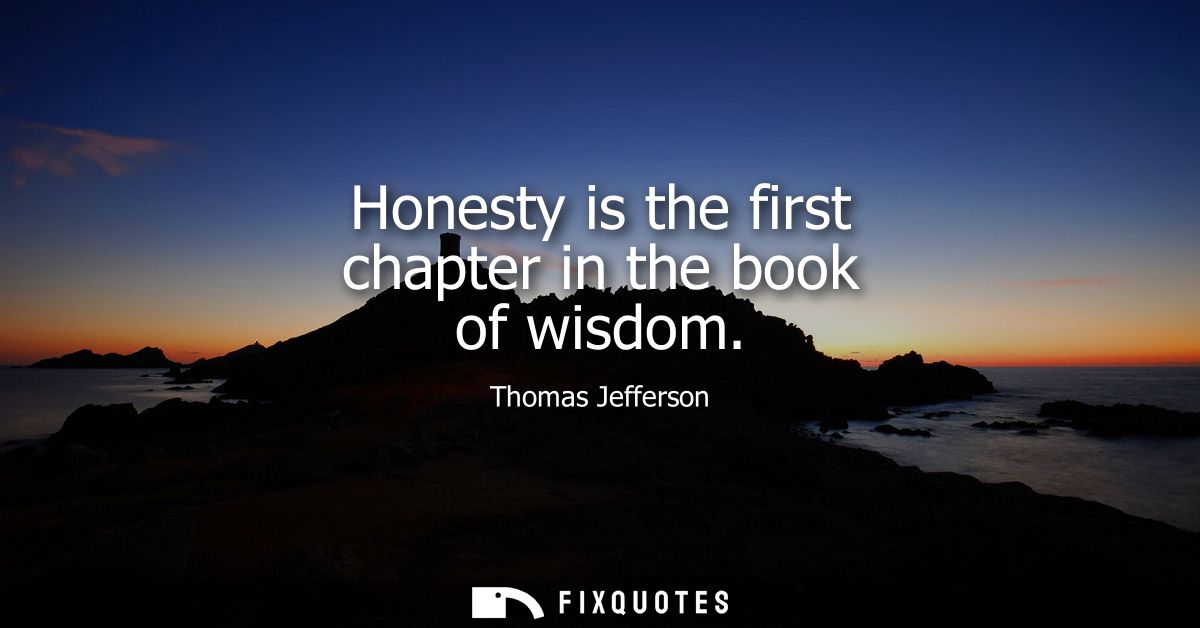
"Honesty is the first chapter in the book of wisdom"
About this Quote
Jefferson’s line turns a private virtue into a civic technology. Calling honesty the "first chapter" doesn’t just praise truth-telling; it frames it as a prerequisite for everything that follows, the basic literacy of a functioning republic. The metaphor matters: wisdom isn’t an inborn glow, it’s an acquired text, assembled over time. You don’t jump to the grand arguments about rights, liberty, or governance until you can manage the opening pages without self-deception.
The subtext is political as much as moral. In a new nation trying to justify its legitimacy, honesty becomes a form of public infrastructure: without it, consent is a sham, debate is theater, and leadership is just performance with better stationery. Jefferson is also slyly setting a standard for authority. If wisdom is a book, then leaders are not prophets; they’re readers and editors, accountable to evidence, contradiction, and revision.
Context complicates the elegance. Jefferson was a master rhetorician of Enlightenment clarity, but also a man whose life exposed deep fractures between principle and practice, especially around slavery. That tension doesn’t cancel the line; it sharpens it. The phrase can read like aspiration, even self-exhortation: honesty as the opening chapter he wants the country (and maybe himself) to keep rereading.
What makes it work is its quiet severity. It flatters no one. It implies that without honesty, you’re not merely immoral; you’re illiterate in the language of wisdom.
The subtext is political as much as moral. In a new nation trying to justify its legitimacy, honesty becomes a form of public infrastructure: without it, consent is a sham, debate is theater, and leadership is just performance with better stationery. Jefferson is also slyly setting a standard for authority. If wisdom is a book, then leaders are not prophets; they’re readers and editors, accountable to evidence, contradiction, and revision.
Context complicates the elegance. Jefferson was a master rhetorician of Enlightenment clarity, but also a man whose life exposed deep fractures between principle and practice, especially around slavery. That tension doesn’t cancel the line; it sharpens it. The phrase can read like aspiration, even self-exhortation: honesty as the opening chapter he wants the country (and maybe himself) to keep rereading.
What makes it work is its quiet severity. It flatters no one. It implies that without honesty, you’re not merely immoral; you’re illiterate in the language of wisdom.
Quote Details
| Topic | Honesty & Integrity |
|---|---|
| Source | Help us find the source |
More Quotes by Thomas
Add to List