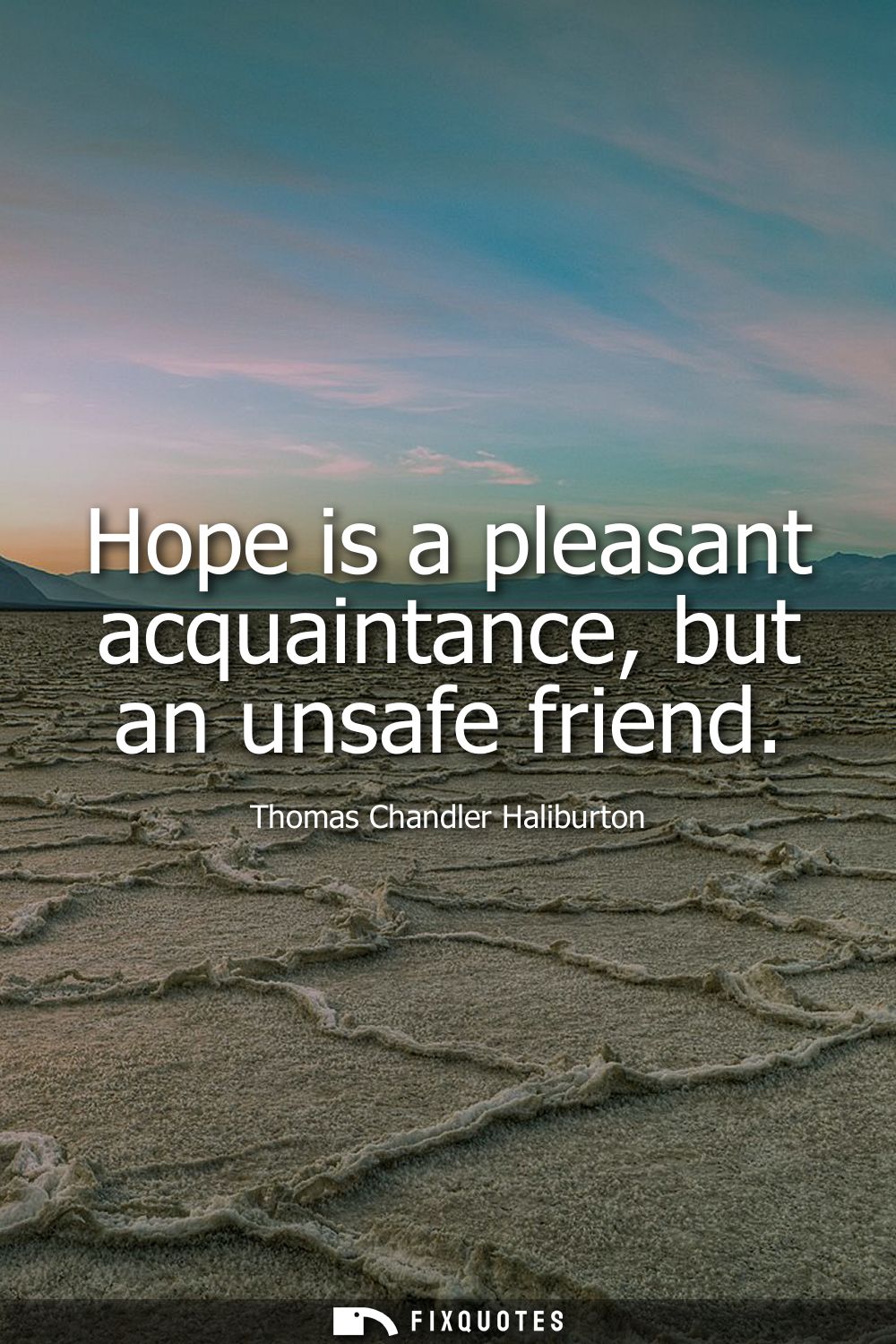
"Hope is a pleasant acquaintance, but an unsafe friend"
About this Quote
Hope gets demoted here from guiding light to charming liability. Haliburton’s line works because it flatters the reader’s realism while quietly indicting the kind of optimism that substitutes for action. Calling hope a "pleasant acquaintance" grants it social value: it makes life tolerable in small doses, like a witty dinner guest. Then the turn lands - "an unsafe friend" - and the metaphor hardens into a warning about dependency. Friends are who you rely on when things get serious. Hope, he implies, is unreliable precisely at the moment you want it most.
The subtext is moral and political. Haliburton wrote in a 19th-century Anglo-North Atlantic world that prized self-help, discipline, and suspicion of airy sentiment. In that climate, hope wasn’t inherently virtuous; it could look like procrastination dressed up as faith. The sentence also carries a Protestant-inflected caution: trust too much in future deliverance and you stop doing the hard, ordinary work of repair, saving, organizing, or governing yourself.
Stylistically, the aphorism is engineered for repeatability. It’s balanced, compact, and slightly cold. "Pleasant" softens the blow, making the speaker seem fair-minded rather than dour, which strengthens the authority of the rebuke. Haliburton isn’t trying to banish hope; he’s putting it in its place. Keep it around for morale, he suggests, but don’t let it drive the decisions that require clarity, planning, and consequences.
The subtext is moral and political. Haliburton wrote in a 19th-century Anglo-North Atlantic world that prized self-help, discipline, and suspicion of airy sentiment. In that climate, hope wasn’t inherently virtuous; it could look like procrastination dressed up as faith. The sentence also carries a Protestant-inflected caution: trust too much in future deliverance and you stop doing the hard, ordinary work of repair, saving, organizing, or governing yourself.
Stylistically, the aphorism is engineered for repeatability. It’s balanced, compact, and slightly cold. "Pleasant" softens the blow, making the speaker seem fair-minded rather than dour, which strengthens the authority of the rebuke. Haliburton isn’t trying to banish hope; he’s putting it in its place. Keep it around for morale, he suggests, but don’t let it drive the decisions that require clarity, planning, and consequences.
Quote Details
| Topic | Hope |
|---|---|
| Source | Help us find the source |
| Cite | Cite this Quote |
Citation Formats
APA Style (7th ed.)
Haliburton, Thomas Chandler. (n.d.). Hope is a pleasant acquaintance, but an unsafe friend. FixQuotes. https://fixquotes.com/quotes/hope-is-a-pleasant-acquaintance-but-an-unsafe-163264/
Chicago Style
Haliburton, Thomas Chandler. "Hope is a pleasant acquaintance, but an unsafe friend." FixQuotes. Accessed February 2, 2026. https://fixquotes.com/quotes/hope-is-a-pleasant-acquaintance-but-an-unsafe-163264/.
MLA Style (9th ed.)
"Hope is a pleasant acquaintance, but an unsafe friend." FixQuotes, https://fixquotes.com/quotes/hope-is-a-pleasant-acquaintance-but-an-unsafe-163264/. Accessed 2 Feb. 2026.
More Quotes by Thomas
Add to List