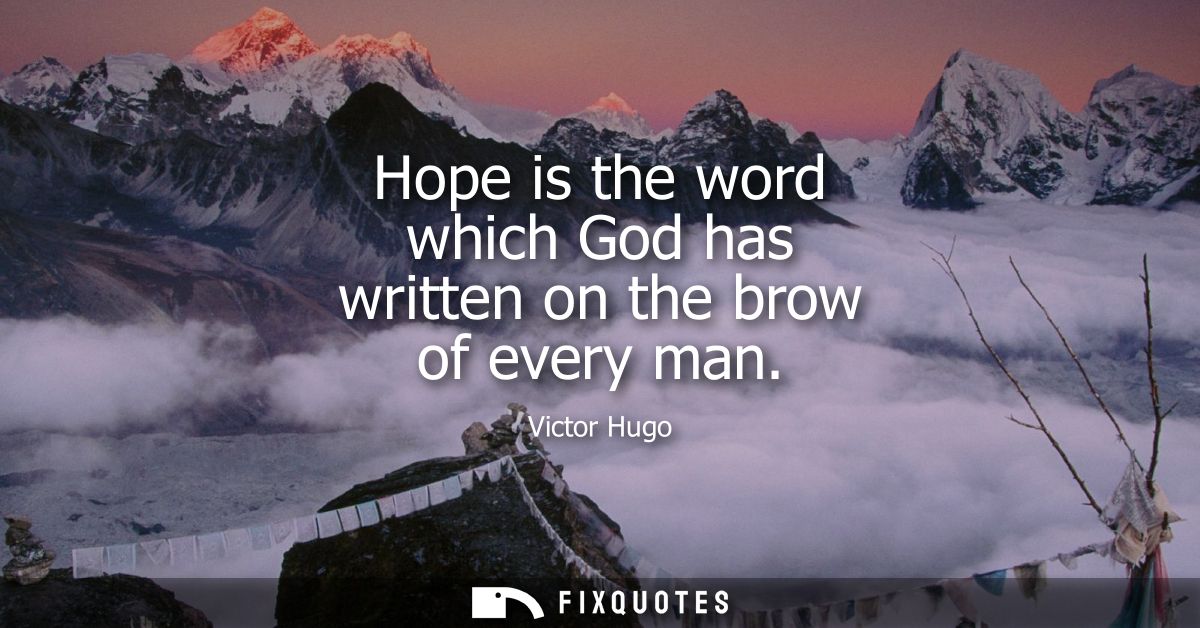
"Hope is the word which God has written on the brow of every man"
About this Quote
Hugo turns hope into a physical mark, stamped right onto the human face like a passport nobody asked for but everyone carries. The “brow” matters: it’s public, visible, impossible to hide. Hope isn’t framed as a private feeling you cultivate in a journal; it’s presented as a readable, almost involuntary sign of being alive. That move is classic Hugo, the novelist who loved turning inner states into architecture, weather, crowds, and symbols big enough to hold an entire society.
Invoking God does two things at once. It gives hope the authority of a commandment, not a lifestyle choice, and it smuggles in a kind of radical equality. If God has written it on “every man,” then hope belongs as much to the condemned, the poor, the exiled, and the disgraced as it does to the comfortable. That’s the political edge under the spiritual glow: Hugo’s work is obsessed with the way institutions crush people, and he repeatedly insists that dignity survives their verdicts.
The line also has a strategic optimism. Not naive, not blind to suffering, but defiant in the face of it. In a 19th-century France racked by revolutions, restorations, and state violence, “hope” reads less like sentiment and more like resistance: a refusal to let history’s machinery have the last word. Hugo’s brilliance is that he doesn’t argue for hope; he anatomizes it as destiny, a signature already there, daring you to live up to it.
Invoking God does two things at once. It gives hope the authority of a commandment, not a lifestyle choice, and it smuggles in a kind of radical equality. If God has written it on “every man,” then hope belongs as much to the condemned, the poor, the exiled, and the disgraced as it does to the comfortable. That’s the political edge under the spiritual glow: Hugo’s work is obsessed with the way institutions crush people, and he repeatedly insists that dignity survives their verdicts.
The line also has a strategic optimism. Not naive, not blind to suffering, but defiant in the face of it. In a 19th-century France racked by revolutions, restorations, and state violence, “hope” reads less like sentiment and more like resistance: a refusal to let history’s machinery have the last word. Hugo’s brilliance is that he doesn’t argue for hope; he anatomizes it as destiny, a signature already there, daring you to live up to it.
Quote Details
| Topic | Hope |
|---|---|
| Source | Help us find the source |
| Cite |
Citation Formats
APA Style (7th ed.)
Hugo, Victor. (2026, January 16). Hope is the word which God has written on the brow of every man. FixQuotes. https://fixquotes.com/quotes/hope-is-the-word-which-god-has-written-on-the-137803/
Chicago Style
Hugo, Victor. "Hope is the word which God has written on the brow of every man." FixQuotes. January 16, 2026. https://fixquotes.com/quotes/hope-is-the-word-which-god-has-written-on-the-137803/.
MLA Style (9th ed.)
"Hope is the word which God has written on the brow of every man." FixQuotes, 16 Jan. 2026, https://fixquotes.com/quotes/hope-is-the-word-which-god-has-written-on-the-137803/. Accessed 3 Apr. 2026.
More Quotes by Victor
Add to List