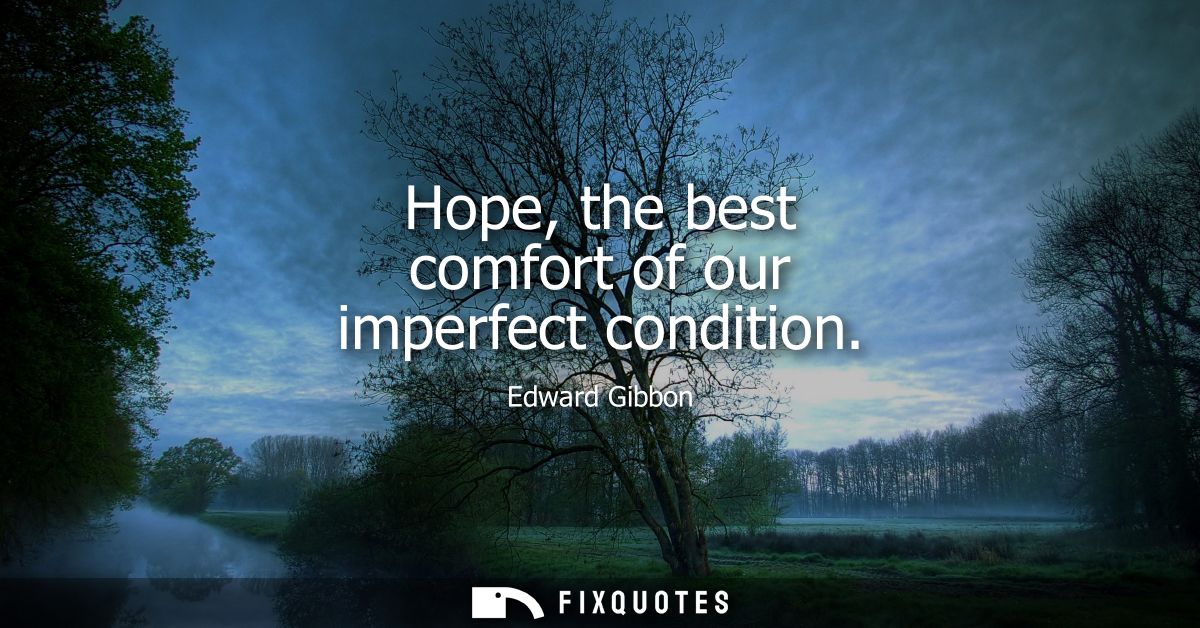
"Hope, the best comfort of our imperfect condition"
About this Quote
“Hope” is doing quiet rhetorical labor here: it’s framed not as a virtue that redeems the world, but as a coping technology for a world that won’t be redeemed. Gibbon, the great anatomist of empires and illusions, offers comfort with a blade still in it. The phrase “our imperfect condition” widens the target beyond personal misfortune to the human project itself - history as a record of ambition, decay, and error repeated with better costumes. In that bleak panorama, hope isn’t triumph; it’s triage.
The line works because it refuses both piety and despair. “Best comfort” is faint praise, deliberately domestic and unheroic. Comfort is what you reach for when cures are unavailable. Gibbon isn’t selling hope as moral clarity or divine promise; he’s describing its utility. Hope becomes the mental bridge that lets people keep building, governing, loving, and writing history even when the evidence for improvement is thin.
The subtext carries Enlightenment skepticism without the swagger. To call our condition “imperfect” is to reject utopian endpoints and any theology of guaranteed progress. Yet he also avoids the fashionable cynic’s pose that nothing matters. Hope is “best” precisely because it’s modest: it doesn’t demand that the world become just, only that we endure it without collapsing into paralysis.
Read against Gibbon’s larger work, the line sounds like a historian’s concession. After you’ve watched Rome fall in slow motion, hope isn’t naive - it’s the remaining instrument that keeps humans from mistaking decline for destiny.
The line works because it refuses both piety and despair. “Best comfort” is faint praise, deliberately domestic and unheroic. Comfort is what you reach for when cures are unavailable. Gibbon isn’t selling hope as moral clarity or divine promise; he’s describing its utility. Hope becomes the mental bridge that lets people keep building, governing, loving, and writing history even when the evidence for improvement is thin.
The subtext carries Enlightenment skepticism without the swagger. To call our condition “imperfect” is to reject utopian endpoints and any theology of guaranteed progress. Yet he also avoids the fashionable cynic’s pose that nothing matters. Hope is “best” precisely because it’s modest: it doesn’t demand that the world become just, only that we endure it without collapsing into paralysis.
Read against Gibbon’s larger work, the line sounds like a historian’s concession. After you’ve watched Rome fall in slow motion, hope isn’t naive - it’s the remaining instrument that keeps humans from mistaking decline for destiny.
Quote Details
| Topic | Hope |
|---|---|
| Source | Help us find the source |
| Cite | Cite this Quote |
Citation Formats
APA Style (7th ed.)
Gibbon, Edward. (n.d.). Hope, the best comfort of our imperfect condition. FixQuotes. https://fixquotes.com/quotes/hope-the-best-comfort-of-our-imperfect-condition-68135/
Chicago Style
Gibbon, Edward. "Hope, the best comfort of our imperfect condition." FixQuotes. Accessed February 3, 2026. https://fixquotes.com/quotes/hope-the-best-comfort-of-our-imperfect-condition-68135/.
MLA Style (9th ed.)
"Hope, the best comfort of our imperfect condition." FixQuotes, https://fixquotes.com/quotes/hope-the-best-comfort-of-our-imperfect-condition-68135/. Accessed 3 Feb. 2026.
More Quotes by Edward
Add to List