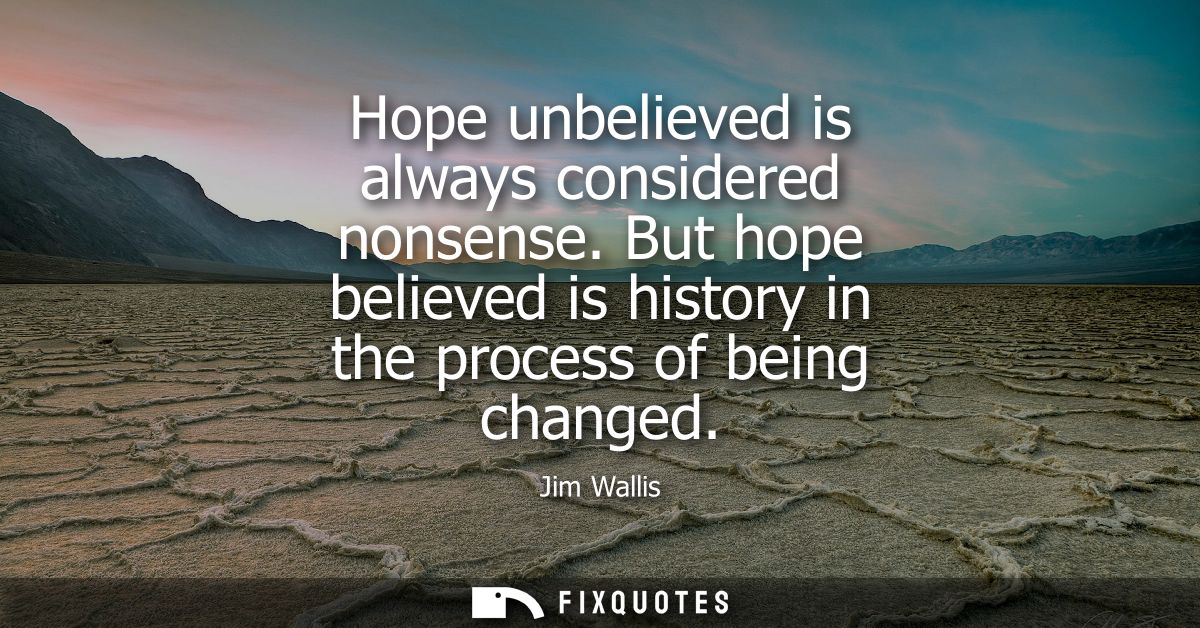
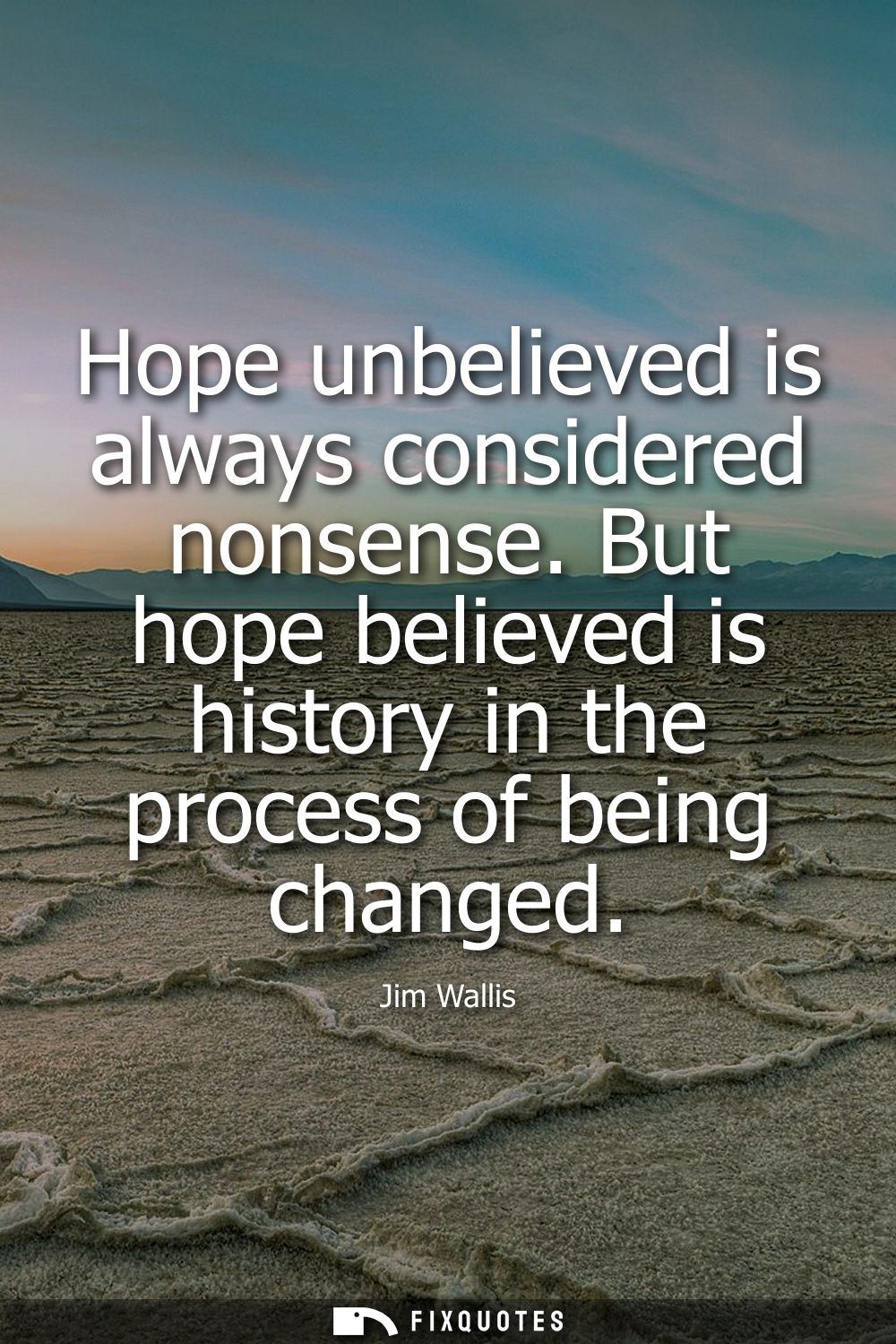
"Hope unbelieved is always considered nonsense. But hope believed is history in the process of being changed"
About this Quote
Then he flips the frame with a daring redefinition: hope “believed” becomes “history in the process of being changed.” That’s not motivational-poster uplift; it’s a theory of how movements work. Wallis treats belief as collective commitment, the moment when private longing hardens into public action. History, in his formulation, isn’t a neutral record of what happened. It’s a contested project, and belief is the lever that moves it.
The line also carries the imprint of Wallis’s long career at the intersection of faith and politics, where “hope” can sound like a pious cop-out. He refuses that. By tying hope to historical change, he argues that moral imagination is not separate from material consequences; it’s often their precondition. The subtext is a challenge: if your hope can’t survive mockery, it isn’t ready for power. If it can gather believers, it stops being a wish and starts becoming a plan.
Quote Details
| Topic | Hope |
|---|---|
| Source | Help us find the source |
| Cite |
Citation Formats
APA Style (7th ed.)
Wallis, Jim. (2026, January 15). Hope unbelieved is always considered nonsense. But hope believed is history in the process of being changed. FixQuotes. https://fixquotes.com/quotes/hope-unbelieved-is-always-considered-nonsense-but-153591/
Chicago Style
Wallis, Jim. "Hope unbelieved is always considered nonsense. But hope believed is history in the process of being changed." FixQuotes. January 15, 2026. https://fixquotes.com/quotes/hope-unbelieved-is-always-considered-nonsense-but-153591/.
MLA Style (9th ed.)
"Hope unbelieved is always considered nonsense. But hope believed is history in the process of being changed." FixQuotes, 15 Jan. 2026, https://fixquotes.com/quotes/hope-unbelieved-is-always-considered-nonsense-but-153591/. Accessed 29 Mar. 2026.