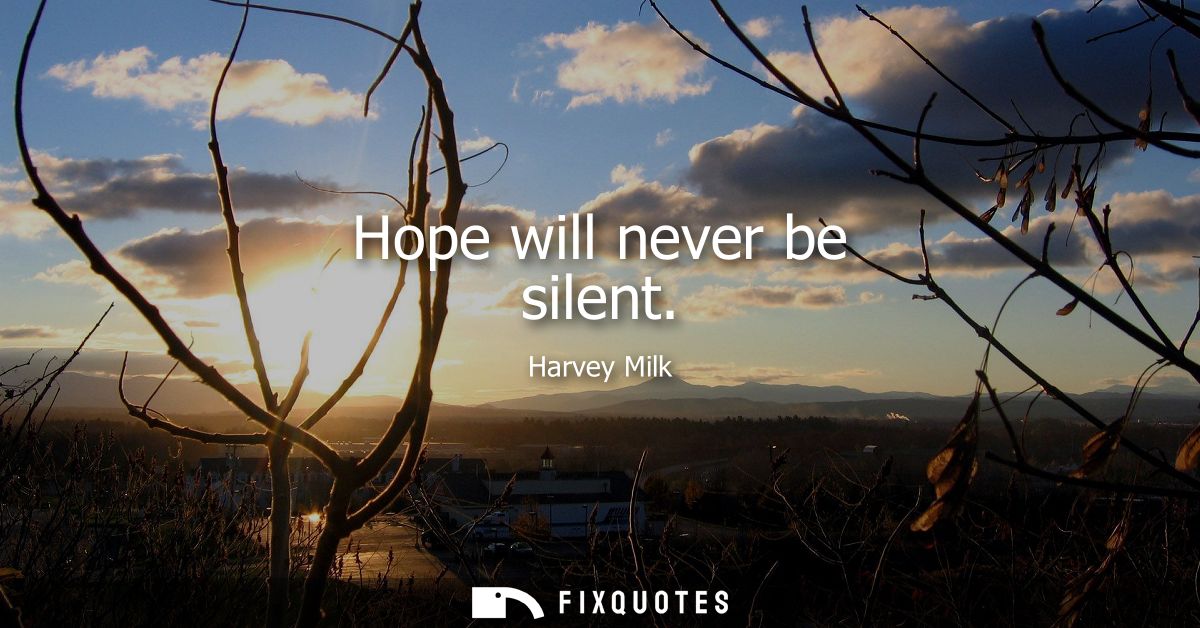
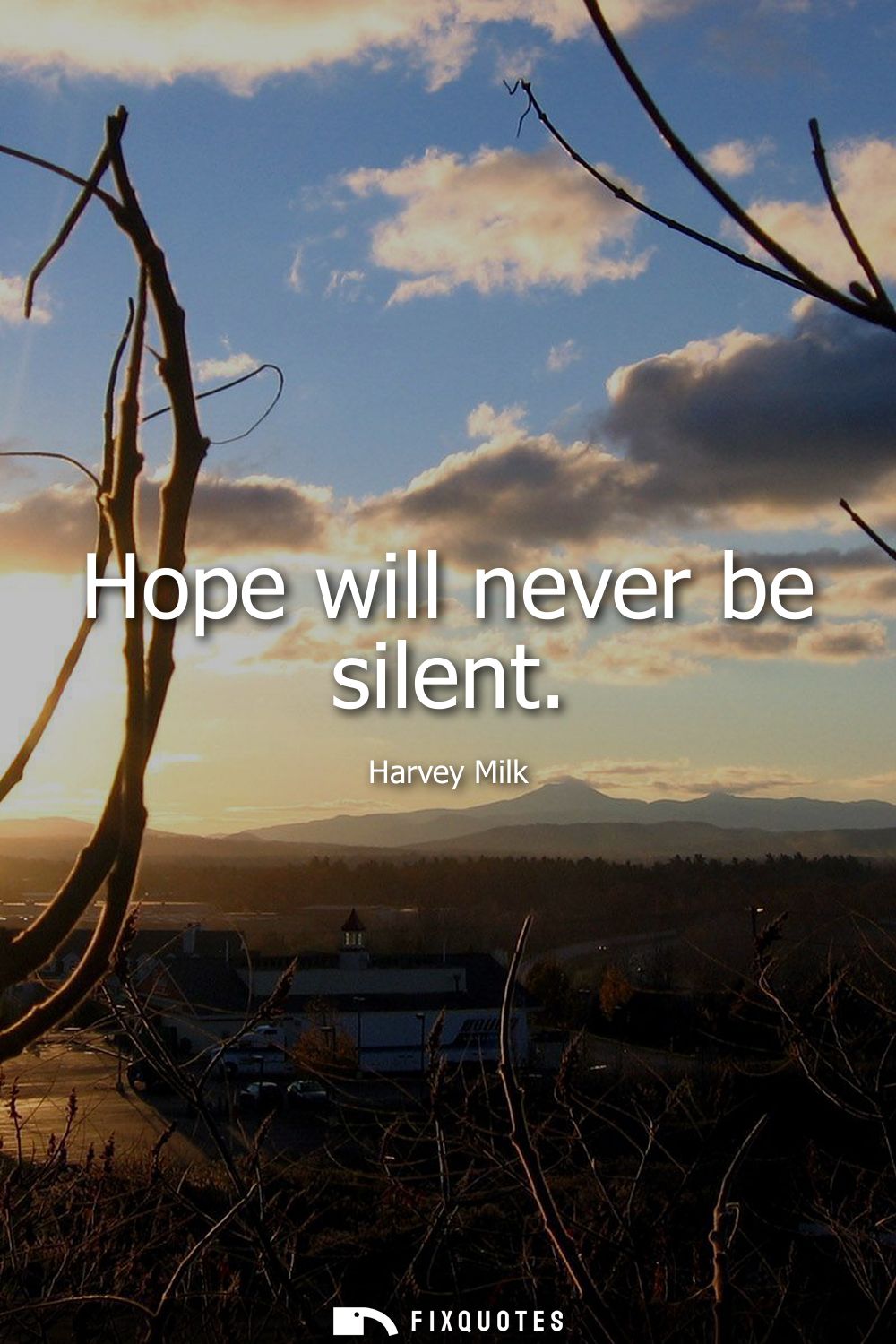
"Hope will never be silent"
About this Quote
“Hope will never be silent” is a line that turns optimism into a tactic. Harvey Milk isn’t offering comfort; he’s issuing a forecast and a dare. The phrasing matters: “will never” carries the hard certainty of a campaign promise, but the subject isn’t a bill or an election outcome. It’s an emotion recast as a public force, something that speaks even when institutions don’t.
Milk, as one of the first openly gay elected officials in the U.S., understood how power works when you’re denied it: visibility is leverage. Silence was never neutral for queer people in the 1970s; it was a condition imposed by stigma, job loss, family rejection, police harassment. In that context, “hope” isn’t a private feeling you nurse in the dark. It’s what happens when people risk being seen, when a community stops treating survival as an individual problem and starts treating it as politics.
The subtext is a refusal of the respectable, quiet version of tolerance. Milk is arguing that progress doesn’t arrive through polite patience; it arrives through testimony, protest, voting, organizing, naming names. Even grief is implied here: when violence tries to shut a movement up, the movement’s answer is sound. Coming from a politician later assassinated, the line reads as both prophetic and defiant. It’s not that hope is gentle. It’s that hope, in the face of erasure, has to get loud enough to be heard.
Milk, as one of the first openly gay elected officials in the U.S., understood how power works when you’re denied it: visibility is leverage. Silence was never neutral for queer people in the 1970s; it was a condition imposed by stigma, job loss, family rejection, police harassment. In that context, “hope” isn’t a private feeling you nurse in the dark. It’s what happens when people risk being seen, when a community stops treating survival as an individual problem and starts treating it as politics.
The subtext is a refusal of the respectable, quiet version of tolerance. Milk is arguing that progress doesn’t arrive through polite patience; it arrives through testimony, protest, voting, organizing, naming names. Even grief is implied here: when violence tries to shut a movement up, the movement’s answer is sound. Coming from a politician later assassinated, the line reads as both prophetic and defiant. It’s not that hope is gentle. It’s that hope, in the face of erasure, has to get loud enough to be heard.
Quote Details
| Topic | Hope |
|---|---|
| Source | Help us find the source |
| Cite |
Citation Formats
APA Style (7th ed.)
Milk, Harvey. (2026, January 15). Hope will never be silent. FixQuotes. https://fixquotes.com/quotes/hope-will-never-be-silent-71223/
Chicago Style
Milk, Harvey. "Hope will never be silent." FixQuotes. January 15, 2026. https://fixquotes.com/quotes/hope-will-never-be-silent-71223/.
MLA Style (9th ed.)
"Hope will never be silent." FixQuotes, 15 Jan. 2026, https://fixquotes.com/quotes/hope-will-never-be-silent-71223/. Accessed 25 Mar. 2026.
More Quotes by Harvey
Add to List