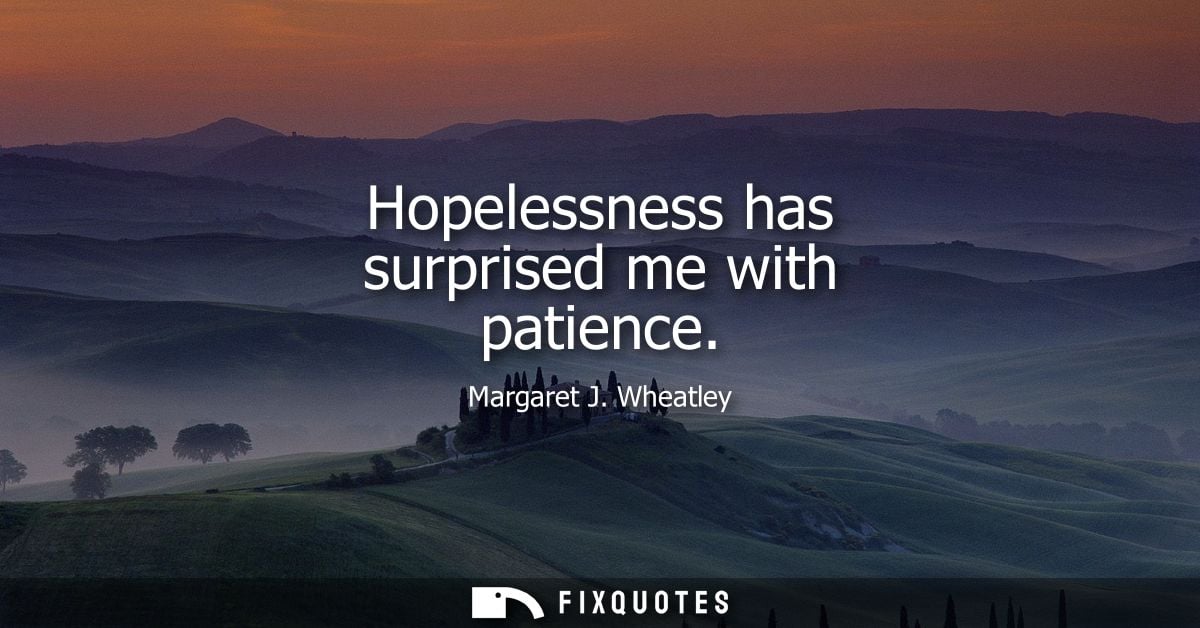
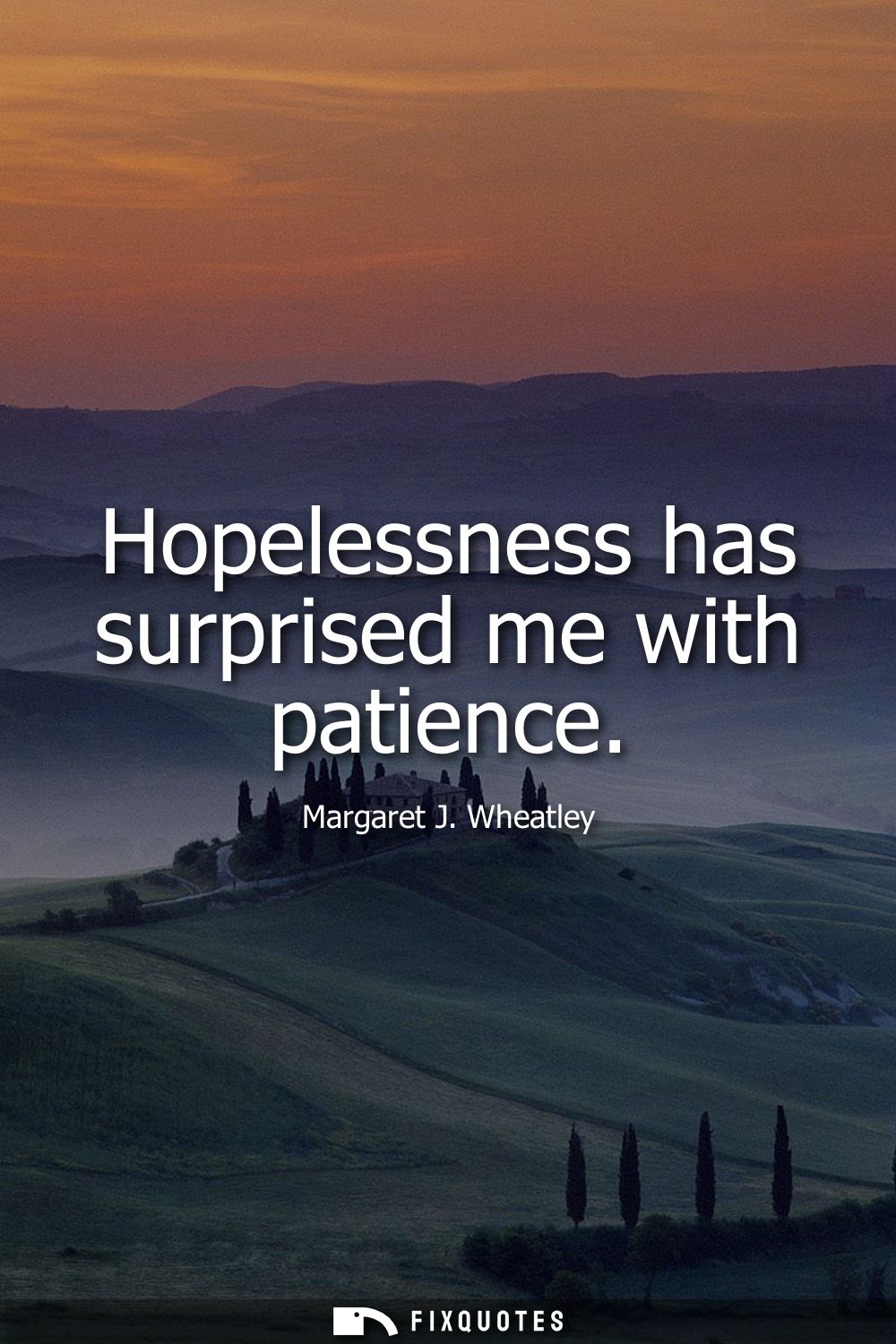
"Hopelessness has surprised me with patience"
About this Quote
Hopelessness isn’t supposed to be patient. It’s supposed to be a trapdoor: fast, final, melodramatic. Margaret J. Wheatley flips that expectation with one quiet verb: “surprised.” The line lands because it treats despair not as a single crash but as a long companionable weather system, something that can sit beside you, unhurried, until you stop fighting it and start noticing what it’s doing to your nervous system and your choices.
Wheatley’s work, rooted in organizational life and leadership, has long resisted the self-help industrial complex’s cult of optimism. Read in that context, “hopelessness” isn’t just personal sadness; it’s the atmosphere of institutions in decline, political fatigue, burnout culture, the slow-motion recognition that a beloved system may not be fixable. The surprise is that hopelessness doesn’t always demand surrender. Sometimes it simply waits, creating a strange kind of clarity: when the fantasy of control runs out, the performative cheerleading can finally stop. Patience, here, is the unsettling gift. It forces you to live in the unresolvable without constant denial.
The subtext is almost ethical: there’s a difference between hope and truth. Hopelessness, patient and persistent, becomes a test of what remains when motivation collapses. Do you still show up? Do you still care, even without the payoff of progress narratives? Wheatley’s sentence works as a corrective to “stay positive” culture, offering a sterner compassion: you can’t rush your way out of despair, but you can learn what it makes possible once you stop treating it as failure.
Wheatley’s work, rooted in organizational life and leadership, has long resisted the self-help industrial complex’s cult of optimism. Read in that context, “hopelessness” isn’t just personal sadness; it’s the atmosphere of institutions in decline, political fatigue, burnout culture, the slow-motion recognition that a beloved system may not be fixable. The surprise is that hopelessness doesn’t always demand surrender. Sometimes it simply waits, creating a strange kind of clarity: when the fantasy of control runs out, the performative cheerleading can finally stop. Patience, here, is the unsettling gift. It forces you to live in the unresolvable without constant denial.
The subtext is almost ethical: there’s a difference between hope and truth. Hopelessness, patient and persistent, becomes a test of what remains when motivation collapses. Do you still show up? Do you still care, even without the payoff of progress narratives? Wheatley’s sentence works as a corrective to “stay positive” culture, offering a sterner compassion: you can’t rush your way out of despair, but you can learn what it makes possible once you stop treating it as failure.
Quote Details
| Topic | Sadness |
|---|---|
| Source | Help us find the source |
| Cite |
Citation Formats
APA Style (7th ed.)
Wheatley, Margaret J. (2026, January 17). Hopelessness has surprised me with patience. FixQuotes. https://fixquotes.com/quotes/hopelessness-has-surprised-me-with-patience-79534/
Chicago Style
Wheatley, Margaret J. "Hopelessness has surprised me with patience." FixQuotes. January 17, 2026. https://fixquotes.com/quotes/hopelessness-has-surprised-me-with-patience-79534/.
MLA Style (9th ed.)
"Hopelessness has surprised me with patience." FixQuotes, 17 Jan. 2026, https://fixquotes.com/quotes/hopelessness-has-surprised-me-with-patience-79534/. Accessed 12 Feb. 2026.
More Quotes by Margaret
Add to List