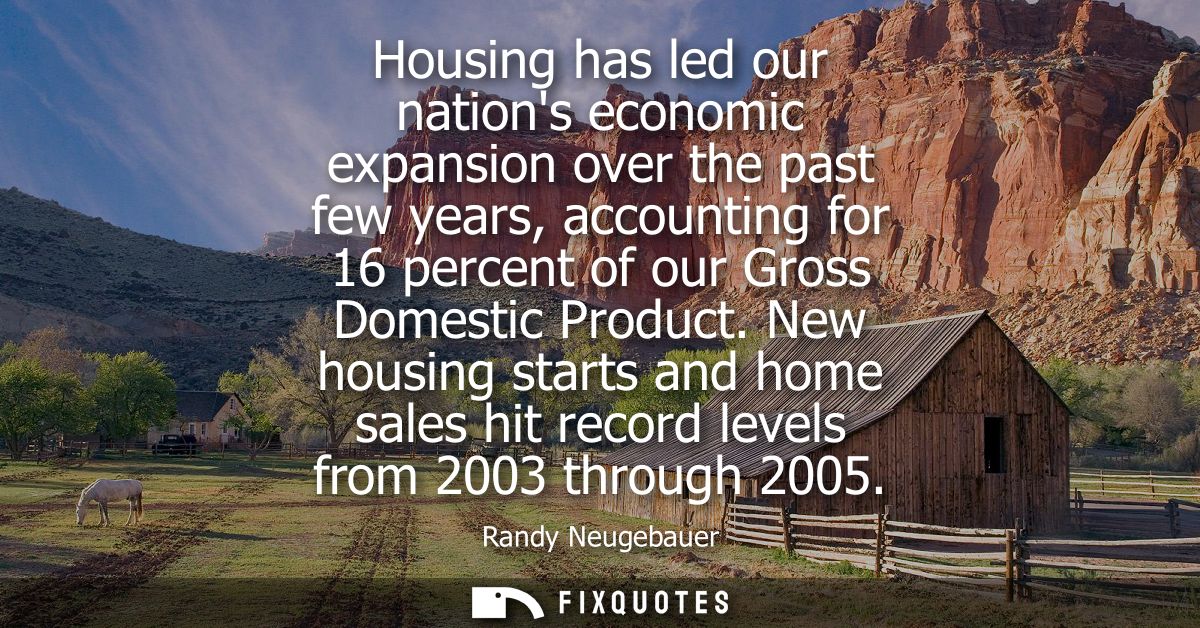
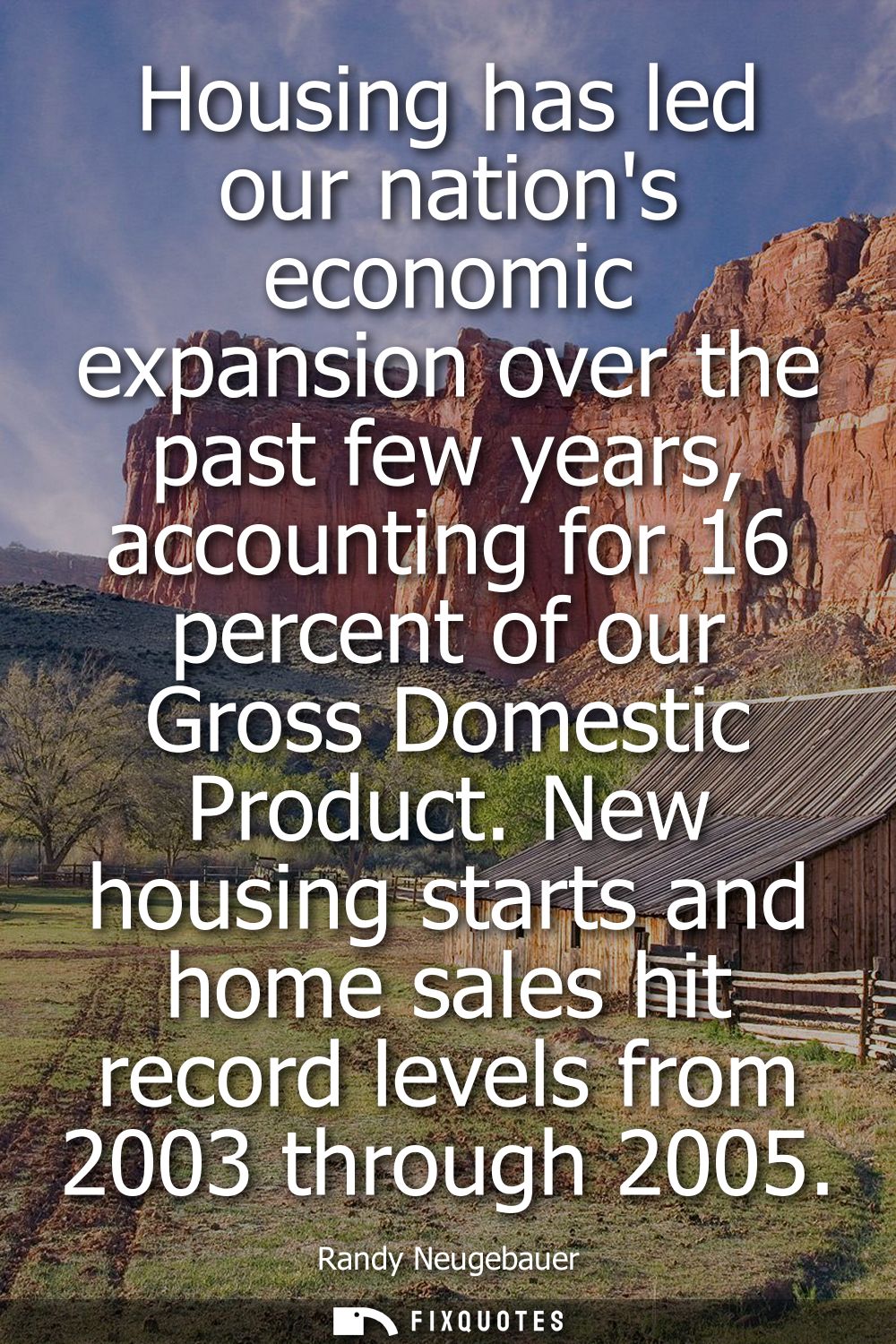
"Housing has led our nation's economic expansion over the past few years, accounting for 16 percent of our Gross Domestic Product. New housing starts and home sales hit record levels from 2003 through 2005"
About this Quote
The subtext is more revealing than the statistic. By framing housing as the engine of “economic expansion,” Neugebauer implicitly ties prosperity to homeownership, construction jobs, and rising property values - an agenda-friendly triad for a Republican lawmaker in a period when housing policy, mortgage credit, and deregulation were widely treated as growth accelerants. “Record levels” works as a political shield: if the metrics are breaking records, questioning the model sounds like cynicism.
Context makes the line read differently now. Those were peak bubble years, when cheap credit, lax underwriting, and speculative buying inflated “starts” and “sales” into a kind of national scoreboard. The quote’s intent is to reassure and validate a growth narrative; its accidental irony is that it highlights the economy’s dependence on a sector uniquely vulnerable to leverage and psychology. Calling housing a driver of GDP is accurate - and, in hindsight, a quiet admission of fragility. The boom is real, the foundation less so.
Quote Details
| Topic | Money |
|---|---|
| Source | Help us find the source |
| Cite |
Citation Formats
APA Style (7th ed.)
Neugebauer, Randy. (2026, January 17). Housing has led our nation's economic expansion over the past few years, accounting for 16 percent of our Gross Domestic Product. New housing starts and home sales hit record levels from 2003 through 2005. FixQuotes. https://fixquotes.com/quotes/housing-has-led-our-nations-economic-expansion-73278/
Chicago Style
Neugebauer, Randy. "Housing has led our nation's economic expansion over the past few years, accounting for 16 percent of our Gross Domestic Product. New housing starts and home sales hit record levels from 2003 through 2005." FixQuotes. January 17, 2026. https://fixquotes.com/quotes/housing-has-led-our-nations-economic-expansion-73278/.
MLA Style (9th ed.)
"Housing has led our nation's economic expansion over the past few years, accounting for 16 percent of our Gross Domestic Product. New housing starts and home sales hit record levels from 2003 through 2005." FixQuotes, 17 Jan. 2026, https://fixquotes.com/quotes/housing-has-led-our-nations-economic-expansion-73278/. Accessed 12 Mar. 2026.