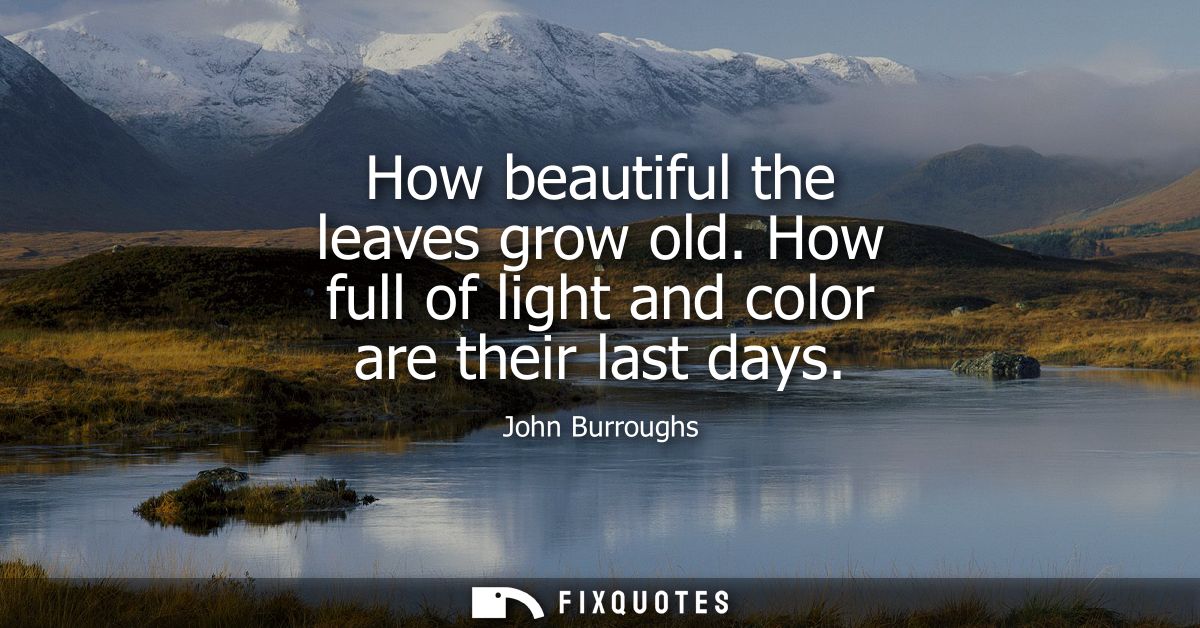
"How beautiful the leaves grow old. How full of light and color are their last days!"
About this Quote
Burroughs wrote as an essayist-naturalist in an America intoxicated by progress, speed, and the idea that newness equals value. Against that current, he offers a counter-ethic: the late phase has its own radiance, not despite its closeness to death but because of it. "Full of light and color" is more than pretty description. It’s a reframing of what “last days” can mean - not the dimming of a life, but its concentration. Autumn becomes an argument that intensity and finitude are linked.
The subtext is personal and cultural. It comforts without sentimentality: you don’t have to deny loss to recognize beauty. It also implies an adult kind of attention - the willingness to stay with an ending long enough to see it clearly. Burroughs isn’t selling optimism; he’s coaching perception. The leaves are a lesson in how to watch time pass without flinching.
Quote Details
| Topic | Autumn |
|---|---|
| Source | Help us find the source |
| Cite |
Citation Formats
APA Style (7th ed.)
Burroughs, John. (2026, February 19). How beautiful the leaves grow old. How full of light and color are their last days! FixQuotes. https://fixquotes.com/quotes/how-beautiful-the-leaves-grow-old-how-full-of-56414/
Chicago Style
Burroughs, John. "How beautiful the leaves grow old. How full of light and color are their last days!" FixQuotes. February 19, 2026. https://fixquotes.com/quotes/how-beautiful-the-leaves-grow-old-how-full-of-56414/.
MLA Style (9th ed.)
"How beautiful the leaves grow old. How full of light and color are their last days!" FixQuotes, 19 Feb. 2026, https://fixquotes.com/quotes/how-beautiful-the-leaves-grow-old-how-full-of-56414/. Accessed 9 Mar. 2026.