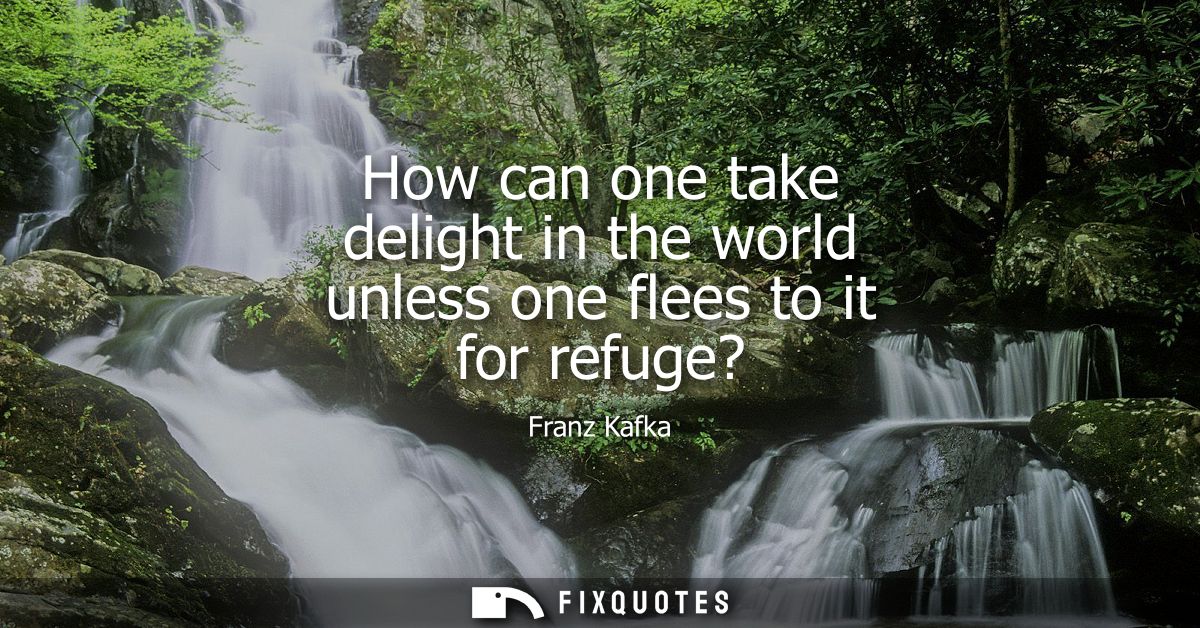
"How can one take delight in the world unless one flees to it for refuge?"
About this Quote
Kafka’s intent is slyly diagnostic. He treats delight not as a stable mood but as a survival tactic, something you access only when the alternative is unbearable. The question form matters: it’s not offering comfort, it’s cross-examining the reader’s innocence. If you’re taking delight without fleeing to it, are you actually delighting, or just consuming? Kafka suspects the latter. Genuine joy, in this view, is keyed to threat; it has the quickened pulse of escape.
The subtext is classic Kafka: the world is both the source of oppression and the only imaginable shelter from it. The refuge isn’t necessarily nature or art alone; it’s “the world” in the broadest sense, the very terrain that also contains bureaucracy, judgment, and a nagging, internalized sense of guilt. That paradox is the point. Modern life makes you feel trapped, then sells you moments of aliveness as a kind of temporary asylum.
Contextually, Kafka wrote from within the pressure-cooker of early 20th-century Prague: a precarious Jewish identity, a punishing day job in insurance, chronic illness, and a literary imagination tuned to systems that crush without touching you. The line reads like a pocket-sized manifesto for his fiction: escape isn’t elsewhere. It’s into the only place you’re already stuck, trying to find, against the odds, a corner where you can breathe.
Quote Details
| Topic | Deep |
|---|---|
| Source | Verified source: Betrachtungen über Sünde, Leid, Hoffnung und den wahren Weg (Franz Kafka, 1931)
Evidence: Wie kann man sich über die Welt freuen, außer wenn man zu ihr flüchtet? (Aphorism 25 (page number varies by edition; often cited as p. 229 in the 1931 Kiepenheuer volume 'Beim Bau der Chinesischen Mauer')). Your English quote (“How can one take delight in the world unless one flees to it for refuge?”) appears to be a *loose / embellished translation* of this aphorism: the German original does not include a word equivalent to “refuge” (e.g., “Zuflucht”). The text is part of Kafka’s Zürau Aphorisms (written 1917–1918) and was first published posthumously in 1931 by Gustav Kiepenheuer (Berlin) in the edited volume associated with 'Beim Bau der Chinesischen Mauer', edited by Max Brod and Hans Joachim Schoeps. Other candidates (1) Top Inspiring Thoughts of Franz Kafka (M.D. Sharma, 2021) compilation95.0% ... How can one take delight in the world unless one flees to it for refuge ? 26. Humility provides everyone , even h... |
| Cite |
Citation Formats
APA Style (7th ed.)
Kafka, Franz. (2026, February 17). How can one take delight in the world unless one flees to it for refuge? FixQuotes. https://fixquotes.com/quotes/how-can-one-take-delight-in-the-world-unless-one-7018/
Chicago Style
Kafka, Franz. "How can one take delight in the world unless one flees to it for refuge?" FixQuotes. February 17, 2026. https://fixquotes.com/quotes/how-can-one-take-delight-in-the-world-unless-one-7018/.
MLA Style (9th ed.)
"How can one take delight in the world unless one flees to it for refuge?" FixQuotes, 17 Feb. 2026, https://fixquotes.com/quotes/how-can-one-take-delight-in-the-world-unless-one-7018/. Accessed 2 Apr. 2026.