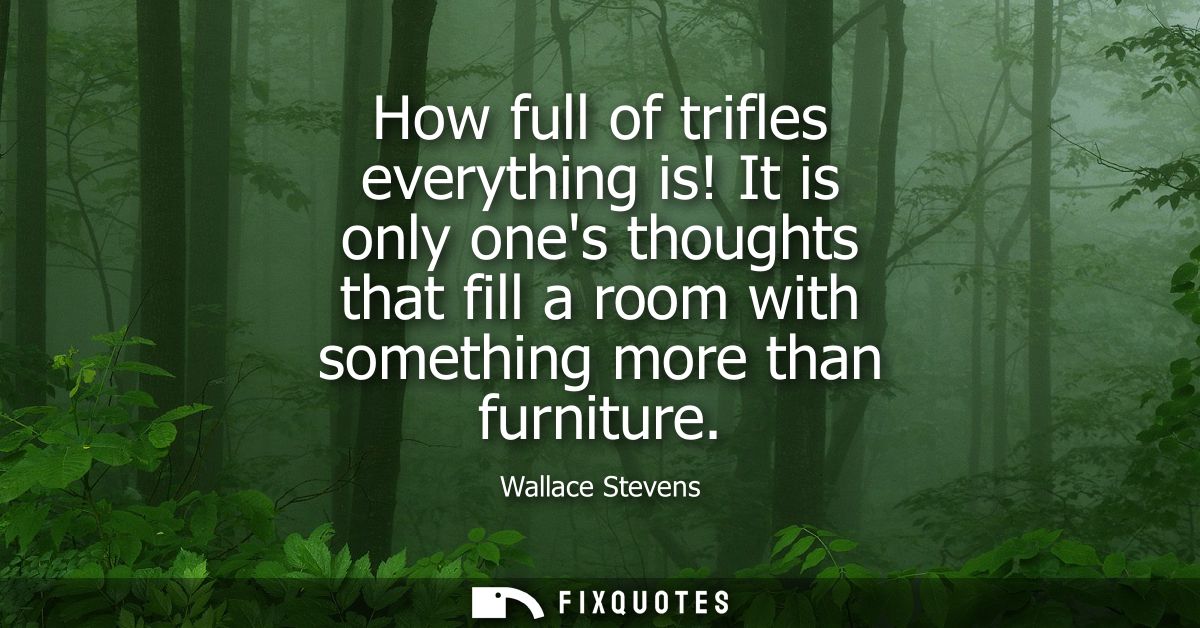
"How full of trifles everything is! It is only one's thoughts that fill a room with something more than furniture"
About this Quote
Then he pivots, sharply, to the only thing that can redeem the scene: “It is only one’s thoughts that fill a room with something more than furniture.” The room here isn’t merely domestic space; it’s the mind’s staging area. Stevens is suggesting that objects are inert until consciousness animates them, and he’s also warning that without thought, even the most lived-in room becomes a showroom. The line carries a quiet austerity: you don’t decorate your way into depth.
Context matters. Stevens wrote as a modernist who spent his days in the practical world (an insurance executive) while producing poetry obsessed with imagination’s power to remake reality. That split-life tension hums beneath the quote: the material world is unavoidable, but it’s insufficient. Subtextually, it’s a manifesto for interiority in an era already tilting toward consumer display and social performance. The room becomes an ethical test: do you inhabit your space, or just store your life in it?
Quote Details
| Topic | Deep |
|---|---|
| Source | Help us find the source |
| Cite |
Citation Formats
APA Style (7th ed.)
Stevens, Wallace. (2026, January 16). How full of trifles everything is! It is only one's thoughts that fill a room with something more than furniture. FixQuotes. https://fixquotes.com/quotes/how-full-of-trifles-everything-is-it-is-only-ones-89927/
Chicago Style
Stevens, Wallace. "How full of trifles everything is! It is only one's thoughts that fill a room with something more than furniture." FixQuotes. January 16, 2026. https://fixquotes.com/quotes/how-full-of-trifles-everything-is-it-is-only-ones-89927/.
MLA Style (9th ed.)
"How full of trifles everything is! It is only one's thoughts that fill a room with something more than furniture." FixQuotes, 16 Jan. 2026, https://fixquotes.com/quotes/how-full-of-trifles-everything-is-it-is-only-ones-89927/. Accessed 29 Mar. 2026.