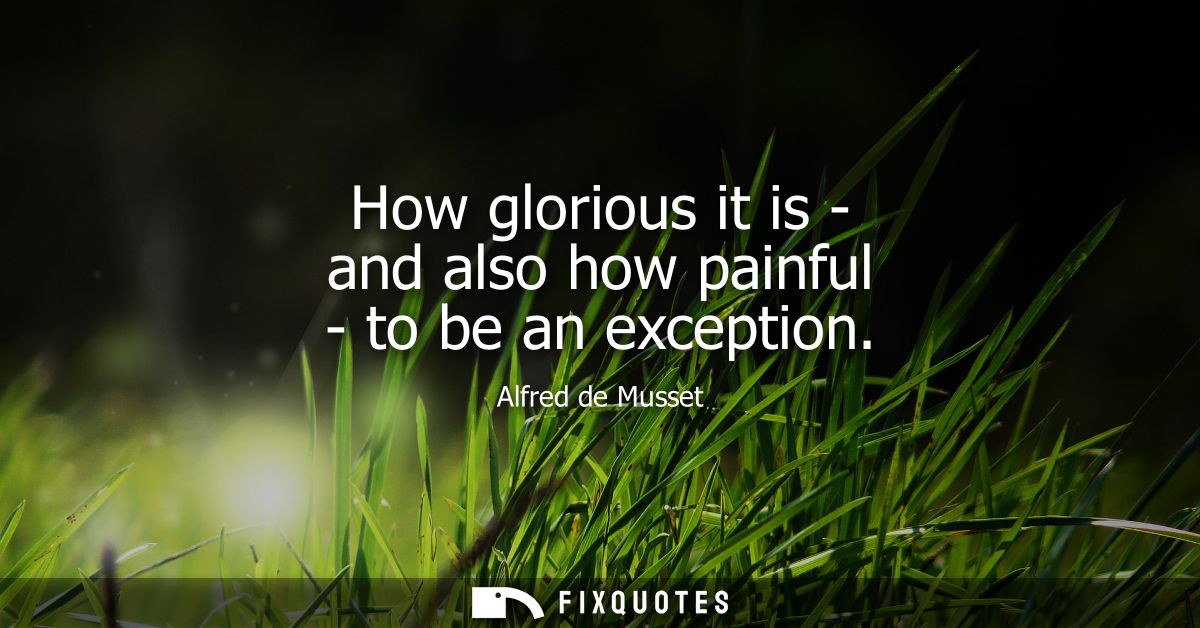
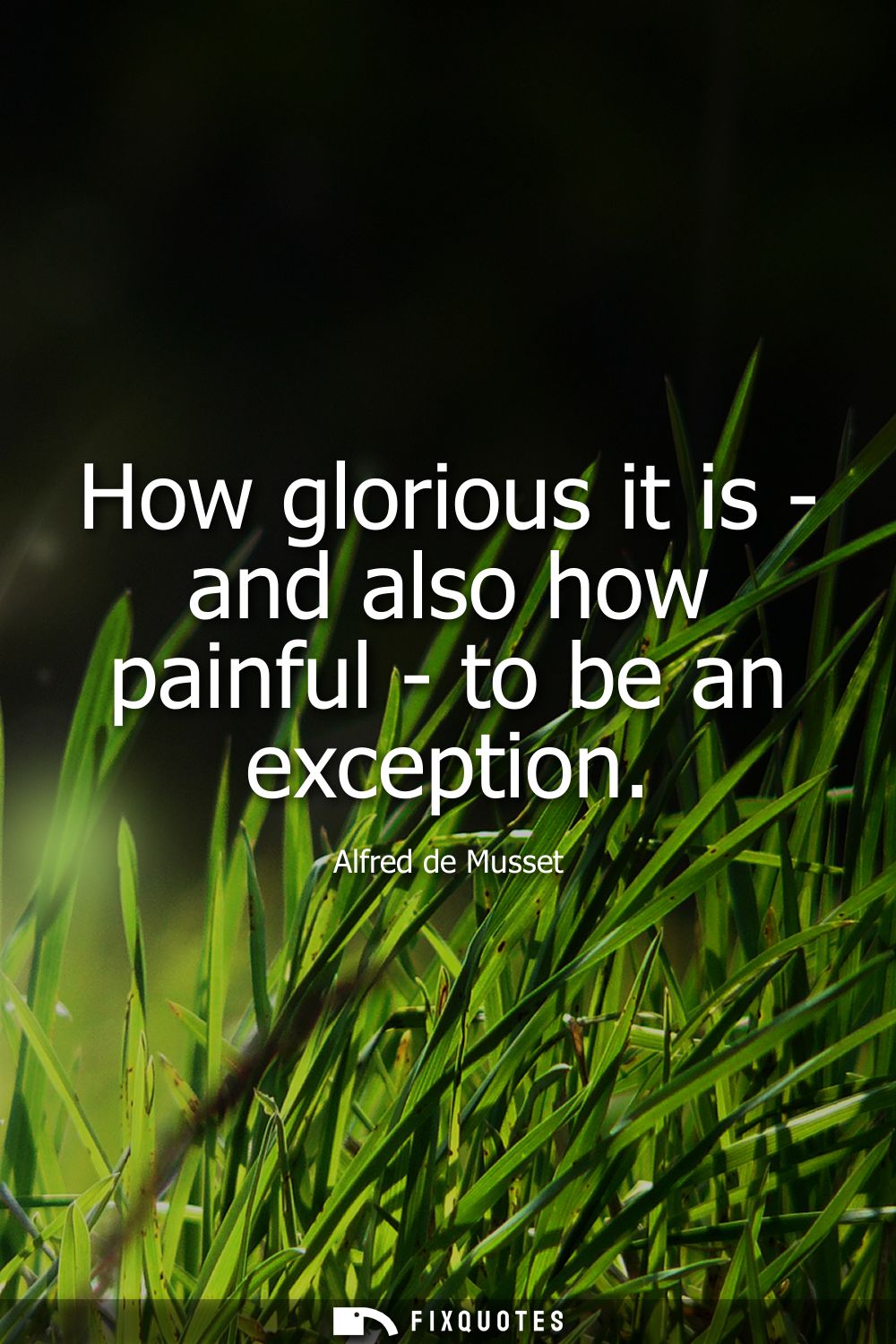
"How glorious it is - and also how painful - to be an exception"
About this Quote
To be "an exception" sounds like a victory lap until Musset reminds you what it costs. The line is built on a hinge: glorious - and also painful. That dash does more than pause; it stages the psychological whiplash of difference. In one breath, he grants the thrill of standing apart, of being singled out by talent, temperament, class, desire, or fate. In the next, he exposes the loneliness baked into distinction. Exceptionalism is a spotlight that warms and burns.
Musset writes from the Romantic century, when originality was practically a moral imperative and suffering was treated as proof of depth. His generation worshipped singularity, but it also discovered the social tax attached to it: admiration that curdles into suspicion, intimacy that fails under the weight of myth, a self-image that becomes a performance. The word "exception" carries a legal and social echo - exceptions confirm the rule. That is the sting: to be exceptional is to be defined against a norm you didn't choose, then used to reinforce it.
The subtext is a warning disguised as a confession. Musset, a writer whose public persona and private turmoil were inseparable, recognizes that difference can become a trap: you start needing your own estrangement to stay "special". The line works because it refuses the clean romance of being unique. It names the double bind: the world rewards what it cannot fully tolerate, and the person who receives that reward is left both elevated and exiled.
Musset writes from the Romantic century, when originality was practically a moral imperative and suffering was treated as proof of depth. His generation worshipped singularity, but it also discovered the social tax attached to it: admiration that curdles into suspicion, intimacy that fails under the weight of myth, a self-image that becomes a performance. The word "exception" carries a legal and social echo - exceptions confirm the rule. That is the sting: to be exceptional is to be defined against a norm you didn't choose, then used to reinforce it.
The subtext is a warning disguised as a confession. Musset, a writer whose public persona and private turmoil were inseparable, recognizes that difference can become a trap: you start needing your own estrangement to stay "special". The line works because it refuses the clean romance of being unique. It names the double bind: the world rewards what it cannot fully tolerate, and the person who receives that reward is left both elevated and exiled.
Quote Details
| Topic | Wisdom |
|---|---|
| Source | Help us find the source |
| Cite |
Citation Formats
APA Style (7th ed.)
Musset, Alfred de. (2026, January 17). How glorious it is - and also how painful - to be an exception. FixQuotes. https://fixquotes.com/quotes/how-glorious-it-is-and-also-how-painful-to-be-61664/
Chicago Style
Musset, Alfred de. "How glorious it is - and also how painful - to be an exception." FixQuotes. January 17, 2026. https://fixquotes.com/quotes/how-glorious-it-is-and-also-how-painful-to-be-61664/.
MLA Style (9th ed.)
"How glorious it is - and also how painful - to be an exception." FixQuotes, 17 Jan. 2026, https://fixquotes.com/quotes/how-glorious-it-is-and-also-how-painful-to-be-61664/. Accessed 5 Apr. 2026.
More Quotes by Alfred
Add to List