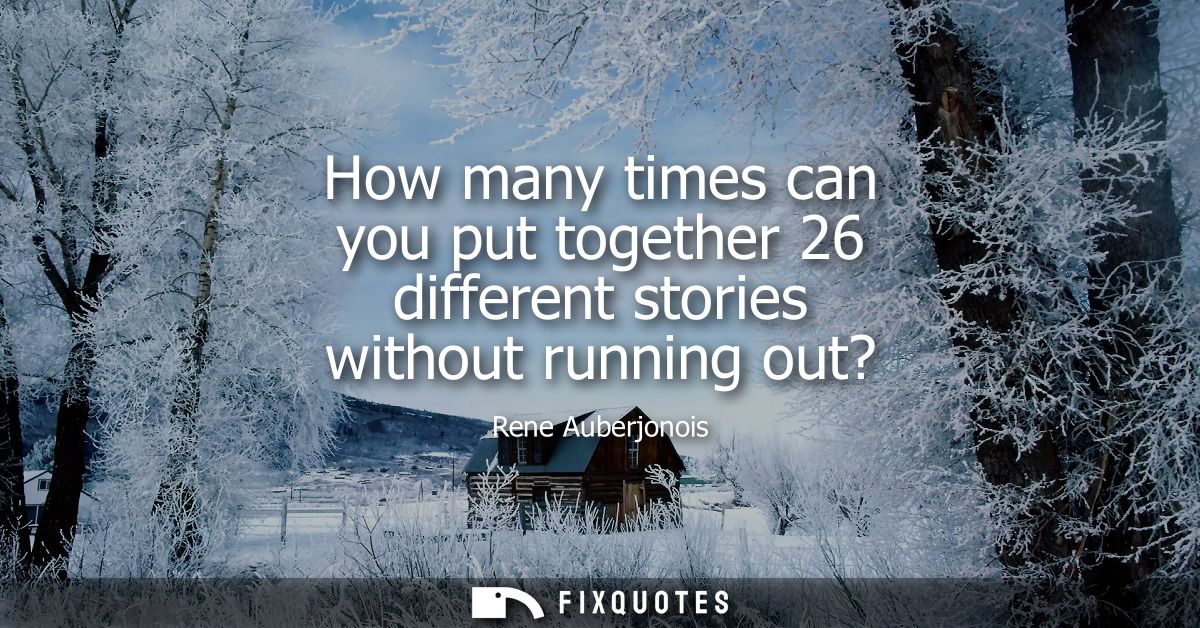
"How many times can you put together 26 different stories without running out?"
About this Quote
The line works because it’s half-curious, half-challenging. On its face, it’s an innocent worry about depletion: doesn’t repetition eventually win? Underneath, it’s a critique of the audience’s appetite and the industry’s incentives. We want the comfort of a familiar world but also the thrill of surprise; studios want reliable formats that can be replicated; writers are asked to make the same engine produce fresh motion every week. Auberjonois, as an actor, sits at the receiving end of that pipeline - he has to inhabit these "different stories" convincingly, even when the scaffolding looks familiar.
The subtext is also a quiet defense of craft. Great episodic storytelling isn't infinite originality; it’s variation under pressure. The question implies that running out isn’t inevitable if you understand what actually generates story: character contradictions, moral trade-offs, shifting alliances, the way a single premise refracts into new dilemmas. It’s a reminder that the hardest part isn’t having ideas. It’s sustaining attention inside a system designed to consume them.
Quote Details
| Topic | Writing |
|---|---|
| Source | Help us find the source |
| Cite |
Citation Formats
APA Style (7th ed.)
Auberjonois, Rene. (2026, January 16). How many times can you put together 26 different stories without running out? FixQuotes. https://fixquotes.com/quotes/how-many-times-can-you-put-together-26-different-107514/
Chicago Style
Auberjonois, Rene. "How many times can you put together 26 different stories without running out?" FixQuotes. January 16, 2026. https://fixquotes.com/quotes/how-many-times-can-you-put-together-26-different-107514/.
MLA Style (9th ed.)
"How many times can you put together 26 different stories without running out?" FixQuotes, 16 Jan. 2026, https://fixquotes.com/quotes/how-many-times-can-you-put-together-26-different-107514/. Accessed 6 Apr. 2026.