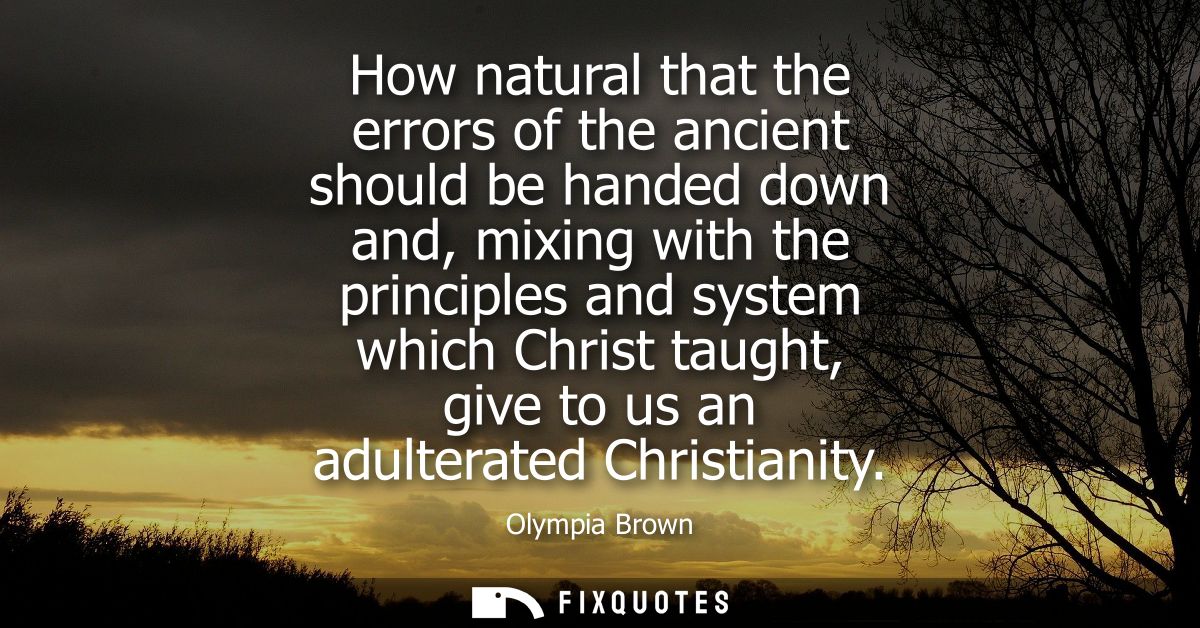
"How natural that the errors of the ancient should be handed down and, mixing with the principles and system which Christ taught, give to us an adulterated Christianity"
About this Quote
“Adulterated Christianity” is a deliberately scandalous phrase, and Olympia Brown knows it. She’s not attacking faith so much as accusing religious institutions of tampering with it - watering it down, spiking it with leftovers from “the ancient,” then selling the mixture as divine truth. The line works because it flips a pious assumption: tradition isn’t automatically wisdom; tradition can be contamination.
Brown, a trailblazing suffrage-era activist and one of the first ordained women in the United States, is speaking from inside Christianity while refusing to treat the church as the sole custodian of Christ’s message. Her target is the way pre-Christian social orders - patriarchy, hierarchy, obedience to authority, suspicion of women’s autonomy - can survive by disguising themselves as doctrine. Calling these “errors” frames them as inherited mistakes, not inevitable realities. “How natural” adds a cool, almost weary bite: of course power preserves itself; of course institutions prefer continuity over correction.
The subtext is a political strategy. If injustice is not Christ’s teaching but an accretion, then reform isn’t heresy; it’s restoration. That move matters in Brown’s context, when women’s rights advocates were routinely dismissed as ungodly. She’s reassigning the burden of proof: the radical isn’t the activist challenging the church, but the church that has blended human prejudice into sacred principle. The sentence is a pressure test for believers: are you loyal to the living ethical core of Christianity, or to the sediment piled on top of it?
Brown, a trailblazing suffrage-era activist and one of the first ordained women in the United States, is speaking from inside Christianity while refusing to treat the church as the sole custodian of Christ’s message. Her target is the way pre-Christian social orders - patriarchy, hierarchy, obedience to authority, suspicion of women’s autonomy - can survive by disguising themselves as doctrine. Calling these “errors” frames them as inherited mistakes, not inevitable realities. “How natural” adds a cool, almost weary bite: of course power preserves itself; of course institutions prefer continuity over correction.
The subtext is a political strategy. If injustice is not Christ’s teaching but an accretion, then reform isn’t heresy; it’s restoration. That move matters in Brown’s context, when women’s rights advocates were routinely dismissed as ungodly. She’s reassigning the burden of proof: the radical isn’t the activist challenging the church, but the church that has blended human prejudice into sacred principle. The sentence is a pressure test for believers: are you loyal to the living ethical core of Christianity, or to the sediment piled on top of it?
Quote Details
| Topic | Faith |
|---|
More Quotes by Olympia
Add to List