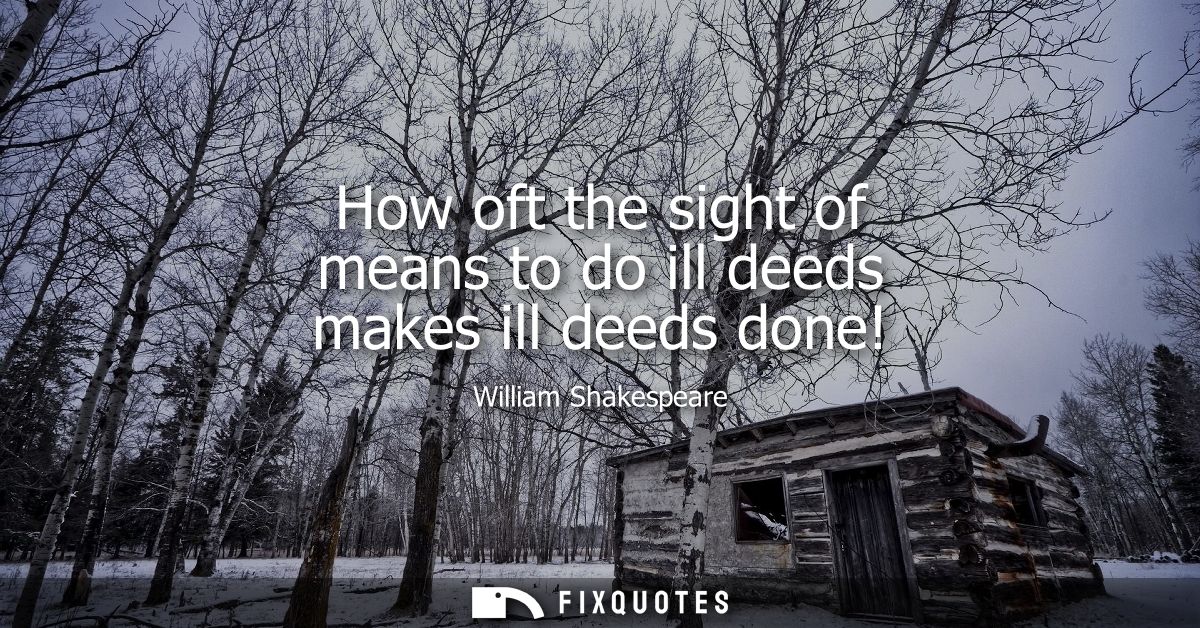
"How oft the sight of means to do ill deeds makes ill deeds done!"
About this Quote
Shakespeare nails a grim little algorithm of human behavior: give people the tools, and the taboo starts looking like a task. The line is less about wickedness in the abstract than about opportunity as an accelerant. "Means" carries a double charge: resources and methods, yes, but also the moral loophole of practicality. Once the means are visible, the mind rehearses the act; the deed shifts from unthinkable to doable. Shakespeare is pointing at that slippery moment when imagination stops being a warning and becomes a plan.
The phrasing is built to feel inevitable. "How oft" opens with weary frequency, the voice of someone who has watched this play out too many times. The sentence almost trips over its own repetition - "ill deeds... ill deeds" - mirroring how quickly contemplation becomes completion. The move from "to do" (potential) to "done" (fact) is the punchline, and it's a bleak one: the difference between restraint and crime is sometimes just access.
In context (from Henry IV, Part 2), it's a line that fits a world where power, proximity, and permissive company keep turning ethical boundaries into suggestions. Shakespeare's England knew what it meant for violence to be procedural: wars, executions, statecraft, tavern brawls. The subtext is that morality isn't simply a private virtue; it's an ecology. Change the environment - make the tools available, make the act seem normal, make consequences distant - and "ill" stops needing a villain. It just needs a chance.
The phrasing is built to feel inevitable. "How oft" opens with weary frequency, the voice of someone who has watched this play out too many times. The sentence almost trips over its own repetition - "ill deeds... ill deeds" - mirroring how quickly contemplation becomes completion. The move from "to do" (potential) to "done" (fact) is the punchline, and it's a bleak one: the difference between restraint and crime is sometimes just access.
In context (from Henry IV, Part 2), it's a line that fits a world where power, proximity, and permissive company keep turning ethical boundaries into suggestions. Shakespeare's England knew what it meant for violence to be procedural: wars, executions, statecraft, tavern brawls. The subtext is that morality isn't simply a private virtue; it's an ecology. Change the environment - make the tools available, make the act seem normal, make consequences distant - and "ill" stops needing a villain. It just needs a chance.
Quote Details
| Topic | Ethics & Morality |
|---|---|
| Source | Help us find the source |
| Cite | Cite this Quote |
Citation Formats
APA Style (7th ed.)
Shakespeare, William. (n.d.). How oft the sight of means to do ill deeds makes ill deeds done! FixQuotes. https://fixquotes.com/quotes/how-oft-the-sight-of-means-to-do-ill-deeds-makes-87124/
Chicago Style
Shakespeare, William. "How oft the sight of means to do ill deeds makes ill deeds done!" FixQuotes. Accessed February 1, 2026. https://fixquotes.com/quotes/how-oft-the-sight-of-means-to-do-ill-deeds-makes-87124/.
MLA Style (9th ed.)
"How oft the sight of means to do ill deeds makes ill deeds done!" FixQuotes, https://fixquotes.com/quotes/how-oft-the-sight-of-means-to-do-ill-deeds-makes-87124/. Accessed 1 Feb. 2026.
More Quotes by William
Add to List